Medical Coding Classes in Pune

Blog

From Life Science Graduate to Certified Medical Coder: A Practical Career Roadmap for 2026

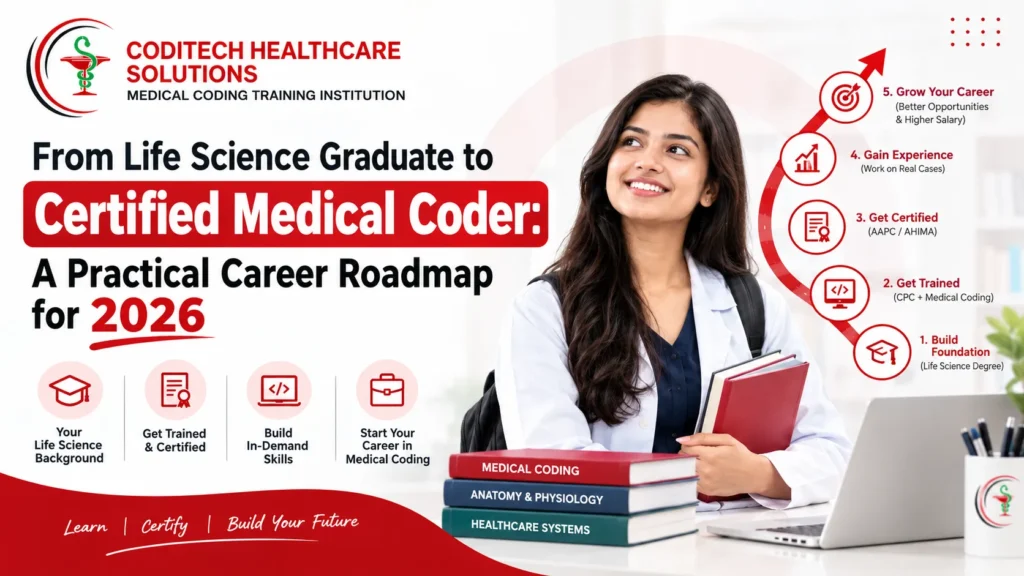
From Life Science Graduate to Certified Medical Coder: A Practical Career Roadmap for 2026 Graduation day feels like the end of one journey, but for many life science students, it is actually where the difficult questions begin. What should I do next? Should I continue studying? Should I look for a healthcare job? Is there a career where my life science knowledge can actually be useful? If you have asked yourself any of these questions, medical coding may be worth exploring. Medical coding has become an interesting career option for graduates who want to work in the healthcare industry without choosing a traditional clinical career. It combines healthcare knowledge, medical documentation, coding guidelines, technology, and attention to detail. The good news for life science graduates is that you are not starting completely from zero. You already have exposure to many concepts that can make the learning process easier. With structured training, practical experience, and certification preparation, you can gradually build the skills needed to pursue a career in medical coding. So, what does that journey actually look like? Let’s break it down. What Does a Medical Coder Actually Do? Before choosing any career, it is important to understand the actual work involved. A medical coder reviews healthcare documentation and converts relevant clinical information into standardized medical codes. A patient’s record can contain information about: Diagnoses Symptoms Medical history Procedures Treatments Laboratory tests Imaging Medications Follow-up care The coder studies this information and assigns appropriate codes according to established coding systems and official guidelines. Common code sets include: ICD-10-CM CPT HCPCS Level II ICD-10-PCS in applicable inpatient/facility coding environments It sounds straightforward until you see an actual medical record. The documentation may contain multiple conditions, procedures, abbreviations, clinical details, and instructions that need to be interpreted correctly. That is why professional medical coding requires knowledge and judgment, not just memorization. Why Life Science Graduates Have an Advantage One of the biggest benefits of coming from a life science background is that healthcare terminology may not feel completely unfamiliar. Depending on your degree, you may already have studied subjects such as: Anatomy Physiology Pathology Pharmacology Biochemistry Microbiology Human biology Disease processes This foundation can make it easier to understand medical records. For example, when you encounter terminology related to the cardiovascular, respiratory, digestive, or musculoskeletal system, you may already have some understanding of what it means. However, there is an important difference between understanding medicine and coding medicine. A life science degree gives you the foundation. Professional coding training teaches you how to apply that knowledge according to coding rules. Step 1: Understand the Medical Coding Career Don’t start by immediately buying every coding book or trying to memorize thousands of codes. Start by understanding the profession. Learn: What medical coders do Where coders work Difference between coding and billing Different types of medical coding Common coding certifications What employers look for What skills are required for entry-level roles This gives you a realistic picture of the career before you commit to it. Step 2: Strengthen Your Medical Foundation Even if you have studied life sciences, revisiting important healthcare concepts can be useful. Focus on: Anatomy and Physiology Understand the body’s major systems, organs, structures, and functions. Medical Terminology Learn commonly used medical terms, abbreviations, disease names, and procedure terminology. Pathophysiology Understand how diseases affect the body. You don’t need to become a physician to become a coder. But you do need enough clinical understanding to read and interpret healthcare documentation accurately. Step 3: Learn ICD-10-CM Once your foundation is strong, move into diagnosis coding. ICD-10-CM is used to classify diagnoses and other health conditions. This is where you start learning how clinical information is converted into standardized codes. Don’t approach ICD-10-CM as a list of numbers to memorize. Instead, learn how to: Search for diagnoses Navigate the Alphabetic Index Verify codes in the Tabular List Understand inclusion and exclusion notes Apply instructional notes Identify required specificity Follow sequencing principles Use official coding guidelines The goal is to understand the process behind code selection. Step 4: Learn CPT and HCPCS Diagnosis coding is only part of the picture. Depending on your career path, you may also need to understand procedure and service coding. CPT is used for reporting many medical procedures and professional services. HCPCS Level II covers various healthcare services, supplies, products, and other items. Understanding how diagnosis and procedure codes relate to the services documented in a patient’s record can make your coding knowledge much more complete. This is one reason a well-rounded medical coding training in Pune program should cover more than ICD-10-CM alone. Step 5: Understand Coding Guidelines This is where many beginners realize that medical coding isn’t simply about finding the closest code. Two cases may appear similar at first glance but require different coding decisions because of differences in documentation. You need to understand concepts such as: Coding conventions Sequencing Excludes notes Code-first instructions Use additional code instructions Combination codes Specificity Documentation requirements Learning the guidelines helps you explain why a code is appropriate instead of simply saying, “This looks like the right code.” Step 6: Start Practicing With Medical Records This is probably the most important stage of your journey. Reading a textbook is useful. But reading a medical record is different. A practical case may contain several diagnoses, procedures, clinical findings, and pieces of information that appear important but aren’t necessarily reportable. You need to learn how to separate the relevant information from the noise. A useful approach is: Read → Understand → Identify → Research → Verify → Code → Review With regular practice, this process becomes more natural. This is why students comparing medical coding classes in Pune should look beyond the syllabus and ask how much practical case-based learning is included. Step 7: Decide Which Certification Matches Your Goal Certification can strengthen your professional profile, but the right certification depends on the type of coding career you want. One commonly considered credential is the CPC (Certified Professional Coder). CPC preparation
Medical Coding Training Pune
Blog

Is Medical Coding a Good Career for Non-Life Science Graduates?

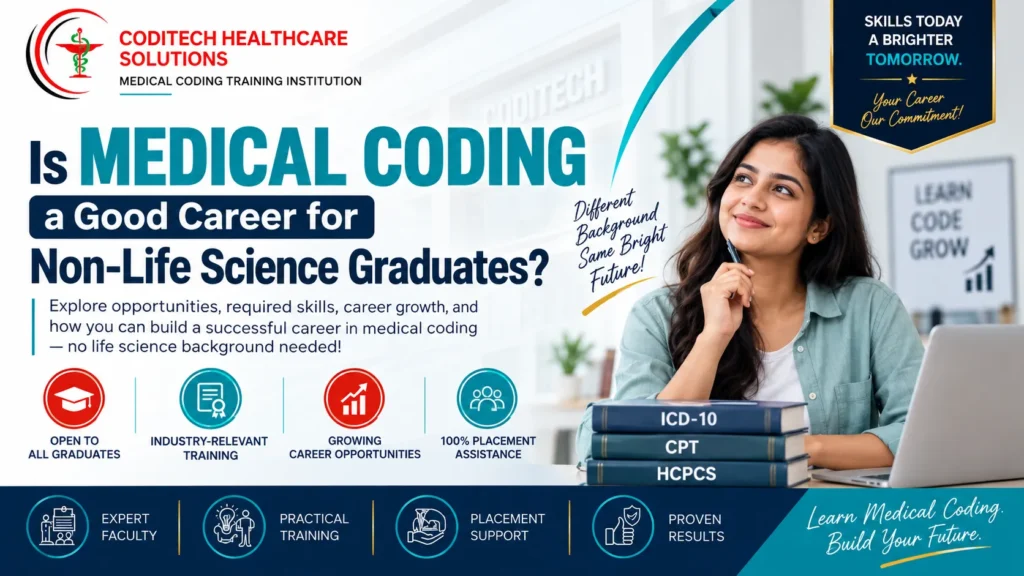
Is Medical Coding a Good Career for Non-Life Science Graduates? What if your degree is in engineering, computer science, commerce, or another non-life science field—but you still want to enter the healthcare industry? You may have already searched for different healthcare career options and come across medical coding. At first, medical coding can seem like a career meant only for students with a medical or life science background. After all, coders work with diagnoses, medical procedures, anatomy, and clinical documentation. But is a life science degree really necessary to build a career in medical coding? Not necessarily. With the right training, consistent practice, and an interest in learning healthcare concepts, students from non-life science backgrounds can develop the skills required for medical coding. The important question isn’t only what you studied in college—it is whether you are willing to learn the fundamentals and apply them correctly. Let’s understand what it takes. What Is Medical Coding? Before deciding whether medical coding is suitable for you, it helps to understand what the job actually involves. Medical coding is the process of converting information from healthcare documentation into standardized medical codes. When a patient visits a hospital or healthcare provider, the medical record may contain information about: Symptoms Diagnoses Medical history Treatments Procedures Investigations Medications Follow-up care A medical coder reviews this documentation and assigns appropriate codes according to established coding systems and guidelines. Some commonly used code sets include: ICD-10-CM CPT HCPCS Level II ICD-10-PCS for applicable facility/inpatient coding environments So, medical coding is not simply about typing codes into a computer. It requires documentation reading, medical knowledge, attention to detail, and logical thinking. Do You Need a Life Science Degree to Become a Medical Coder? This is one of the biggest questions asked by students from non-medical backgrounds. A life science or healthcare education can certainly provide an advantage because you may already know anatomy, physiology, medical terminology, and basic disease concepts. However, coming from a non-life science background does not automatically mean that medical coding is closed to you. You can learn the required healthcare concepts through structured training. For example, a student with a background in: Computer Science Engineering Commerce Business Administration Mathematics Arts Other graduate disciplines may begin learning medical coding by first developing the necessary medical foundation. The learning curve may be different from someone who studied biology or healthcare, but that does not mean the career is impossible. What Challenges Can Non-Life Science Graduates Face? Let’s be realistic. A non-life science graduate may initially find certain medical concepts unfamiliar. Terms such as myocardial infarction, cholecystitis, nephrolithiasis, or arthroscopy may look complicated when you encounter them for the first time. Similarly, understanding body systems and medical documentation can take time. The good news is that these are learnable skills. The key is not to rush directly into advanced coding. Start with the basics. Build Your Foundation First A beginner should gradually learn: Medical Terminology → Anatomy & Physiology → Disease Processes → ICD-10-CM → CPT → HCPCS → Coding Guidelines → Practical Cases Once the foundation becomes stronger, coding concepts become much easier to understand. Medical Terminology: Your First Step Into Healthcare If you’re from a non-life science background, medical terminology should be one of your first priorities. Think of medical terminology as learning a new language. Many medical words can be broken into smaller parts, such as prefixes, roots, and suffixes. Understanding these components can help you recognize the meaning of unfamiliar terms. For example, learning common terminology related to: Cardiovascular system Respiratory system Digestive system Musculoskeletal system Nervous system Urinary system can gradually make medical records easier to understand. You don’t need to learn every medical term in existence. You need to build a strong working vocabulary that helps you understand the documentation you encounter as a coder. Anatomy and Physiology Can Be Learned Another area that may initially feel difficult is anatomy. A non-life science graduate might not have studied the human body in detail during college. That’s okay. A good Medical Coding Training in Pune program should introduce anatomy and physiology in a way that connects directly to coding. Instead of simply memorizing the names of organs, try to understand: Where an organ is located What it does Which body system it belongs to Common conditions affecting it Common procedures performed on it When you understand the relationship between anatomy, disease, and treatment, medical documentation becomes much easier to interpret. Medical Coding Is More Than Memorizing Codes One of the biggest misconceptions about medical coding is that successful coders simply memorize thousands of codes. That’s not how professional coding works. A coder needs to understand the documentation and then use coding resources and guidelines to determine the appropriate code. For example, a medical record may mention a condition but provide additional details that affect code selection. You may need to determine: The exact diagnosis The anatomical location Acuity or clinical status where relevant Whether the condition is documented as confirmed Whether additional codes are required Which guideline applies What should be sequenced first This is why analytical thinking can be just as important as medical knowledge. And this is one area where students from technical or analytical backgrounds can often develop useful strengths. What Skills Do You Need to Become a Medical Coder? Your degree is only one part of the picture. To become a competent medical coder, focus on developing the following skills. 1. Medical Terminology You need to understand commonly used healthcare language. 2. Anatomy and Physiology Learn the body’s major systems and their functions. 3. Coding Knowledge Understand ICD-10-CM, CPT, HCPCS, and other relevant coding systems. 4. Documentation Reading Learn how to identify the information that matters for coding. 5. Coding Guidelines Understand how official guidelines and coding conventions affect code selection. 6. Attention to Detail A small documentation difference can sometimes change the coding decision. 7. Analytical Thinking You need to interpret information rather than simply copy it. 8. Computer Skills Most coding work involves digital systems, electronic

Medical Coding Certification
Blog

Beyond ICD-10: The Skills That Actually Make a Medical Coder Job-Ready

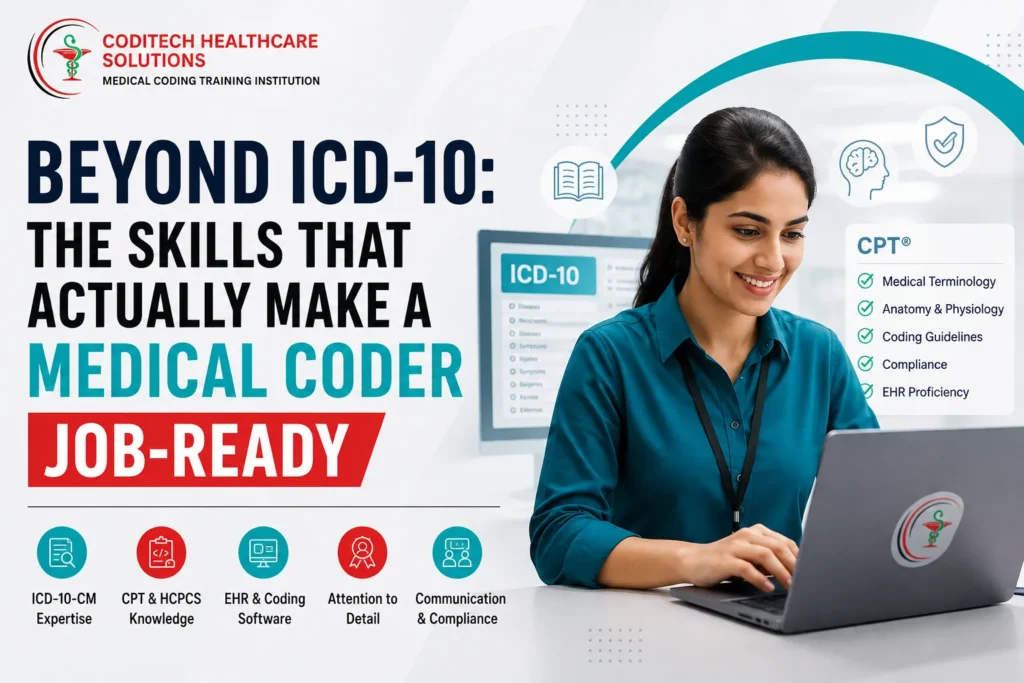
Beyond ICD-10: The Skills That Actually Make a Medical Coder Job-Ready You can memorize hundreds of medical codes and still struggle on your first day as a medical coder. That may sound surprising, but medical coding is not simply about opening an ICD-10-CM book, finding a code, and entering it into a system. Real-world coding requires much more. A job-ready medical coder needs to understand medical documentation, anatomy, procedures, coding guidelines, payer requirements, and the logic behind every coding decision. This is where the difference between learning medical coding and becoming a job-ready medical coder becomes clear. Whether you are a graduate looking for your first healthcare job, a professional planning a career change, or someone preparing for a certification such as CPC, CCS, CIC, COC, or CRC, developing practical skills is just as important as understanding coding systems. What Does It Really Mean to Be a Job-Ready Medical Coder? Being job-ready means you can look at a medical record and understand what is happening clinically before you start searching for codes. A good medical coder should be able to answer questions such as: What condition is the patient being treated for? What procedure or service was performed? What information in the documentation supports the code? Is the diagnosis confirmed or only suspected? Which coding guideline applies? Are there any applicable modifiers? Does the documentation support the level of service? Are there sequencing or bundling considerations? These questions require reasoning, not just memorization. ICD-10-CM is an important part of medical coding, but it is only one piece of the overall skill set. 1. Strong Medical Terminology Knowledge Imagine receiving documentation that contains terms such as cholecystectomy, hypertension, arthroscopy, myocardial infarction, or gastroesophageal reflux disease. If you don’t understand the terminology, finding the correct code becomes difficult. Medical terminology is essentially the language of healthcare. A coder doesn’t necessarily need to become a doctor, but they do need to understand commonly used medical terms and abbreviations. A strong foundation should include: Common medical terminology Prefixes, suffixes, and root words Disease terminology Surgical terminology Diagnostic terminology Common medical abbreviations Names of procedures and treatments This knowledge makes the coding process faster and reduces the possibility of choosing a code based only on a familiar word. 2. Anatomy and Physiology Matter More Than You Think Coding becomes much easier when you understand where a condition or procedure occurs in the body. For example, a coder working on surgical documentation may need to distinguish between different anatomical structures, organs, tissues, or body regions. A basic understanding of anatomy and physiology helps coders connect the documentation with the correct diagnosis and procedure. You should understand: Major body systems Organs and their functions Anatomical terminology Body regions Common diseases affecting each system Basic physiological processes This is especially useful when working with specialties such as surgery, emergency medicine, cardiology, orthopedics, radiology, and obstetrics. 3. Learn to Read Medical Documentation One of the most important skills for a professional medical coder is documentation reading. Coding isn’t about picking a code because a diagnosis appears somewhere in a report. You need to understand the context surrounding that diagnosis. A medical record may contain: Chief complaint History of present illness Past medical history Physical examination Assessment Plan Operative notes Discharge summaries Laboratory findings Imaging reports Procedure documentation The coder needs to identify what information is actually relevant for coding. This is one reason practical case studies are so valuable during Medical Coding Training in Pune. Working with realistic documentation helps students understand how coding decisions are made in actual situations. 4. Understand CPT and HCPCS, Not Just ICD-10 Many beginners associate medical coding primarily with ICD-10-CM. But professional coding often involves multiple code sets. Depending on the role, a coder may work with: ICD-10-CM – Diagnosis coding CPT – Procedures and professional services HCPCS Level II – Supplies, services, medications, and other healthcare items Understanding how these code sets work together is an important part of becoming job-ready. For example, a patient’s medical record may describe a condition using an ICD-10-CM code while a procedure performed for that condition is reported using a CPT code. A coder must understand the relationship between the diagnosis, service, documentation, and applicable coding rules. 5. Coding Guidelines and Conventions A medical coder cannot rely only on memory. Coding guidelines exist for a reason. ICD-10-CM includes conventions, instructional notes, sequencing rules, exclusions, combination codes, “code first” instructions, “use additional code” instructions, and other important guidance. Professional coders need to know how to locate and apply these instructions. Instead of asking: “What code do I remember for this condition?” A better question is: “What does the documentation support, and what do the official coding guidelines tell me to report?” That mindset is essential for accurate coding. 6. Learn Modifiers and Their Practical Use Modifiers can look confusing when you first encounter them. But understanding when and why modifiers are used is an important part of professional coding, particularly in CPT-based environments. Some modifiers communicate that: A service was performed under special circumstances. Multiple procedures were performed. A service was distinct or separately identifiable. A professional or technical component applies. A procedure was reduced or discontinued. However, modifiers should never be added simply because they seem appropriate. The documentation must support their use. Practical examples are one of the best ways to understand modifiers and avoid common mistakes. 7. Develop Medical Coding Logic This is the skill that often separates a memorization-based learner from a confident coder. Coding requires logical thinking. Suppose a medical record contains several diagnoses. Which one should be reported first? Which conditions are relevant to the encounter? Is a symptom separately reportable? Is there a combination code? Does the documentation support a more specific code? These are reasoning questions. A good training program should therefore include coding scenarios, case studies, chart reviews, and practice exercises instead of focusing entirely on theoretical definitions. 8. Know How to Use Coding Tools and Resources A professional coder should know how to research. You may

medical coding classes in Pune
Blog

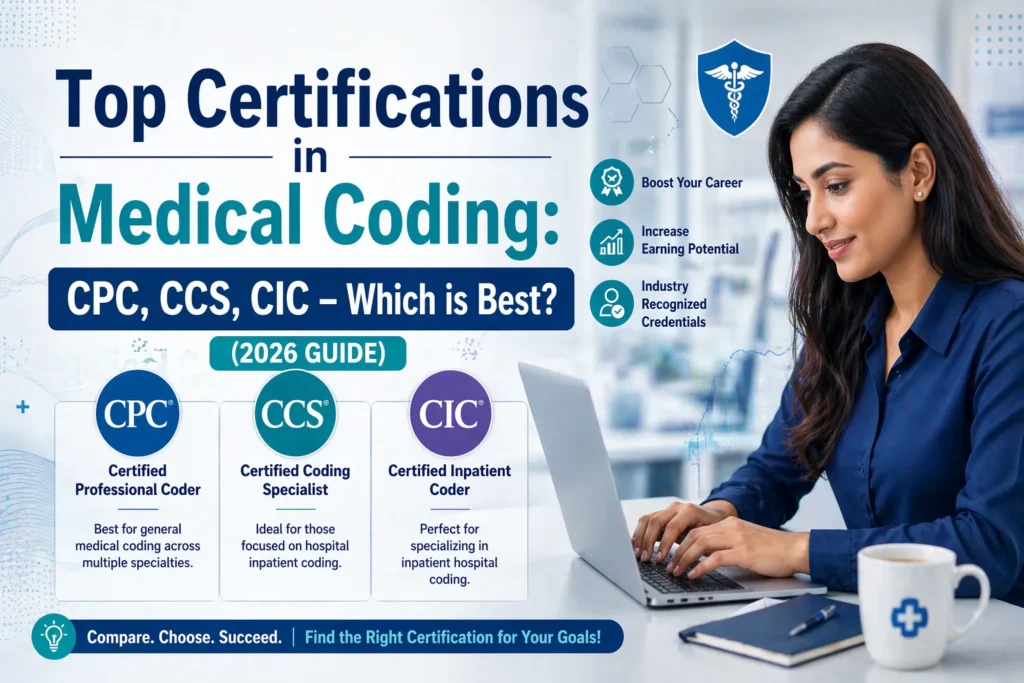
Top Certifications in Medical Coding: CPC, CCS, CIC – Which is Best? (2026 Guide)

Top Certifications in Medical Coding: CPC, CCS, CIC – Which is Best? (2026 Guide) Medical coding is one of the fastest-growing careers in the healthcare industry. However, to build a successful career, having the right certification is extremely important. If you are confused about which certification to choose—CPC, CCS, or CIC—this guide will help you understand each one and decide what’s best for your career. At Coditech Healthcare Solutions, a leading medical coding training institute in Pune, we guide students in choosing the right certification based on their career goals. Why Medical Coding Certification is Important Certification is not just an added advantage—it is often a requirement for getting hired. Benefits of Certification: • Improves job opportunities• Increases salary potential• Builds credibility• Validates your coding skills• Helps in career growth Students who complete professional medical coding classes in Pune with certification preparation have a higher chance of getting placed. Overview of Top Medical Coding Certifications Let’s understand the three most popular certifications in medical coding: 1. CPC (Certified Professional Coder) Best for: Beginners / Freshers The CPC certification (offered by AAPC) is the most popular entry-level certification. Key Features: • Focus on outpatient coding• Covers ICD-10-CM, CPT, and HCPCS• Widely accepted by companies• Ideal for freshers Why Choose CPC? • Easy to start your career• High demand in healthcare companies• Suitable for beginners At Coditech Healthcare Solutions, our medical coding classes in Pune are specially designed to prepare students for CPC certification. 2. CCS (Certified Coding Specialist) Best for: Intermediate / Experienced Coders The CCS certification (offered by AHIMA) is more advanced compared to CPC. Key Features: • Focus on inpatient coding• Covers complex coding scenarios• Requires strong coding knowledge Why Choose CCS? • Higher salary potential• Preferred for hospital coding roles• Good for career advancement Students who complete advanced medical codig classes in Pune can prepare for CCS after gaining basic experience. 3. CIC (Certified Inpatient Coder) Best for: Specialization in Inpatient Coding The CIC certification (offered by AAPC) focuses specifically on inpatient hospital coding. Key Features: • Detailed inpatient coding training• Covers DRG systems and hospital billing• Advanced-level certification Why Choose CIC? • Specialized career path• High demand in hospitals• Better growth opportunities At Coditech Healthcare Solutions, we provide guidance for advanced certifications after completing foundational training at our medical coding training institute in Pune. CPC vs CCS vs CIC – Quick Comparison Certification Level Focus Area Best For CPC Beginner Outpatient Coding Freshers CCS Intermediate Inpatient + Advanced Experienced Coders CIC Advanced Inpatient Specialization Hospital Careers Which Certification is Best for You? For Freshers: 👉 CPC is the best choiceIt is beginner-friendly and helps you get your first job. For Career Growth: 👉 CCS is idealIt opens doors to advanced roles and higher salaries. For Specialization: 👉 CIC is recommendedIt is perfect for those who want to work in hospital inpatient coding. At Coditech Healthcare Solutions, we recommend starting with CPC through our medical coding classes in Pune, then moving to advanced certifications. How to Choose the Right Certification Before selecting a certification, consider: • Your experience level• Career goals• Type of coding (inpatient/outpatient)• Job market demand Joining a trusted medical coding training institute in Pune can help you make the right decision. Why Choose Coditech Healthcare Solutions? If you are looking for expert guidance and training, Coditech Healthcare Solutions offers: • Complete training at a leading medical coding training institute in Pune• Beginner to advanced medical coding classes in Pune• CPC certification preparation• Practical coding sessions• Interview and placement support We ensure students are job-ready and confident to build successful careers in medical coding. Career Opportunities After Certification After completing certification, you can apply for roles such as: • Medical Coder• Coding Analyst• Medical Billing Executive• Coding Auditor (with experience) Certified professionals have better chances of getting hired and growing faster. Final Thoughts Choosing the right certification is the first step toward a successful medical coding career. If you are a beginner, start with CPC, then upgrade to CCS or CIC as you gain experience. With proper training, certification, and guidance from Coditech Healthcare Solutions, you can build a stable and high-growth career in the healthcare industry.

AI transforming medical coding in 2026
Blog

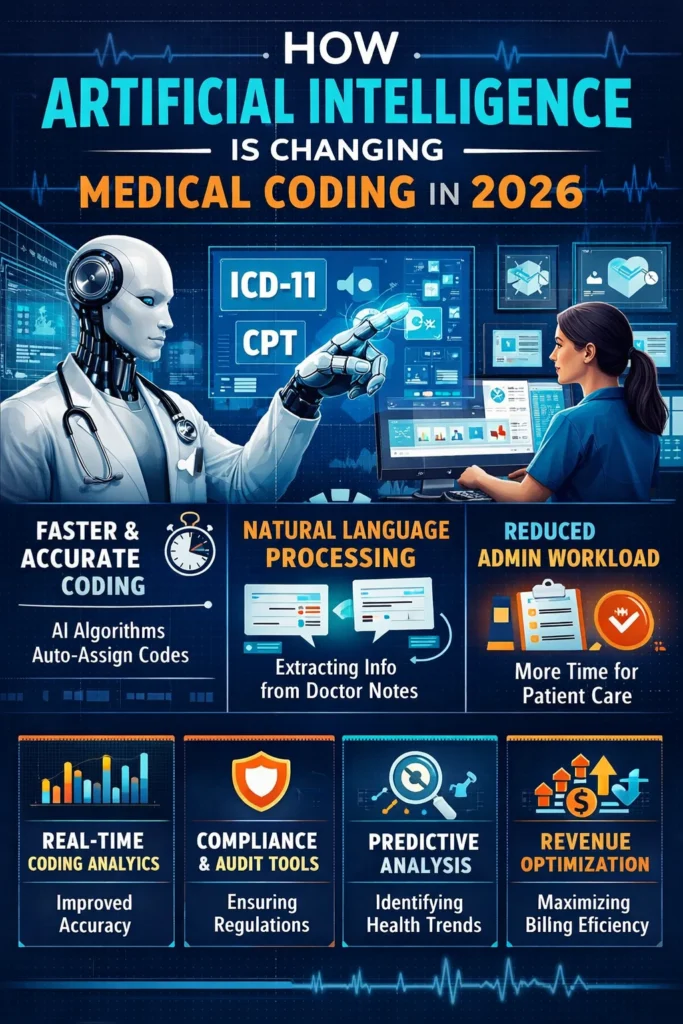
How Artificial Intelligence Is Changing Medical Coding in 2026

How Artificial Intelligence Is Changing Medical Coding in 2026 By Coditech Healthcare Solutions | Leading Medical Coding Institute in Pune Introduction: The AI Revolution Has Arrived in Medical Coding Artificial Intelligence is no longer a futuristic concept confined to science fiction or technology conferences. In 2026, AI is actively reshaping industries across the globe — and medical coding is no exception. From automating routine code assignments to flagging compliance errors in real time, AI is fundamentally changing the way medical coders work, learn, and grow in their careers. For students enrolled in medical coding classes in Pune and for working professionals in the healthcare industry, understanding how AI is transforming medical coding is no longer optional — it is essential. The coders who thrive in the coming years will not be the ones who fear AI, but the ones who learn to work alongside it. At Coditech Healthcare Solutions, one of the most trusted medical coding institutes in Pune, we believe that the future of medical coding belongs to skilled, certified, and AI-literate coders. In this blog, we take a deep dive into how Artificial Intelligence is changing medical coding in 2026, what it means for your career, and how you can stay ahead of the curve. What Is AI-Powered Medical Coding? AI-powered medical coding refers to the use of machine learning algorithms, natural language processing (NLP), and deep learning models to automatically read clinical documentation — such as physician notes, discharge summaries, operative reports, and lab results — and suggest or assign the appropriate medical codes. Traditional medical coding is a manual process where trained coders read clinical documents and assign ICD-10-CM, CPT, and HCPCS codes based on their knowledge of coding guidelines and medical terminology. AI tools aim to assist or partially automate this process by analyzing large volumes of clinical text at speeds no human coder can match. In 2026, AI medical coding tools are being used by hospitals, healthcare BPO companies, and insurance organizations across the world — including in India’s rapidly growing RCM sector where many medical coding classes in Pune are now incorporating AI literacy into their training curriculum. How AI Is Being Used in Medical Coding in 2026 1. Automated Code Suggestion The most visible application of AI in medical coding today is automated code suggestion. AI tools scan clinical documentation and recommend ICD-10-CM diagnosis codes, CPT procedure codes, and HCPCS codes based on patterns learned from millions of previously coded records. Rather than replacing the coder, these tools function as intelligent assistants — surfacing the most likely codes for the coder to review, validate, and finalize. This dramatically reduces the time a coder spends searching through codebooks and cross-referencing guidelines, allowing them to focus on accuracy, compliance, and clinical judgment. At Coditech Healthcare Solutions, our medical coding classes in Pune now include dedicated sessions on understanding how AI code suggestion tools work so that our students are prepared for the modern workplace from day one. 2. Natural Language Processing (NLP) in Clinical Documentation Natural Language Processing is the branch of AI that enables computers to understand, interpret, and extract meaning from human language. In medical coding, NLP engines read unstructured clinical text — which is full of abbreviations, medical jargon, and inconsistent formatting — and convert it into structured, codeable data. In 2026, NLP-powered coding tools can read a physician’s handwritten or dictated note and identify the principal diagnosis, secondary diagnoses, co-morbidities, procedures performed, and complications — all in seconds. This capability is particularly transformative for high-volume coding environments like emergency departments, large inpatient facilities, and healthcare BPOs. 3. Computer-Assisted Coding (CAC) Computer-Assisted Coding (CAC) is one of the most mature and widely adopted AI applications in medical coding. CAC systems use NLP and machine learning to analyze clinical documentation and present suggested codes to human coders for review and approval. Unlike fully automated coding — which carries significant compliance risks — CAC maintains the human coder in the loop as the final decision-maker. This hybrid approach is widely considered the most effective and responsible model for AI integration in medical coding. Major CAC platforms in use in 2026 include 3M’s 360 Encompass System, Optum’s CAC solution, Nuance’s AI-powered coding tools, and several newer AI-native platforms. Many companies that hire graduates from medical coding institutes in Pune now expect candidates to be familiar with at least one CAC platform. 4. Real-Time Coding Audits and Compliance Checks AI is also being used extensively for real-time coding audits. Traditional coding quality audits were retrospective — someone reviewed codes after they had already been submitted. In 2026, AI audit tools review codes at the point of entry, flagging potential errors, upcoding risks, undercoding patterns, and compliance violations before claims are submitted. This shift from retrospective to real-time auditing is dramatically reducing claim denials, improving clean claim rates, and protecting healthcare organizations from fraud and abuse risks. For coders, it means working in an environment where AI is constantly checking their work — which makes deep knowledge of coding guidelines more important than ever, not less. 5. Predictive Analytics and Revenue Cycle Optimization Beyond coding itself, AI is being used to predict claim denial patterns, identify revenue leakage points, optimize DRG assignment, and forecast reimbursement outcomes. These predictive analytics capabilities are giving healthcare organizations unprecedented visibility into their revenue cycles. For medical coders, this means that coding accuracy is now directly linked to measurable financial outcomes in ways that are tracked, reported, and acted upon in near real-time. Coders who understand both coding guidelines and basic revenue cycle concepts are becoming increasingly valuable in this AI-enhanced environment. 6. AI-Powered Medical Coding Education One of the most exciting developments for students at medical coding institutes in Pune is the emergence of AI-powered learning platforms for medical coding education. These platforms use adaptive learning algorithms to identify each student’s weak areas, customize practice question sets, and provide personalized study recommendations. At Coditech Healthcare Solutions, we are actively integrating AI-powered practice tools and coding simulators into our medical

medical coding course fee in pune
Blog

Is Medical Coding Difficult to Learn for Beginners? (Complete Guide)

Is Medical Coding Difficult to Learn for Beginners? (Complete Guide) If you are planning to start a career in healthcare, one common question is: “Is medical coding difficult to learn for beginners?” The answer is No, medical coding is not difficult—especially when you learn it through the right medical coding training in Pune with expert guidance. At Coditech Healthcare Solutions, we help beginners learn medical coding step-by-step through practical medical coding classes in Pune designed for freshers. What is Medical Coding? Medical coding is the process of converting medical diagnoses, procedures, and treatments into standardized codes used in: • Insurance claims• Hospital billing• Medical documentation• Healthcare compliance The main coding systems include: • ICD-10-CM• CPT• HCPCS Learning these systems is the foundation of any medical coding course in Pune. Is Medical Coding Difficult for Beginners? Medical coding can feel challenging in the beginning because everything is new. However, with structured learning and proper training, it becomes easy to understand. Common Challenges Beginners Face: • Learning medical terminology• Understanding coding guidelines• Applying codes correctly• Lack of practical exposure But when you join professional medical coding training in Pune, these challenges become much easier to overcome. Why Medical Coding is Easy to Learn 1. Structured Learning Approach A well-designed medical coding course in Pune teaches concepts step-by-step. 2. Practical Training Hands-on practice through real case studies makes learning easier. 3. Rule-Based System Coding follows clear guidelines, so once you understand the rules, it becomes simple. 4. High Demand for Freshers Many companies hire beginners, which motivates students to learn faster. At Coditech Healthcare Solutions, we focus on simplifying concepts through practical medical coding classes in Pune. Skills Required to Learn Medical Coding To make learning easier, beginners should develop: Basic Medical Knowledge Understanding anatomy, diseases, and treatments. Attention to Detail Accuracy is important to avoid coding errors. Analytical Thinking You need to analyze patient records and apply correct codes. Regular Practice Daily practice improves speed and confidence. Our medical coding training in Pune ensures students build these skills through continuous practice. How to Learn Medical Coding Easily (Step-by-Step) Step 1: Join a Professional Course Enroll in a trusted institute offering medical coding course in Pune. Step 2: Focus on Basics Start with medical terminology and anatomy. Step 3: Learn Coding Guidelines Understanding ICD-10, CPT, and HCPCS rules is key. Step 4: Practice Daily Solve coding cases and mock tests. Step 5: Prepare for Certification Certification like CPC increases job opportunities. At Coditech Healthcare Solutions, our medical coding classes in Pune are designed to follow this exact roadmap. Medical Coding Course Fee in Pune Many students also ask about the medical coding course fee in Pune. Average Fee Range: ₹25,000 to ₹80,000 (depending on institute and training level) What Affects the Fee? • Course duration• Certification preparation• Practical training• Placement support At Coditech Healthcare Solutions, we provide affordable and value-based medical coding training in Pune with complete career support. Who Can Learn Medical Coding? Medical coding is suitable for: • BSc Nursing students• BPharm / DPharm graduates• Life science students• Medical graduates• Any graduate interested in healthcare Even non-medical students can join a medical coding course in Pune and start their career. Career Opportunities After Medical Coding After completing training, beginners can apply for: • Medical Coder• Coding Associate• Medical Billing Executive• Coding Analyst Many companies hire freshers who complete medical coding training in Pune. Salary for Freshers in Pune Starting Salary: ₹15,000 to ₹25,000 per month With certification and experience, salary increases significantly. Why Choose Coditech Healthcare Solutions? If you are looking for beginner-friendly medical coding classes in Pune, Coditech Healthcare Solutions offers: • Complete medical coding course in Pune• Expert trainers• Practical coding sessions• CPC certification preparation• Interview and placement support We make medical coding easy to learn—even for beginners. Final Thoughts So, is medical coding difficult to learn for beginners? No, it is not difficult if you learn it the right way. With proper guidance, structured medical coding training in Pune, and regular practice, anyone can master medical coding and build a successful career. If you want to start your journey, Coditech Healthcare Solutions is here to help you with the best training and career support.

medical coding training in Pune
Blog

Best Medical Coding Course in Pune (Complete Guide for 2026)

Best Medical Coding Course in Pune (Complete Guide for 2026) If you are planning to build a career in the healthcare industry without becoming a doctor, medical coding is one of the best options. With the increasing demand for skilled professionals, choosing the best medical coding course in Pune can help you start a stable and high-growth career. In this blog, we will guide you through everything you need to know about medical coding training in Pune, classes in Pune, and fee in Pune, along with career opportunities and how to choose the right institute. At Coditech Healthcare Solutions, we provide industry-focused training designed to help students become job-ready medical coding professionals. What is Medical Coding? Medical coding is the process of converting medical diagnoses, treatments, and procedures into standardized codes used for billing and insurance purposes. The main coding systems include: • ICD-10-CM – Diagnosis coding• CPT – Procedure coding• HCPCS – Supplies and services coding Medical coding plays a key role in hospital billing, insurance claims, and healthcare documentation. Why Choose Medical Coding as a Career? Medical coding is one of the fastest-growing career options in the healthcare industry. Key Benefits: • No clinical or patient interaction required• High demand in India and abroad• Opportunities for freshers• Work-from-home options available• Stable and long-term career Students enrolling in medical coding training in Pune can quickly enter the healthcare IT sector with the right skills. Best Medical Coding Course in Pune – What to Look For? Choosing the right institute is the most important step in your career journey. 1. Updated Curriculum The course should cover: • ICD-10-CM• CPT coding• HCPCS• Real-time case studies 2. Expert Trainers Learning from industry professionals helps you understand real-world coding scenarios. 3. Practical Training Hands-on coding practice improves accuracy and confidence. 4. Certification Preparation The course should prepare you for certifications like CPC (Certified Professional Coder). 5. Placement Support A good institute provides interview preparation and job assistance. At Coditech Healthcare Solutions, our medical coding classes in Pune are designed to cover all these aspects with practical learning and career guidance. Medical Coding Training in Pune With the rise of healthcare outsourcing and insurance processes, the demand for trained coders is increasing rapidly. Professional medical coding training in Pune helps students: • Learn industry-standard coding systems• Gain practical coding experience• Prepare for certification exams• Build job-ready skills Our training at Coditech Healthcare Solutions focuses on both theoretical knowledge and practical exposure to real-world cases. Medical Coding Classes in Pune Choosing the right medical coding classes in Pune ensures better learning and career outcomes. Features of Quality Training: • Classroom + practical sessions• Daily coding practice• Mock tests and assessments• Doubt-clearing sessions• Interview preparation At Coditech Healthcare Solutions, we provide structured learning programs that help beginners become confident coders. Medical Coding Course Fee in Pune One of the most common questions students ask is about the medical coding course fee in Pune. Average Fee Range: ₹25,000 to ₹80,000 (depending on institute and course level) Factors Affecting Fees: • Course duration• Certification preparation (CPC, etc.)• Practical training and internship• Placement support While choosing a course, focus on quality training rather than just low fees. At Coditech Healthcare Solutions, we offer value-based training with complete career support. Who Can Join a Medical Coding Course? Medical coding is suitable for: • BSc Nursing• BPharm / DPharm• Life Science graduates• Medical graduates• Any graduate interested in healthcare Even non-medical students can join after proper training. Career Opportunities After Medical Coding Course After completing a medical coding course in Pune, you can apply for roles such as: • Medical Coder• Coding Analyst• Medical Billing Executive• Coding Auditor (with experience) Many companies hire freshers, making it a great entry-level career. Salary After Medical Coding Course Fresher Salary in Pune: ₹15,000 to ₹25,000 per month With certification and experience, salary can increase significantly. Why Choose Coditech Healthcare Solutions? If you are looking for the best medical coding course in Pune, Coditech Healthcare Solutions offers: • Complete medical coding training in Pune• Expert trainers with industry experience• Practical coding sessions• CPC certification preparation• Job assistance and interview support Our goal is to help students build a successful career in the healthcare industry. Final Thoughts Choosing the best medical coding course in Pune is the first step toward a successful career in healthcare. With the right training, certification, and practice, you can secure a job as a medical coder—even as a fresher. If you want to start your journey with expert guidance, Coditech Healthcare Solutions is here to support you with professional medical coding training in Pune, classes in Pune, and career-focused programs.

AI vs Human Coders: Career Opportunities in 2026 and Beyond
Blog

AI vs Human Coders: Career Opportunities in 2026 and Beyond

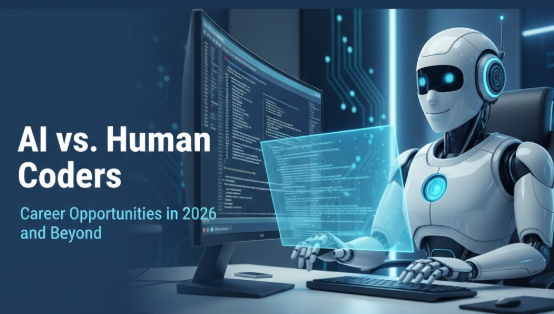
AI vs Human Coders: Career Opportunities in 2026 and Beyond AI vs Human Coders: Career Opportunities in 2026 and Beyond The healthcare industry is evolving faster than ever before. From digital patient records to automated billing systems, technology is transforming every corner of healthcare. At the heart of this transformation lies medical coding — a critical process that connects patient care with healthcare revenue. With the rapid rise of Artificial Intelligence (AI), one big question is on everyone’s mind: 👉 Will AI replace human medical coders in the future?At Coditech Healthcare Solutions, we strongly believe the future is not about AI vs Humans — it’s about AI and Humans working together to build a smarter healthcare ecosystem.If you’re searching for a medical coding training institute in Pune, or planning to join a medical coding course in Pune, this article will help you understand why the future of medical coding is brighter than ever. The Rise of AI in Medical Coding AI has entered almost every area of healthcare — diagnostics, radiology, pharmacy, billing, and now medical coding. Modern AI-powered systems are capable of: Reading clinical documentation Extracting patient diagnosis details Suggesting ICD-10, CPT, and HCPCS codes Automating repetitive outpatient cases Key AI Technologies in Medical Coding ✔ Natural Language Processing (NLP) – Helps software understand doctors’ notes and clinical language. ✔ Machine Learning Algorithms – Improve coding accuracy over time by learning from large volumes of data. ✔ Automated Coding Platforms – Speed up routine billing processes and reduce turnaround time. AI promises faster processing and improved efficiency — making it a valuable support system for healthcare organizations. But does that mean human coders are no longer needed? Absolutely not. Why Human Medical Coders Are Still Irreplaceable Technology can assist — but it cannot replace clinical judgment, ethical responsibility, and analytical thinking. 1️⃣ Handling Complex Cases AI works well for simple cases. However, complex inpatient records, comorbidities, surgical complications, and ambiguous documentation require human interpretation. Human coders understand clinical context — something machines still struggle with. 2️⃣ Compliance & Legal Responsibility Medical coding directly impacts: Hospital revenue Insurance claims Patient records Regulatory compliance Errors can lead to audits, claim denials, or legal consequences. Certified coders ensure adherence to updated guidelines like: AAPC Centers for Medicare & Medicaid Services HIPAA AI can suggest codes — but humans validate them. 3️⃣ Continuous Updates & Expertise Coding systems like: ICD-10-CM CPT HCPCS are updated every year. Human coders undergo continuous training and certification upgrades, while AI systems require retraining and supervision. This makes skilled professionals even more valuable in the long run. 4️⃣ The Human Element in Healthcare AI processes data.Humans understand patients. Medical coding is not just numbers and codes — it reflects patient care stories. Human coders ensure accuracy with responsibility and empathy. The Future: AI + Human Collaboration The real future of medical coding in 2026 and beyond is collaboration. Here’s how the partnership works: AI extracts documentation and suggests possible codes. Human coders review, validate, and ensure compliance. Organizations achieve faster processing with higher accuracy. This hybrid model is already creating new career opportunities such as: AI-Assisted Medical Coder Clinical Documentation Improvement Specialist Medical Coding Auditor Healthcare Data Analyst Those who upgrade their skills and learn AI-assisted coding tools will lead the industry. Career Opportunities in 2026 and Beyond Medical coding continues to grow globally due to: ✔ Increasing healthcare demand✔ Expansion of insurance coverage✔ Outsourcing to India✔ Digital transformation of hospitals Cities like Chennai and Pune are emerging as major healthcare and BPO hubs. If you are looking for: The best medical coding training institute in Pune A job-oriented medical coding course in Pune Practical-oriented medical coding classes in Pune Now is the perfect time to start. Why Choose Coditech Healthcare Solutions? At Coditech Healthcare Solutions, we prepare students not just for jobs — but for the future of healthcare technology. We focus on: ✔ CPC-focused training✔ Real-time case study practice✔ AI awareness in coding✔ 100% placement assistance✔ Industry-oriented curriculum Our mission is to create AI-ready, globally competitive medical coding professionals. Whether you are a fresher, life science graduate, or career switcher, Coditech Healthcare Solutions provides complete guidance to build a stable and rewarding career. Conclusion AI is not a threat to medical coders.It is a tool that enhances productivity. The future belongs to professionals who combine: Technical coding expertise Analytical thinking Adaptability to AI tools In 2026 and beyond, skilled human coders will remain the backbone of the healthcare coding industry. If you’re serious about building a career in medical coding, join Coditech Healthcare Solutions — and become part of the next generation of AI-powered healthcare professionals. 🚀 The future is not AI vs Humans.It’s AI with Humans — and the opportunities are endless.

🎯 Admissions Open for 2026 Batch   |   BMCT New Batch Starting Soon | CPC Certification New Batch Starting Soon | IPDRG New Batch Starting Soon | New Batch for BCHH-C Training With 100% Placement Guarantee | 💼 100% Placement Assistance   |   📞 Call Now: +91-8956660060—  For  Medical Coding Training  

Contact Us

Scroll to Top