Author name: coditechhealthcaresolutions

Medical Coding Certification
Blog

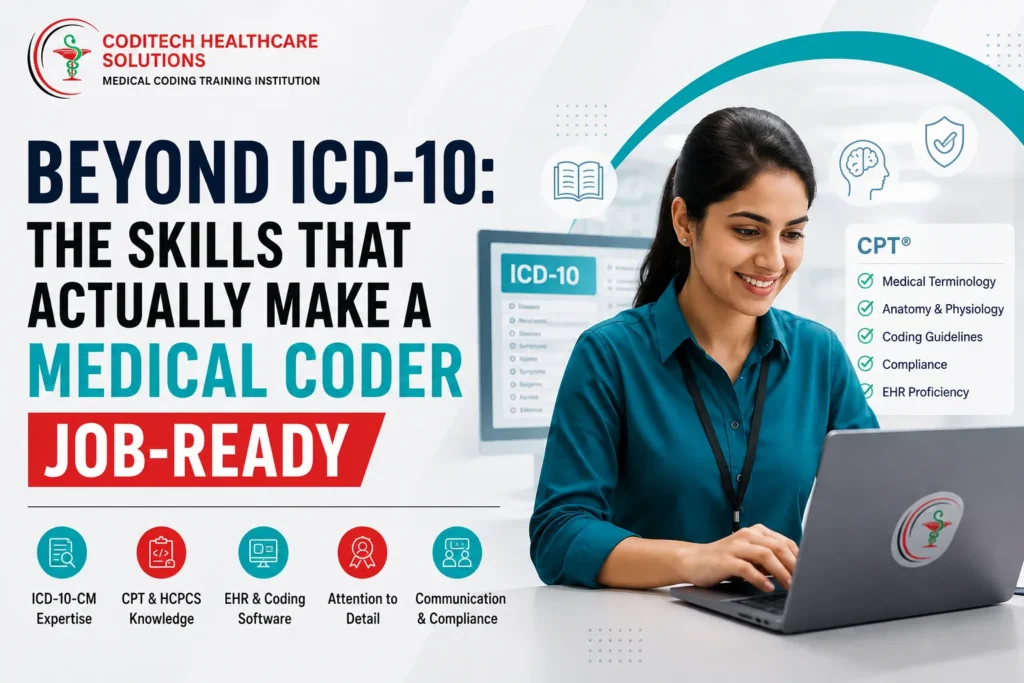
Beyond ICD-10: The Skills That Actually Make a Medical Coder Job-Ready

Beyond ICD-10: The Skills That Actually Make a Medical Coder Job-Ready You can memorize hundreds of medical codes and still struggle on your first day as a medical coder. That may sound surprising, but medical coding is not simply about opening an ICD-10-CM book, finding a code, and entering it into a system. Real-world coding requires much more. A job-ready medical coder needs to understand medical documentation, anatomy, procedures, coding guidelines, payer requirements, and the logic behind every coding decision. This is where the difference between learning medical coding and becoming a job-ready medical coder becomes clear. Whether you are a graduate looking for your first healthcare job, a professional planning a career change, or someone preparing for a certification such as CPC, CCS, CIC, COC, or CRC, developing practical skills is just as important as understanding coding systems. What Does It Really Mean to Be a Job-Ready Medical Coder? Being job-ready means you can look at a medical record and understand what is happening clinically before you start searching for codes. A good medical coder should be able to answer questions such as: What condition is the patient being treated for? What procedure or service was performed? What information in the documentation supports the code? Is the diagnosis confirmed or only suspected? Which coding guideline applies? Are there any applicable modifiers? Does the documentation support the level of service? Are there sequencing or bundling considerations? These questions require reasoning, not just memorization. ICD-10-CM is an important part of medical coding, but it is only one piece of the overall skill set. 1. Strong Medical Terminology Knowledge Imagine receiving documentation that contains terms such as cholecystectomy, hypertension, arthroscopy, myocardial infarction, or gastroesophageal reflux disease. If you don’t understand the terminology, finding the correct code becomes difficult. Medical terminology is essentially the language of healthcare. A coder doesn’t necessarily need to become a doctor, but they do need to understand commonly used medical terms and abbreviations. A strong foundation should include: Common medical terminology Prefixes, suffixes, and root words Disease terminology Surgical terminology Diagnostic terminology Common medical abbreviations Names of procedures and treatments This knowledge makes the coding process faster and reduces the possibility of choosing a code based only on a familiar word. 2. Anatomy and Physiology Matter More Than You Think Coding becomes much easier when you understand where a condition or procedure occurs in the body. For example, a coder working on surgical documentation may need to distinguish between different anatomical structures, organs, tissues, or body regions. A basic understanding of anatomy and physiology helps coders connect the documentation with the correct diagnosis and procedure. You should understand: Major body systems Organs and their functions Anatomical terminology Body regions Common diseases affecting each system Basic physiological processes This is especially useful when working with specialties such as surgery, emergency medicine, cardiology, orthopedics, radiology, and obstetrics. 3. Learn to Read Medical Documentation One of the most important skills for a professional medical coder is documentation reading. Coding isn’t about picking a code because a diagnosis appears somewhere in a report. You need to understand the context surrounding that diagnosis. A medical record may contain: Chief complaint History of present illness Past medical history Physical examination Assessment Plan Operative notes Discharge summaries Laboratory findings Imaging reports Procedure documentation The coder needs to identify what information is actually relevant for coding. This is one reason practical case studies are so valuable during Medical Coding Training in Pune. Working with realistic documentation helps students understand how coding decisions are made in actual situations. 4. Understand CPT and HCPCS, Not Just ICD-10 Many beginners associate medical coding primarily with ICD-10-CM. But professional coding often involves multiple code sets. Depending on the role, a coder may work with: ICD-10-CM – Diagnosis coding CPT – Procedures and professional services HCPCS Level II – Supplies, services, medications, and other healthcare items Understanding how these code sets work together is an important part of becoming job-ready. For example, a patient’s medical record may describe a condition using an ICD-10-CM code while a procedure performed for that condition is reported using a CPT code. A coder must understand the relationship between the diagnosis, service, documentation, and applicable coding rules. 5. Coding Guidelines and Conventions A medical coder cannot rely only on memory. Coding guidelines exist for a reason. ICD-10-CM includes conventions, instructional notes, sequencing rules, exclusions, combination codes, “code first” instructions, “use additional code” instructions, and other important guidance. Professional coders need to know how to locate and apply these instructions. Instead of asking: “What code do I remember for this condition?” A better question is: “What does the documentation support, and what do the official coding guidelines tell me to report?” That mindset is essential for accurate coding. 6. Learn Modifiers and Their Practical Use Modifiers can look confusing when you first encounter them. But understanding when and why modifiers are used is an important part of professional coding, particularly in CPT-based environments. Some modifiers communicate that: A service was performed under special circumstances. Multiple procedures were performed. A service was distinct or separately identifiable. A professional or technical component applies. A procedure was reduced or discontinued. However, modifiers should never be added simply because they seem appropriate. The documentation must support their use. Practical examples are one of the best ways to understand modifiers and avoid common mistakes. 7. Develop Medical Coding Logic This is the skill that often separates a memorization-based learner from a confident coder. Coding requires logical thinking. Suppose a medical record contains several diagnoses. Which one should be reported first? Which conditions are relevant to the encounter? Is a symptom separately reportable? Is there a combination code? Does the documentation support a more specific code? These are reasoning questions. A good training program should therefore include coding scenarios, case studies, chart reviews, and practice exercises instead of focusing entirely on theoretical definitions. 8. Know How to Use Coding Tools and Resources A professional coder should know how to research. You may

Medical Billing Course Pune
Blog

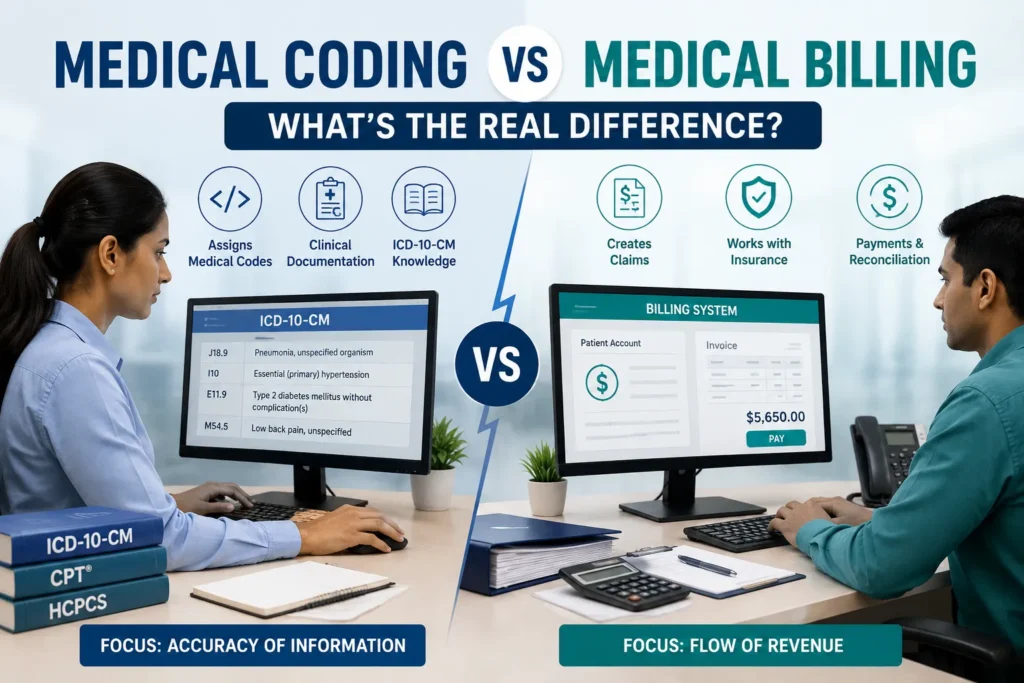
Medical Coding vs Medical Billing: What’s the Real Difference?

Medical Coding vs Medical Billing: What’s the Real Difference? Medical coding and medical billing are often treated as the same career. They’re not. Both roles are connected to the healthcare revenue cycle, and both are important for making sure healthcare providers receive proper payment for the services they provide. However, the work involved, skills required, responsibilities, and career paths are different. If you are considering a Medical Coding Course in Pune or exploring Medical Billing Training in Pune, understanding this difference before enrolling can help you choose a career path that actually matches your interests and strengths. Let’s break it down in simple terms. What Is Medical Coding? Medical coding is the process of converting information from a patient’s medical records into standardized medical codes. When a patient visits a hospital, clinic, or healthcare provider, the medical documentation may contain information about: The patient’s diagnosis Symptoms and conditions Medical procedures Treatments provided Laboratory services Surgical procedures Supplies and healthcare services A medical coder reviews this documentation and assigns the appropriate codes according to established coding guidelines. Some of the major coding systems used in healthcare include ICD-10-CM, CPT, and HCPCS. For example, if a physician documents a particular diagnosis and treatment, the coder needs to understand the documentation and determine which codes accurately represent the services provided. The job requires attention to detail because even a small coding error can affect a claim or healthcare reimbursement. What Is Medical Billing? Medical billing focuses more on the financial and claims side of healthcare. Once the services have been coded, the billing process involves preparing and submitting claims to insurance companies or other payers. Medical billers may also follow up on claims, check payment status, handle denials, and communicate with insurance companies regarding outstanding payments. A medical biller’s responsibilities can include: Preparing insurance claims Submitting claims to payers Checking claim status Following up on unpaid claims Working on rejected or denied claims Posting payments Reviewing patient balances Communicating with insurance companies Maintaining billing records In simple words, medical coding identifies and translates healthcare services into codes, while medical billing deals with the financial side of those coded services. Medical Coding vs Medical Billing: The Main Difference The easiest way to understand the difference is to look at where each professional fits into the healthcare revenue cycle. Medical Coding Medical Billing Reviews medical documentation Works with claims and payments Assigns medical codes Submits and tracks claims Uses ICD-10-CM, CPT and HCPCS Works with insurance and payer processes Requires strong coding knowledge Requires strong billing and claims knowledge Focuses on accurate code assignment Focuses on reimbursement and payment Documentation-oriented Financial and administrative-oriented Although the two professions work closely together, they require different skill sets. How Does Medical Coding Work? Imagine that a patient visits a hospital because of a medical problem. The physician examines the patient, documents the diagnosis, performs the required services, and records the treatment provided. The medical coder then reviews the documentation. The coder asks questions such as: What condition was diagnosed? What procedure was performed? What services were provided? Does the documentation support the selected code? Based on the documentation and coding guidelines, the appropriate codes are assigned. These codes are then used as part of the claim and reimbursement process. This is why medical coders need a strong understanding of medical terminology, anatomy, physiology, and coding guidelines. How Does Medical Billing Work? After coding is completed, the billing process comes into play. The medical biller works with the coded information and prepares the claim for submission to the appropriate payer. Once the claim is submitted, the biller may need to monitor its progress. If the claim is accepted and paid, the payment is recorded. If the claim is rejected or denied, the biller may investigate the reason, correct the issue when appropriate, and resubmit or appeal the claim according to the relevant process. This means billing professionals need to understand not only healthcare claims but also payer requirements and the financial side of healthcare administration. Medical Coding Requires Strong Attention to Detail One of the biggest characteristics of a good medical coder is attention to detail. Medical records can contain a large amount of information. A coder needs to identify the relevant documentation and select codes that accurately represent the patient’s condition and the services provided. For someone who enjoys: Working with medical information Reading documentation Learning medical terminology Following guidelines Finding details Working with codes and classification systems medical coding can be an interesting career option. This is one reason many graduates choose a Medical Coding Training in Pune program before entering the field. Medical Billing Requires Strong Communication and Follow-Up Skills Medical billing has a different working style. Billers may spend considerable time working with claims, insurance companies, payment information, and claim denials. Communication and follow-up skills can therefore be extremely useful. A billing professional may need to understand why a claim wasn’t processed correctly and determine what action needs to be taken. If you enjoy: Administrative work Claim processing Communication Insurance-related processes Problem-solving Financial documentation then medical billing may be worth exploring. Medical Coding Course Pune: What Should You Learn? If you are planning to join a Medical Coding Course in Pune, don’t choose a program simply because it has a low fee. Look at what the course actually teaches. A good training program should cover important fundamentals such as: 1. Anatomy and Physiology Understanding the human body is important because medical coding involves diagnoses, body systems, procedures, and treatments. 2. Medical Terminology You should become comfortable with common medical terms, abbreviations, conditions, procedures, and healthcare language. 3. ICD-10-CM ICD-10-CM is used to report diagnoses and health conditions in many healthcare settings. 4. CPT CPT codes are used to describe many medical procedures and professional services. 5. HCPCS HCPCS coding is important for reporting various healthcare services, supplies, and products. 6. Coding Guidelines Knowing the code itself isn’t enough. A coder must understand how and when codes should be assigned according to applicable guidelines. 7.

CPC Certification Course in Pune
Blog

Affordable Medical Coding Courses with 100% Placement Support

Affordable Medical Coding Courses with 100% Placement Support Affordable Medical Coding Courses with 100% Placement Support in Pune Looking for a healthcare career that offers strong growth without spending years in college? Medical coding could be the opportunity you’ve been searching for. With the healthcare industry expanding rapidly, skilled medical coders are increasingly needed to maintain accurate medical records, billing, insurance claims, and healthcare documentation. For students and graduates in Pune, choosing the right medical coding course can be the first step toward building a stable career in the healthcare industry. But with so many training institutes available, one question matters most: Which institute provides practical training, certification preparation, and genuine placement assistance at an affordable fee? Why Choose Medical Coding as a Career? Medical coding is an important part of the healthcare revenue cycle. Medical coders convert diagnoses, medical procedures, and healthcare services into standardized codes used for billing, insurance claims, and documentation. The best part is that you don’t necessarily need a medical degree to start learning medical coding. With proper training in anatomy, physiology, ICD-10-CM, CPT, HCPCS and medical coding guidelines, candidates can develop the skills required for entry-level coding jobs. This makes medical coding an attractive career option for: B.Sc. and life-science graduates Pharmacy graduates Nursing graduates Allied healthcare professionals Fresh graduates looking for healthcare careers Professionals planning to switch careers Candidates interested in CPC certification Affordable Medical Coding Courses in Pune Cost is an important factor when selecting a training program. However, choosing a course only because it is cheap may not always be the right decision. A good medical coding training institute in Pune should provide a combination of experienced trainers, practical learning, certification preparation, doubt-solving support, mock examinations, and placement assistance. At Coditech Healthcare Solutions, the focus is on providing career-oriented medical coding training that helps students understand both the fundamentals and practical aspects of coding. The training can cover important areas such as: Anatomy & Physiology ICD-10-CM Coding CPT Coding HCPCS Coding Medical Terminology Coding Guidelines Medical Billing Basics Healthcare Documentation Case-based coding practice Certification exam preparation CPC Certification Training in Pune The CPC (Certified Professional Coder) certification is one of the most recognized credentials for professionals interested in medical coding. A CPC-focused training program helps candidates prepare for the concepts and coding guidelines they are likely to encounter during certification preparation and professional coding work. If your goal is to become a certified medical coder, choosing a CPC certification training institute in Pune that provides structured preparation can make the learning process much easier. At Coditech Healthcare Solutions, students can prepare for CPC certification while developing their understanding of medical coding concepts through guided training and practice. Medical Coding & CPC Certification Courses A strong medical coding program should not focus only on theory. Students need to understand how coding concepts are applied to real-world healthcare documentation. A comprehensive medical coding and CPC certification course in Pune can help students build knowledge in: Medical Coding → Anatomy & Physiology → ICD-10-CM → CPT → HCPCS → Coding Guidelines → Case Studies → CPC Exam Preparation This step-by-step approach helps beginners understand coding concepts rather than simply memorizing codes. 100% Placement Assistance for Students Completing a course is only one part of starting a career. The next challenge is finding the right job opportunity. That’s why 100% placement assistance can be an important factor when selecting a medical coding institute. At Coditech Healthcare Solutions, students receive placement assistance after completing their training. The objective is to help candidates become job-ready and guide them through the recruitment process. Placement assistance may include: Resume preparation Interview preparation Job opportunity updates Interview guidance Communication and professional skills Assistance during the recruitment process Important: Placement assistance means dedicated support throughout the job-search process; actual hiring depends on the candidate’s performance, eligibility, and employer selection process. 100% Pass Guarantee for Certification Preparation Certification examinations can be challenging, especially for beginners who are unfamiliar with medical coding guidelines. Proper preparation, regular practice, mock tests, and trainer support can make a significant difference. Coditech Healthcare Solutions provides a 100% pass guarantee as part of its training commitment, helping students prepare systematically for their certification journey. The goal is not simply to complete the syllabus but to make students confident with coding concepts and exam-oriented practice. Why Choose Coditech Healthcare Solutions in Pune? Choosing the right institute can save you time, money, and unnecessary confusion. Coditech Healthcare Solutions focuses on practical and career-oriented medical coding education. Key Benefits Include: ✔ Experienced TrainersLearn important coding concepts with guidance from experienced trainers. ✔ Online & Offline ClassesChoose a learning format that fits your schedule. ✔ Flexible Learning SupportUseful for students and working professionals who need flexibility. ✔ CPC Certification TrainingStructured preparation for candidates targeting CPC certification. ✔ Practical Coding TrainingUnderstand coding through examples and case-based learning. ✔ 100% Placement AssistanceGet support while preparing to enter the medical coding job market. ✔ 100% Pass GuaranteeDedicated preparation to help candidates work toward certification success. ✔ Affordable Course OptionsCareer-focused training designed to provide value without unnecessary expenses. Other Medical Coding Certifications You Can Explore CPC is not the only certification available in medical coding. Depending on your career goals, you can explore different certification paths. Some popular options include: CPC – Certified Professional Coder CCS – Certified Coding Specialist CIC – Certified Inpatient Coder COC – Certified Outpatient Coder CRC – Certified Risk Adjustment Coder BCHH-C – Board Certified Home Health Coder Each certification focuses on different areas of healthcare coding. Before choosing one, it is important to understand your educational background and career objective. Who Can Join a Medical Coding Course? Medical coding training can be suitable for candidates from different educational backgrounds. You can consider medical coding training if you are: A graduate looking for a healthcare career From a life-science background A pharmacy or nursing graduate An allied healthcare professional A fresher searching for a career opportunity Interested in CPC certification Looking for a career change Interested in working in medical

Career Progression in Medical Coding
Blog

Career Progression in Medical Coding: From CPC to Coding Auditor

Career Progression in Medical Coding: From CPC to Coding Auditor Career Progression in Medical Coding: From CPC to Coding Auditor The healthcare industry is growing rapidly, and so is the demand for skilled medical coders. Today, medical coding is no longer just an entry-level profession—it offers excellent career growth, attractive salaries, and opportunities to specialize in different areas. Many students begin their journey with a Certified Professional Coder (CPC) certification and gradually move into advanced positions such as Senior Medical Coder, Coding Quality Analyst, Team Lead, Coding Educator, and Coding Auditor. If you’re planning a long-term career in healthcare without becoming a doctor or nurse, medical coding can be an excellent choice. At Coditech Healthcare Solutions, Pune, we help students build a strong foundation through practical training, industry-oriented curriculum, and certification guidance that supports long-term career success. What is Medical Coding? Medical coding is the process of converting medical diagnoses, procedures, treatments, and healthcare services into standardized codes using coding systems such as: ICD-10-CM CPT HCPCS Level II These codes help hospitals and insurance companies process medical claims accurately and ensure healthcare providers receive proper reimbursement. Step 1: Become a Certified Professional Coder (CPC) The first milestone in a medical coding career is earning the CPC (Certified Professional Coder) certification offered by AAPC. A CPC certification demonstrates that you understand: Medical terminology Human anatomy ICD-10-CM coding CPT coding HCPCS coding Insurance guidelines Medical documentation This certification is highly recognized by hospitals, healthcare organizations, and medical coding companies worldwide. Students looking for CPC Certification Training Institute in Pune often choose Coditech Healthcare Solutions because of its practical training approach, experienced trainers, and placement support. Step 2: Gain Practical Experience After obtaining CPC certification, most professionals start working as: Junior Medical Coder Outpatient Medical Coder Physician Coder Medical Billing Executive Healthcare Documentation Specialist During this stage, coders learn: Real-time medical records Coding accuracy Productivity targets Claim submission Insurance requirements Compliance standards This practical experience builds confidence and prepares coders for advanced roles. Step 3: Specialize in Medical Coding Once you gain 1–3 years of experience, specialization can significantly improve your career prospects. Popular specialty coding domains include: Evaluation & Management (E/M) Focuses on physician consultation coding and outpatient visits. Surgery Coding Involves coding complex surgical procedures across multiple specialties. Emergency Department (ED) Coding Requires quick understanding of emergency documentation and coding rules. IP-DRG Coding Specializes in inpatient hospital coding and Diagnosis Related Groups (DRGs). HCC Coding Risk adjustment coding for chronic conditions and Medicare Advantage plans. Home Health Coding (BCHH-C) Focuses on coding for home healthcare services and patient care documentation. At Coditech Healthcare Solutions, students can pursue advanced specialty training in E/M, ED, Surgery, IP-DRG, HCC, and BCHH-C to expand their career opportunities. Step 4: Earn Advanced Certifications After gaining experience, professionals often pursue advanced certifications to increase their earning potential. Popular certifications include: CCS (Certified Coding Specialist) CIC (Certified Inpatient Coder) COC (Certified Outpatient Coder) CRC (Certified Risk Adjustment Coder) BCHH-C Certification CPMA (Certified Professional Medical Auditor) These certifications demonstrate advanced coding knowledge and make candidates more competitive in the healthcare job market. Step 5: Become a Senior Medical Coder With strong coding skills and several years of experience, professionals can advance to the role of Senior Medical Coder. Responsibilities include: Reviewing complex medical records Assisting junior coders Resolving coding queries Improving coding quality Ensuring compliance with coding guidelines Coordinating with physicians and healthcare providers Senior coders are valued for both their technical expertise and leadership abilities. Step 6: Move into Coding Quality and Compliance Many experienced coders transition into quality-focused roles such as: Coding Quality Analyst Coding Compliance Specialist Documentation Improvement Specialist (CDI) Coding Trainer These professionals ensure that coding is accurate, compliant with industry standards, and aligned with payer requirements. This stage also offers opportunities to mentor new coders and contribute to organizational quality improvement. Step 7: Become a Coding Auditor One of the most respected positions in the medical coding profession is Coding Auditor. A coding auditor reviews medical records to verify: Coding accuracy Compliance with coding guidelines Documentation completeness Revenue integrity Audit readiness Risk identification Coding auditors play a critical role in helping healthcare organizations reduce claim denials, prevent compliance issues, and improve reimbursement accuracy. Professionals in this role often work with hospitals, insurance companies, healthcare consulting firms, and revenue cycle management organizations. Skills Needed for Career Growth Career progression in medical coding depends on continuous learning and skill development. Key skills include: Strong knowledge of ICD-10-CM, CPT, and HCPCS Medical terminology Human anatomy and physiology Analytical thinking Attention to detail Time management Communication skills Problem-solving Knowledge of payer guidelines Compliance awareness Professionals who regularly update their coding knowledge are more likely to secure promotions and advanced roles. Typical Medical Coding Career Path Experience Position Fresher CPC Certified Medical Coder 1–2 Years Medical Coder 2–4 Years Senior Medical Coder 4–6 Years Specialty Coder / Team Lead 5–8 Years Coding Quality Analyst 6–10 Years Coding Auditor 8+ Years Coding Manager / Coding Consultant / Trainer Why Choose Coditech Healthcare Solutions? If you’re looking for a Medical Coding Training Institute in Pune, choosing the right institute is the first step toward a successful career. At Coditech Healthcare Solutions, we focus on building practical skills that prepare students for real-world healthcare environments. We Offer: CPC Certification Training CCS Certification Training CIC Certification Training COC Certification Training CRC Certification Training BCHH-C Certification Training Australian Medical Coding Training E/M Specialty Training Surgery Coding Training ED Coding Training IP-DRG Training HCC Coding Training Live Practical Coding Sessions Interview Preparation Resume Building Support Certification Guidance 100% Placement Assistance Our experienced trainers provide industry-focused learning that helps students confidently begin their careers and prepare for future advancement. Final Thoughts A career in medical coding offers much more than an entry-level job. With the right certifications, practical experience, and continuous learning, professionals can progress from a Certified Professional Coder (CPC) to respected roles such as Senior Medical Coder, Coding Quality Analyst, and ultimately Coding Auditor. If you’re ready to build a rewarding career in

How to Become a Certified Coding Specialist
Blog

How to Become a Certified Coding Specialist (CCS): Step-by-Step Guide

How to Become a Certified Coding Specialist (CCS): Step-by-Step Guide How to Become a Certified Coding Specialist (CCS): Step-by-Step Guide The healthcare industry is growing rapidly, and with it comes an increasing demand for skilled medical coding professionals. If you’re looking to advance your career in medical coding, earning a Certified Coding Specialist (CCS) certification is one of the best decisions you can make. Recognized by healthcare employers worldwide, the CCS credential demonstrates your expertise in coding inpatient and outpatient medical records accurately using ICD-10-CM, ICD-10-PCS, and CPT coding systems. In this guide, we’ll walk you through the complete process of becoming a Certified Coding Specialist, from understanding the certification to preparing for the exam and building a successful career. What Is a Certified Coding Specialist (CCS)? The Certified Coding Specialist (CCS) credential is a professional certification designed for experienced medical coders who can accurately assign diagnosis and procedure codes for hospitals and healthcare facilities. CCS-certified professionals play an important role in ensuring accurate documentation, proper reimbursement, compliance with healthcare regulations, and efficient revenue cycle management. Because of its industry recognition, many hospitals, insurance companies, and healthcare organizations prefer hiring professionals with CCS certification. Why Should You Earn a CCS Certification? Obtaining a CCS certification offers several career benefits. Better job opportunities Higher earning potential Greater industry recognition Opportunities to work in hospitals and multispecialty healthcare organizations Stronger knowledge of advanced coding guidelines Increased confidence in handling complex medical records For professionals who already have basic medical coding knowledge, CCS certification can significantly improve career growth. Step 1: Learn the Basics of Medical Coding Before preparing for CCS certification, it’s essential to understand the fundamentals of medical coding. You should become familiar with: Medical terminology Human anatomy and physiology Disease processes Pharmacology basics Healthcare documentation ICD-10-CM coding ICD-10-PCS coding CPT coding HCPCS coding Having a strong foundation makes advanced CCS concepts much easier to understand. Step 2: Join a Professional CCS Certification Training Program Although self-study is possible, structured classroom or online training provides a much stronger learning experience. A good CCS Certification Training Institute in Pune offers: Experienced trainers Updated study materials Practical coding exercises Real hospital case studies Mock examinations One-on-one doubt clearing sessions Interview preparation Professional guidance helps students understand complex coding scenarios and improves exam confidence. Step 3: Practice Real Medical Records The CCS examination focuses on practical coding rather than memorization. Spend time coding actual inpatient and outpatient medical records. Practice: Surgical reports Emergency department records Radiology reports Pathology reports Discharge summaries Operative notes The more real-world cases you solve, the stronger your coding skills become. Step 4: Understand the CCS Exam Pattern Before taking the examination, it’s important to understand its structure. The CCS exam generally evaluates: ICD-10-CM coding ICD-10-PCS coding CPT coding Clinical documentation Coding guidelines Reimbursement concepts Medical terminology Healthcare compliance Consistent practice and regular mock tests can help improve both speed and accuracy. Step 5: Take Mock Tests Regularly Many candidates know the concepts but struggle with time management during the actual examination. Mock tests help you: Improve coding speed Identify weak areas Build confidence Understand exam difficulty Reduce examination stress Treat every mock test as if it were the real exam. Step 6: Stay Updated with Coding Guidelines Medical coding is constantly evolving. New ICD-10 updates, payer guidelines, and healthcare regulations are introduced regularly. Successful CCS professionals make it a habit to: Read coding updates Follow official coding guidelines Attend workshops and webinars Continue learning after certification Continuous learning keeps your skills relevant throughout your career. Career Opportunities After CCS Certification Once you become CCS certified, you can explore opportunities in various healthcare settings. Common job roles include: Medical Coder Senior Medical Coder Inpatient Coder Outpatient Coder Coding Auditor Clinical Documentation Specialist Quality Analyst Revenue Cycle Executive Healthcare Compliance Specialist Many professionals also choose remote and international medical coding opportunities after gaining experience. Skills That Make a Successful CCS Professional Apart from coding knowledge, employers value professionals who possess: Strong analytical thinking Attention to detail Knowledge of medical terminology Time management Communication skills Accuracy under pressure Problem-solving ability Developing these skills alongside technical knowledge can help you grow faster in your career. Why Choose Coditech Healthcare Solutions? If you’re looking for a trusted CCS Certification Training Institute in Pune, choosing the right training provider can make a significant difference in your success. Coditech Healthcare Solutions is committed to helping students build strong medical coding careers through practical, industry-focused training. Our CCS Certification Classes in Pune are designed by experienced trainers who focus on real-world coding scenarios, updated coding guidelines, and hands-on practice. Whether you are a beginner or an experienced medical coder aiming to upgrade your skills, our comprehensive training program helps you prepare confidently for the CCS certification exam. From expert mentorship and mock tests to placement assistance and interview preparation, Coditech Healthcare Solutions provides the support you need to achieve your career goals in the healthcare industry. Conclusion Becoming a Certified Coding Specialist requires dedication, consistent practice, and quality training. By building a strong foundation, practicing real medical records, staying updated with coding guidelines, and preparing strategically for the exam, you can earn a certification that opens the door to excellent career opportunities. If you’re planning to start your CCS journey, enrolling in a reputed CCS Certification Training Institute in Pune can help you learn from industry experts and gain practical experience. With the right guidance and commitment, your goal of becoming a Certified Coding Specialist is well within reach.

AI-assisted medical coding
Blog

How AI Is Reducing Claim Denials and Improving Coding Accuracy

How AI Is Reducing Claim Denials and Improving Coding Accuracy How AI Is Reducing Claim Denials and Improving Coding Accuracy In today’s healthcare industry, medical coding plays a critical role in ensuring accurate reimbursement and smooth revenue cycle management. However, coding errors and claim denials continue to be major challenges for healthcare providers. With the rise of Artificial Intelligence (AI), the industry is witnessing a significant transformation. AI-powered tools are helping organizations improve coding accuracy, reduce claim denials, and streamline the overall billing process. Understanding Claim Denials in Healthcare Claim denials occur when insurance companies reject reimbursement requests due to issues such as: Incorrect or incomplete coding Missing documentation Inaccurate patient information Failure to follow payer-specific guidelines Duplicate claims or billing errors These denials not only delay payments but also increase administrative workload and impact the financial health of healthcare organizations. How AI Is Transforming Medical Coding Artificial Intelligence is revolutionizing medical coding by automating repetitive tasks and assisting coders in identifying accurate diagnosis and procedure codes. AI systems use technologies such as Natural Language Processing (NLP) and Machine Learning (ML) to analyze clinical documentation and recommend appropriate codes. Instead of manually reviewing every document, coders can now rely on AI-assisted coding platforms to enhance productivity and accuracy. 1. Improved Coding Accuracy One of the biggest advantages of AI is its ability to minimize human errors. AI tools can analyze physician notes, discharge summaries, and clinical documentation to suggest the most appropriate ICD-10-CM, CPT, and HCPCS codes. This helps in: Reducing coding mistakes Maintaining coding compliance Improving documentation quality Ensuring accurate reimbursement By identifying inconsistencies before claims are submitted, AI significantly lowers the chances of coding-related denials. 2. Early Detection of Documentation Gaps Incomplete documentation is a common reason behind claim denials. AI-powered systems can detect missing information and alert coders or physicians in real time. For example, if a diagnosis lacks supporting clinical evidence, the system can flag the issue before claim submission. This proactive approach helps healthcare providers avoid costly rework and delays. 3. Faster Claim Processing Manual coding and claim review processes consume valuable time. AI automates many of these tasks, allowing claims to be processed more quickly. Benefits include: Faster turnaround time Reduced administrative burden Increased productivity Quicker reimbursements Healthcare organizations can focus more on patient care while improving operational efficiency. 4. Predicting Claim Denials Before Submission Advanced AI solutions can analyze historical claim data and identify patterns that commonly lead to denials. Based on these insights, the system predicts potential issues and recommends corrective actions. This predictive capability enables organizations to: Prevent denials before they occur Improve first-pass claim acceptance rates Reduce revenue leakage Enhance financial performance 5. Supporting Compliance and Regulatory Updates Medical coding guidelines and payer policies change frequently. AI systems can stay updated with the latest coding rules and compliance requirements, helping coders maintain accuracy. This reduces the risk of: Non-compliance penalties Audit failures Incorrect code assignments Revenue loss due to outdated practices Will AI Replace Medical Coders? Despite its capabilities, AI is not replacing medical coders. Instead, it is acting as a powerful support tool. Human expertise remains essential for interpreting complex cases, ensuring documentation quality, and making final coding decisions. The future of medical coding lies in collaboration between skilled coders and intelligent technologies. Professionals who understand both coding principles and AI-assisted workflows will have a competitive advantage in the healthcare industry. The Future of AI in Healthcare Revenue Cycle Management As AI technology continues to evolve, healthcare organizations are expected to adopt more advanced coding and billing solutions. From automated coding suggestions to denial prediction and real-time documentation analysis, AI is helping create a more efficient and accurate revenue cycle. Organizations that embrace AI-driven solutions can improve patient care, enhance operational efficiency, and maximize reimbursements while minimizing claim denials. Conclusion Artificial Intelligence is transforming medical coding by improving coding accuracy, reducing claim denials, and increasing efficiency across healthcare operations. While AI simplifies many processes, the expertise of certified medical coders remains indispensable. As the healthcare industry moves toward a technology-driven future, professionals who combine coding knowledge with an understanding of AI tools will be highly sought after. At Coditech Healthcare Solutions, we believe that the future of medical coding lies in combining human expertise with emerging technologies. Our industry-focused training programs are designed to help aspiring coders develop strong coding fundamentals while staying updated with the latest advancements, including AI-assisted coding practices. With expert guidance, practical exposure, and certification-oriented training, Coditech Healthcare Solutions prepares students to build successful careers in the rapidly evolving healthcare industry.

Why Accuracy Matters in Medical Coding | Coditech Healthcare Solutions
Blog

Why Accuracy Matters in Medical Coding

Why Accuracy Matters in Medical Coding Why Accuracy Matters in Medical Coding Medical coding plays an Important role in the healthcare industry. Every diagnosis, treatment, and medical procedure must be translated into standardized codes that healthcare providers, insurance companies, and regulatory authorities can understand. Because these codes directly impact billing, reimbursement, compliance, and patient records, accuracy is essential. A single coding error may seem minor, but it can lead to claim denials, payment delays, compliance issues, and inaccurate patient documentation. This is why healthcare organizations place a high value on skilled medical coders who can maintain precision and consistency in their work. At Coditech Healthcare Solutions, students are trained to understand coding guidelines, medical terminology, and documentation practices that help build strong coding accuracy from the beginning of their careers. Understanding Accuracy in Medical Coding Medical coding accuracy refers to assigning the correct codes to diagnoses, procedures, treatments, and healthcare services based on patient documentation. Medical coders work with coding systems such as: ICD (International Classification of Diseases) CPT (Current Procedural Terminology) HCPCS (Healthcare Common Procedure Coding System) To select the correct code, coders must carefully review medical records, physician notes, laboratory reports, and treatment documentation. Accurate interpretation ensures that the healthcare service provided is properly represented. Accurate Coding Supports Proper Billing Healthcare providers rely on medical codes to generate bills and submit claims to insurance companies. When coding is accurate, organizations can process claims smoothly and receive appropriate reimbursement for the services they provide. Benefits of accurate coding include: Faster claim processing Reduced billing errors Improved revenue cycle management Better financial performance for healthcare facilities Fewer claim rejections and payment delays Incorrect coding can result in underpayments, overpayments, or claim denials, creating additional administrative work for healthcare providers. Reducing Insurance Claim Denials Insurance companies review submitted claims before approving payments. If a claim contains incorrect, incomplete, or inconsistent coding, it may be denied or delayed. Accurate medical coding helps: Increase claim acceptance rates Minimize claim rework Reduce administrative burden Improve reimbursement timelines Strengthen communication between providers and insurers Healthcare organizations prefer coders who can consistently submit error-free claims and maintain high-quality documentation standards. Maintaining Regulatory Compliance The healthcare industry operates under strict coding regulations and compliance standards. Medical coders must follow official coding guidelines and payer-specific requirements to ensure compliance. Accurate coding helps organizations: Meet regulatory requirements Reduce audit risks Prevent compliance violations Support ethical healthcare practices Avoid financial penalties Maintaining coding accuracy is one of the key ways healthcare providers protect themselves from legal and regulatory challenges. Enhancing Patient Record Quality Medical coding is not only about billing. It also contributes to maintaining accurate patient records and healthcare data. Proper coding supports: Clear patient history documentation Continuity of care Clinical research and analysis Healthcare reporting Public health monitoring When coding errors occur, patient records may become incomplete or misleading, potentially affecting future treatment decisions. The Impact of Small Coding Errors Even minor coding mistakes can create significant challenges. Common consequences include: Delayed insurance payments Rejected claims Compliance concerns Incorrect patient records Increased administrative workload Financial losses for healthcare providers Because of these risks, attention to detail is considered one of the most important qualities of a successful medical coder. Essential Skills for Coding Accuracy Medical coders can improve their accuracy by developing the following skills: Attention to Detail Carefully reviewing documentation helps identify critical information and prevents coding mistakes. Knowledge of Medical Terminology Understanding medical terms, conditions, procedures, and abbreviations is essential for selecting the correct codes. Anatomy and Physiology Understanding A strong foundation in human anatomy helps coders interpret medical records accurately. Analytical Thinking Coders must analyze documentation thoroughly and apply coding guidelines correctly. Familiarity with Coding Guidelines Staying updated with coding changes and industry standards ensures consistent coding quality. Documentation Review Skills The ability to review and interpret clinical documentation is vital for coding accuracy. Growing Demand for Accurate Medical Coders As healthcare systems continue to expand and digitize, the need for skilled medical coders is increasing worldwide. Healthcare organizations seek accurate coders because they help: Improve operational efficiency Reduce claim denials Support compliance efforts Enhance patient data quality Strengthen revenue management This growing demand creates excellent career opportunities for individuals interested in the healthcare sector. Build Your Medical Coding Career with Coditech Healthcare Solutions Coditech Healthcare Solutions is committed to helping aspiring medical coders develop the knowledge and practical skills needed for success in the healthcare industry. Through structured training programs, industry-focused learning, certification guidance, and practical exposure, students gain confidence in medical coding concepts and real-world applications. Whether you are a graduate, a career changer, or someone looking to enter the healthcare industry, medical coding can offer a stable and rewarding career path. Frequently Asked Questions (FAQs) 1. Why is accuracy important in medical coding? Accuracy is important because coding errors can affect billing, insurance claims, compliance requirements, and patient records. Correct coding ensures smooth healthcare operations and proper reimbursement. 2. What happens if a medical coder makes a mistake? Coding errors can result in claim denials, delayed payments, compliance issues, inaccurate patient records, and financial losses for healthcare providers. 3. How can medical coders improve their accuracy? Medical coders can improve accuracy through continuous learning, regular practice, strong documentation review skills, and staying updated with coding guidelines. 4. Is attention to detail necessary in medical coding? Yes. Attention to detail is one of the most important skills for medical coders because even small mistakes can have significant consequences. 5. Can beginners become successful medical coders? Absolutely. With proper training, dedication, and practical experience, beginners can develop strong coding skills and build successful careers in medical coding. 6. What skills are required to become a medical coder? Key skills include medical terminology knowledge, anatomy understanding, analytical thinking, attention to detail, documentation review, and coding guideline knowledge. 7. Is medical coding a good career option? Yes. Medical coding offers strong career prospects, growing demand, opportunities for professional certification, and long-term growth within the healthcare industry. 8. Does Coditech Healthcare Solutions provide medical coding training?

medical coding jobs in Pune
Blog

The Credential Crossroads: Why Experienced Coders Are Dropping CPC for CCS in 2026

The Credential Crossroads: Why Experienced Coders Are Dropping CPC for CCS in 2026 A growing number of seasoned medical coders are making a bold career move — trading in their CPC for the CCS. Here’s what’s driving the shift and whether it makes sense for you. Introduction: The Credential Landscape Is Shifting For years, the Certified Professional Coder (CPC) credential — offered by the American Academy of Professional Coders (AAPC) — was the gold standard for anyone entering the medical coding profession. It was the first step, the most recognizable badge, and the credential that opened doors in physician offices and outpatient clinics across the country. But in 2026, something interesting is happening. Experienced coders — professionals with five, eight, even fifteen years under their belt — are sitting for the Certified Coding Specialist (CCS) exam offered by AHIMA. Some are replacing their CPC entirely. Others are stacking credentials. And a surprising number are walking away from outpatient-focused roles into the higher-complexity world of inpatient hospital coding. So what exactly is driving this shift? And is the CCS right for you? Understanding the Two Credentials Before we dive into the “why,” let’s quickly outline what sets these two certifications apart: Feature CPC (AAPC) CCS (AHIMA) Issuing Body AAPC AHIMA Primary Setting Outpatient / Physician Office Inpatient Hospital / Facility Code Sets CPT, ICD-10-CM, HCPCS ICD-10-CM, ICD-10-PCS, DRG Exam Difficulty Moderate High (especially PCS) Salary Potential Moderate–Good Good–Excellent 1. The Salary Gap Is Real — and Growing Let’s be honest: one of the biggest motivators for any professional credential switch is money. And the salary data in 2026 is hard to ignore. Inpatient coders holding the CCS credential — particularly those working in acute care hospitals or large health systems — consistently command higher salaries than their outpatient CPC counterparts. The complexity of inpatient coding, which involves ICD-10-PCS procedures, Diagnosis-Related Groups (DRGs), Medicare Severity DRGs (MS-DRGs), and Case Mix Index (CMI) calculations, means that qualified coders are harder to find and easier to pay well. With healthcare systems under increasing pressure to optimize reimbursement, specialists who understand DRG optimization and Clinical Documentation Improvement (CDI) are more valuable than ever. The CCS is your ticket into that world. 2. ICD-10-PCS: The Great Differentiator If you’ve only ever worked with CPT codes, ICD-10-PCS will feel like learning a new language — because it essentially is one. With over 87,000 codes built on a 7-character alphanumeric structure, PCS demands a level of anatomical precision and logical reasoning that CPT coding simply doesn’t require. This steep learning curve is exactly why CCS-credentialed coders are scarce. And scarcity, in any market, translates to leverage. Experienced CPC holders who invest the time to master PCS are effectively moving from a crowded pool into a much smaller, more specialized one. Many experienced coders report that mastering PCS — while challenging — is intellectually rewarding in a way that outpatient coding simply isn’t after years of repetition. 3. Hospital and Health System Demand Is Surging Post-pandemic restructuring, the rapid expansion of hospital-at-home programs, and the increasing complexity of inpatient case mixes have all contributed to a persistent shortage of qualified inpatient coders. Large health systems are actively recruiting — and increasingly, they’re specifying CCS in their job postings. In 2026, remote inpatient coding positions — once rare — have become standard. Health systems across the country are hiring remote CCS-credentialed coders, giving professionals the flexibility of working from home alongside the compensation of a hospital-level role. For experienced CPCs who already work remotely, the path is clear: upgrade the credential, unlock a new tier of opportunity. 4. CDI Integration: Where Coding Meets Strategy Clinical Documentation Improvement (CDI) has become one of the fastest-growing specialties in health information management. And CCS-credentialed professionals are perfectly positioned to transition into CDI roles. CDI specialists work directly with physicians and clinical staff to ensure that documentation accurately reflects the complexity and severity of patient conditions — directly impacting DRG assignment and hospital reimbursement. These roles are highly strategic, command excellent salaries, and often come with titles like CDI Specialist, CDI Auditor, or Revenue Integrity Analyst. CPCs, by contrast, rarely have the inpatient DRG knowledge base to step into CDI positions. The CCS essentially unlocks an entirely new career track. 5. Credibility in the HIM World AHIMA (the American Health Information Management Association) has long been the more academically oriented of the two major coding bodies, with stronger ties to HIM directors, compliance officers, and health information technology. The CCS is recognized not just as a coding credential but as a marker of clinical knowledge and analytical ability. For experienced coders looking to move into leadership, auditing, compliance, or consulting roles, the CCS carries significant credibility in hospital and health system environments — sometimes more so than the CPC, which is strongly associated with physician office billing. 6. The CCS Exam: What Makes It Hard — and Beatable Make no mistake: the CCS exam is genuinely difficult. AHIMA’s exam includes medical record analysis cases for both inpatient and outpatient settings, requiring coders to assign complete code sets — including principal diagnosis, secondary diagnoses, ICD-10-PCS procedure codes, and DRG assignment — under timed conditions. But here’s what experienced CPCs have going for them: Strong ICD-10-CM foundation: Years of outpatient coding build excellent diagnosis coding skills. Medical terminology mastery: Clinical knowledge developed over years of coding across specialties. Coding logic and guidelines: The structured thinking that makes a good coder translates directly. The primary gaps to fill are ICD-10-PCS, inpatient sequencing guidelines (UHDDS), DRG/MS-DRG logic, and facility coding guidelines. With a structured study plan, experienced coders typically need 3–6 months of focused preparation to be exam-ready. 7. Should You Replace Your CPC or Stack Both? This is the question every coder at the crossroads faces. The honest answer: it depends on your goals. If you want to stay in outpatient/physician office coding — keep your CPC. It’s the right credential for that world, and it’s well-respected. If you want to transition to inpatient hospital coding — pursue the CCS. It’s

medical coding classes in Pune
Blog

Top Certifications in Medical Coding: CPC, CCS, CIC – Which is Best? (2026 Guide)

Top Certifications in Medical Coding: CPC, CCS, CIC – Which is Best? (2026 Guide) Medical coding is one of the fastest-growing careers in the healthcare industry. However, to build a successful career, having the right certification is extremely important. If you are confused about which certification to choose—CPC, CCS, or CIC—this guide will help you understand each one and decide what’s best for your career. At Coditech Healthcare Solutions, a leading medical coding training institute in Pune, we guide students in choosing the right certification based on their career goals. Why Medical Coding Certification is Important Certification is not just an added advantage—it is often a requirement for getting hired. Benefits of Certification: • Improves job opportunities• Increases salary potential• Builds credibility• Validates your coding skills• Helps in career growth Students who complete professional medical coding classes in Pune with certification preparation have a higher chance of getting placed. Overview of Top Medical Coding Certifications Let’s understand the three most popular certifications in medical coding: 1. CPC (Certified Professional Coder) Best for: Beginners / Freshers The CPC certification (offered by AAPC) is the most popular entry-level certification. Key Features: • Focus on outpatient coding• Covers ICD-10-CM, CPT, and HCPCS• Widely accepted by companies• Ideal for freshers Why Choose CPC? • Easy to start your career• High demand in healthcare companies• Suitable for beginners At Coditech Healthcare Solutions, our medical coding classes in Pune are specially designed to prepare students for CPC certification. 2. CCS (Certified Coding Specialist) Best for: Intermediate / Experienced Coders The CCS certification (offered by AHIMA) is more advanced compared to CPC. Key Features: • Focus on inpatient coding• Covers complex coding scenarios• Requires strong coding knowledge Why Choose CCS? • Higher salary potential• Preferred for hospital coding roles• Good for career advancement Students who complete advanced medical codig classes in Pune can prepare for CCS after gaining basic experience. 3. CIC (Certified Inpatient Coder) Best for: Specialization in Inpatient Coding The CIC certification (offered by AAPC) focuses specifically on inpatient hospital coding. Key Features: • Detailed inpatient coding training• Covers DRG systems and hospital billing• Advanced-level certification Why Choose CIC? • Specialized career path• High demand in hospitals• Better growth opportunities At Coditech Healthcare Solutions, we provide guidance for advanced certifications after completing foundational training at our medical coding training institute in Pune. CPC vs CCS vs CIC – Quick Comparison Certification Level Focus Area Best For CPC Beginner Outpatient Coding Freshers CCS Intermediate Inpatient + Advanced Experienced Coders CIC Advanced Inpatient Specialization Hospital Careers Which Certification is Best for You? For Freshers: 👉 CPC is the best choiceIt is beginner-friendly and helps you get your first job. For Career Growth: 👉 CCS is idealIt opens doors to advanced roles and higher salaries. For Specialization: 👉 CIC is recommendedIt is perfect for those who want to work in hospital inpatient coding. At Coditech Healthcare Solutions, we recommend starting with CPC through our medical coding classes in Pune, then moving to advanced certifications. How to Choose the Right Certification Before selecting a certification, consider: • Your experience level• Career goals• Type of coding (inpatient/outpatient)• Job market demand Joining a trusted medical coding training institute in Pune can help you make the right decision. Why Choose Coditech Healthcare Solutions? If you are looking for expert guidance and training, Coditech Healthcare Solutions offers: • Complete training at a leading medical coding training institute in Pune• Beginner to advanced medical coding classes in Pune• CPC certification preparation• Practical coding sessions• Interview and placement support We ensure students are job-ready and confident to build successful careers in medical coding. Career Opportunities After Certification After completing certification, you can apply for roles such as: • Medical Coder• Coding Analyst• Medical Billing Executive• Coding Auditor (with experience) Certified professionals have better chances of getting hired and growing faster. Final Thoughts Choosing the right certification is the first step toward a successful medical coding career. If you are a beginner, start with CPC, then upgrade to CCS or CIC as you gain experience. With proper training, certification, and guidance from Coditech Healthcare Solutions, you can build a stable and high-growth career in the healthcare industry.

Blog

Is medical coding still a good career in the age of AI?

Is medical coding still a good career in the age of AI? Artificial Intelligence is transforming healthcare at a breathtaking pace. From robotic surgeries to AI-assisted diagnosis, the industry is evolving rapidly. But does that mean medical coders are becoming obsolete? At Coditech Healthcare Solutions, we answer this every day — and the answer is a resounding no. The AI wave in healthcare — what’s actually happening? Over the last few years, AI-powered tools using Natural Language Processing (NLP) have entered medical coding workflows. These tools can scan physician notes, identify diagnoses, and suggest ICD-10 or CPT codes in seconds. On the surface, this sounds like it could replace human coders. But dig a little deeper, and the reality is far more nuanced. AI is fast — but healthcare documentation is complex, legally sensitive, and deeply contextual. The demand for skilled, certified coders has not dropped. In fact, it continues to climb every year. What AI can do — and what it cannot AI tools excel at speed, automation, and handling high-volume routine tasks. But medical coding is far more than a pattern-matching exercise. Here is where AI consistently falls short: Limitations of AI in medical coding Interpreting ambiguous or poorly written physician notes that require clinical judgment Handling rare, complex, and multi-diagnosis cases with overlapping conditions Staying current with constantly changing payer policies, LCD/NCD guidelines, and compliance rules Specialty coding — cardiology, oncology, orthopedics, neurology — requires deep domain expertise Legal accountability and audit defense — AI cannot be held responsible, humans must be Catching upcoding and undercoding errors that carry serious compliance and financial risks The coder’s role is evolving, not disappearing The most progressive healthcare organizations today are deploying a “human-in-the-loop” model — where AI suggests codes and certified human coders validate, audit, and approve them. This is now the industry standard in hospitals, insurance companies, and large health systems worldwide. This means the role of a medical coder is actually becoming more strategic and more valuable. Coders are no longer just assigning codes — they are becoming quality analysts, compliance officers, and AI oversight specialists. Why CPC certification is more important than ever The CPC (Certified Professional Coder) credential from AAPC remains the most respected and widely recognized qualification in medical coding. In an AI-driven world, employers need professionals who can do what AI cannot — apply clinical knowledge, ensure compliance, and take legal responsibility for coded claims. A CPC-certified coder is not just a coder. They are a credentialed expert that organizations trust with their revenue cycle, their compliance posture, and their relationship with payers. That trust cannot be automated. How certified coders are thriving alongside AI in 2025 Auditing and validating AI-suggested codes before submission to payers Specializing in high-complexity areas AI cannot reliably handle alone Moving into Clinical Documentation Improvement (CDI) specialist roles Leading revenue cycle management and denial management teams Working as remote medical coders for US, UAE, and UK-based healthcare firms Becoming AI coding supervisors and quality assurance analysts Top career opportunities for certified coders in 2025 Medical coding offers an incredibly wide range of career paths — in India and globally. Whether you prefer working in hospitals, insurance companies, remote roles, or IT-healthcare firms, a CPC-certified coder has options that are only expanding. In-demand roles for certified medical coders Medical Coder / Senior Medical Coder at hospitals, clinics, and health systems Medical Billing & Denial Management Specialist Revenue Cycle Analyst and RCM Consultant Coding Auditor — CPMA (Certified Professional Medical Auditor) HCC / Risk Adjustment Coder for US-based insurance projects Remote Medical Coder — work from home for international clients Inpatient IP-DRG Coder for hospitals and large health networks Our verdictMedical coding is future-proof — if you are certified and AI-readyAI is not here to replace medical coders. It is here to elevate them. The professionals who invest in the right certification, deepen their clinical knowledge, and learn to work alongside AI tools will be among the most valuable — and highly paid — professionals in healthcare for the decade ahead. If you have been waiting for the right time to start your medical coding career, that time is now. Start your medical coding career with Coditech Healthcare Solutions At Coditech Healthcare Solutions, we don’t just prepare you for a certification exam — we prepare you for the future of healthcare. Our training programs are designed to make you a confident, certified, and AI-ready medical coding professional. Coditech Healthcare Solutions Medical Coding & CPC Certification Training CPC, CCS, COC & CRC certification prep AI-integrated coding curriculum Expert faculty with industry experience 100% placement assistance Online & classroom training options Real-time case study practice ICD-10, CPT & HCPCS deep training Resume building & interview prep Whether you are a fresher, a life science graduate, or a working professional looking to switch careers — Coditech Healthcare Solutions has the right program for you. Join thousands of students who have already built successful medical coding careers with us.

🎯 Admissions Open for 2026 Batch   |   💼 100% Placement Assistance   |   📞 Call Now: +91-8956660060—  For  Medical Coding Training  

Contact Us

Scroll to Top