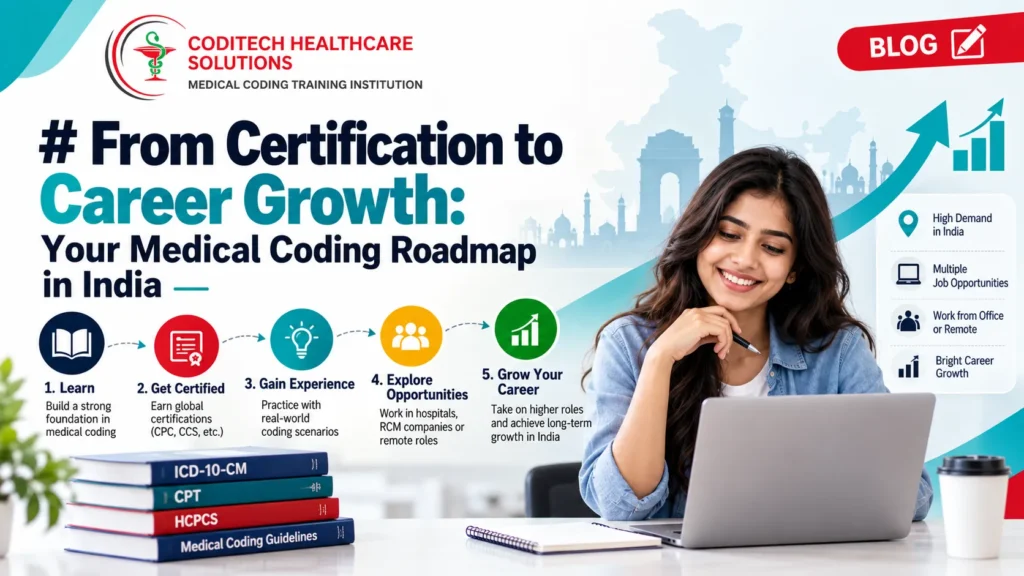
From Certification to Career Growth: Your Medical Coding Roadmap in India
From Certification to Career Growth: Your Medical Coding Roadmap in India Are you looking to build a career in medical coding but don’t know where to start—or what comes after certification? You may have already searched for medical coding courses, CPC certification, job opportunities and salary information. But one question often remains unanswered: “What is the actual roadmap from learning medical coding to building a long-term career?” Medical coding is not simply about completing a course and getting a certificate. A successful career requires a combination of medical knowledge, coding skills, practical exposure, certification, interview preparation and continuous learning. If you’re a graduate or someone planning a career change, this guide will help you understand the journey from your first coding lesson to long-term career growth in India’s healthcare industry. What Is Medical Coding? Medical coding is the process of converting information from healthcare documentation into standardized medical codes. When a patient visits a hospital or healthcare provider, the medical record may contain information about: Diagnoses Symptoms Medical procedures Treatments Tests Patient conditions Physician services A medical coder reviews this documentation and assigns the appropriate codes according to established coding systems and guidelines. Common code sets include ICD-10-CM, CPT and HCPCS. The work requires attention to detail because even a small difference in documentation can affect the appropriate coding decision. Step 1: Understand Whether Medical Coding Is Right for You Before enrolling in a course, understand what the profession actually involves. Medical coding can be suitable for people who enjoy: Working with detailed information Learning medical terminology Reading and analysing documentation Following rules and guidelines Working with computers Performing structured, detail-oriented work You don’t need to know everything before starting. However, you should be willing to learn medical terminology, anatomy, coding guidelines and healthcare documentation. Step 2: Build Your Medical Foundation One of the first things a beginner should focus on is developing basic medical knowledge. Medical Terminology You need to understand the terminology used by doctors and healthcare professionals. Anatomy and Physiology Understanding body systems makes medical documentation easier to interpret. Disease Processes Learning common diseases and conditions helps you understand why certain diagnoses and procedures appear in medical records. These subjects may seem difficult at first, but they become easier when you connect them with real clinical examples. Step 3: Learn ICD-10-CM, CPT and HCPCS After building the foundation, the next stage is learning the major coding systems. ICD-10-CM ICD-10-CM is primarily used for diagnosis coding. You need to learn how to identify the appropriate diagnosis code based on documentation and applicable guidelines. CPT CPT codes are used to report many medical procedures and professional services. HCPCS HCPCS includes codes used for various healthcare services, supplies and products. Don’t approach coding as simple memorization. A professional coder needs to understand how to locate, verify and apply codes correctly. Step 4: Get Practical Coding Experience This is one of the most important stages of your journey. There is a major difference between reading about coding and actually working through a medical record. During training, practice identifying: Diagnoses Procedures Medical terminology Relevant documentation Applicable codes Coding guidelines Modifiers E/M concepts Supporting information Start with simple cases and gradually move toward more complex scenarios. Practical exposure helps you become more comfortable with the type of thinking required in a real coding environment. Step 5: Choose the Right Training Institute The training institute you choose can influence how well you understand the fundamentals. If you’re searching for a Medical Coding Training institute in Pune, don’t compare institutes only by their advertisements or course fees. Instead, look at the actual learning experience. Consider whether the institute provides: Experienced trainers Medical terminology training Anatomy and physiology ICD-10-CM training CPT and HCPCS training Practical coding exercises Certification preparation Mock tests Interview preparation Career guidance For students comparing Medical Coding Courses in Pune, practical training should be one of the most important factors to consider. Step 6: Prepare for CPC Certification Once you have developed your coding foundation, you can consider professional certification. The CPC certification is one of the credentials pursued by people building careers in professional medical coding. Preparing for certification can help you strengthen your understanding of: Coding guidelines Medical terminology Anatomy ICD-10-CM CPT HCPCS Modifiers Coding scenarios However, certification should not be considered the final destination. The certificate can demonstrate your knowledge, but employers may also look at your practical understanding, communication and ability to handle coding scenarios. Step 7: Consider CPC Certification Training in Pune If you are planning to pursue CPC certification, structured preparation can make the learning process easier. When looking for CPC Certification Training in Pune, check whether the program includes both examination preparation and practical coding knowledge. A good preparation program should help you understand: How to approach coding questions How to use coding resources How to interpret documentation How to apply guidelines How to manage your time during the examination How to avoid common mistakes The goal should be to understand why an answer is correct rather than simply memorizing answers. Step 8: Prepare for Your First Medical Coding Job Once your training and certification preparation are complete, it’s time to focus on employment. Your preparation should include both technical and HR interviews. Technical Preparation Revise: ICD-10-CM CPT HCPCS Anatomy Medical terminology Modifiers E/M Coding guidelines Practical coding cases HR Preparation Be ready to explain: Your educational background Why you chose medical coding What you learned during training Your certification Your career goals Your strengths Why you want to work in healthcare Don’t memorize complicated answers. Speak clearly and explain your knowledge naturally. Step 9: Your First Job Is the Beginning, Not the End Getting your first job is an important milestone, but career growth doesn’t stop there. Your first few months can teach you things that cannot always be learned from a classroom. You may become familiar with: Real medical documentation Production requirements Quality audits Client-specific guidelines Team workflows Common coding errors Specialty-specific documentation Pay attention to feedback from senior coders and quality teams.