
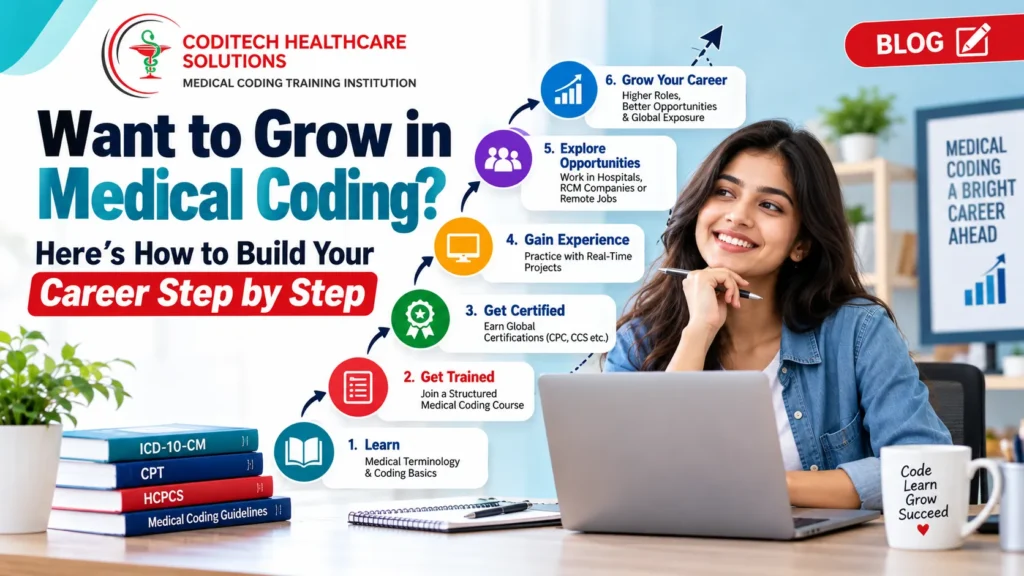
Want to Grow in Medical Coding? Here’s How to Build Your Career Step by Step
Want to Grow in Medical Coding? Here’s How to Build Your Career Step by Step Starting a career in medical coding is one thing. Knowing how to grow after you enter the field is another. Many freshers focus only on getting their first medical coding job. But once you understand the basics, a bigger question starts to come up: What should I learn next? How can I become better at coding? Should I pursue certification? Which skills can help me move into a specialized role? Medical coding is not a career where learning stops after completing a course. Coding guidelines change, healthcare documentation evolves, and different specialties require different levels of knowledge. If you want to build a long-term career, you need a step-by-step approach. This guide explains how you can start, improve your skills and gradually build a stronger career in medical coding. Step 1: Understand What Medical Coders Actually Do Before choosing medical coding as a career, understand what the job involves. Medical coders review healthcare documentation and translate diagnoses, procedures, services and other clinical information into standardized codes. Depending on the role, coders may work with: ICD-10-CM CPT HCPCS E/M coding Medical terminology Anatomy and physiology Coding guidelines Physician documentation Insurance-related information Specialty-specific coding The job requires attention to detail. A coder cannot simply choose a code because it “looks right.” The documentation needs to support the coding decision. That is why understanding the fundamentals is the first step toward career growth. Step 2: Build a Strong Foundation in Medical Terminology If medical terms are confusing, coding can quickly become difficult. A strong foundation in medical terminology helps you understand what physicians and other healthcare professionals are documenting. Start by learning: Common medical terms Prefixes and suffixes Body systems Common diseases and conditions Medical abbreviations Diagnostic terminology Surgical terminology Don’t try to memorize hundreds of terms in one day. Learn them gradually and connect them with anatomy and real clinical examples. The better you understand the language of healthcare, the easier it becomes to understand medical records. Step 3: Learn Anatomy and Physiology Medical coding isn’t just about codes. You also need to understand where a condition occurs, which body system is involved and how different medical procedures relate to the human body. For example, understanding the cardiovascular system can make cardiovascular documentation easier to interpret. Similarly, knowledge of the musculoskeletal system can help when working with orthopedic records. You don’t necessarily need to become a medical professional, but you should develop enough anatomical knowledge to understand clinical documentation accurately. Step 4: Master ICD-10-CM, CPT and HCPCS These code sets form an important part of medical coding education. ICD-10-CM ICD-10-CM is primarily used for diagnosis coding. You need to understand how to identify the appropriate diagnosis code based on the documentation and applicable guidelines. CPT CPT codes are used to report many medical procedures and professional services. HCPCS HCPCS coding includes codes used for various healthcare services, supplies and products that may not be represented by CPT alone. Don’t try to learn these code sets through memorization alone. Instead, learn how to find, verify and apply codes correctly. That difference becomes very important when you start working with actual coding scenarios. Step 5: Learn the Official Coding Guidelines Knowing where to find a code isn’t enough. You also need to understand the rules behind selecting and reporting that code. Coding guidelines help you determine how documentation should be interpreted and how codes should be assigned in different situations. As you progress, become comfortable referring to coding guidelines rather than relying only on memory. A good coder knows that sometimes the correct answer comes from carefully checking the guideline, not from remembering a code instantly. Step 6: Start Practicing With Medical Records This is where your theoretical knowledge starts becoming practical. Reading a textbook is different from reviewing an actual medical record. Practice identifying: Patient diagnoses Symptoms Procedures Relevant documentation Primary and secondary conditions Applicable codes Coding guidelines Supporting documentation Begin with simple cases and gradually move toward more complicated scenarios. The more cases you practice, the more comfortable you become with the process of analyzing documentation. Step 7: Consider Professional Certification Once you have built your fundamentals, certification can be an important part of your career development. The CPC certification, for example, is a commonly pursued credential among medical coding professionals. Certification preparation can help you develop: Coding knowledge Guideline awareness Exam-solving skills Codebook navigation skills Time management Confidence with coding scenarios However, certification should not be treated as the finish line. A certificate may strengthen your profile, but practical knowledge is still important when you enter a professional coding environment. Step 8: Choose the Right Training Program If you’re a fresher, structured training can help you avoid learning everything randomly. When looking for a medical coding training institute in Pune, don’t compare institutes only based on advertisements or course duration. Look at what the training actually covers. A useful program should ideally include: Medical terminology Anatomy and physiology ICD-10-CM CPT HCPCS Coding guidelines Practical coding exercises Mock assessments Certification preparation Interview preparation Career guidance For students searching for medical coding courses Pune, practical exposure should be one of the factors considered while comparing different programs. Step 9: Develop Skills Beyond Coding Technical coding knowledge is important, but professional growth also depends on other skills. Attention to Detail Small documentation differences can affect coding decisions. Developing a habit of carefully reviewing records is essential. Communication Coders may need to communicate with team members, auditors, physicians or other departments depending on their role. Computer Skills Medical coding is technology-driven. Being comfortable with software, electronic records and basic computer applications can make your work easier. Research Skills Sometimes the answer isn’t immediately obvious. Knowing how to research coding guidelines and documentation can be extremely valuable. Time Management Production-based coding environments often involve productivity expectations. Learning to maintain both accuracy and efficiency takes practice. Step 10: Prepare for Your First Interview Getting trained is only one part of becoming