
Medical Coding Institute Pune

Medical Coding Certification
Blog

Beyond ICD-10: The Skills That Actually Make a Medical Coder Job-Ready

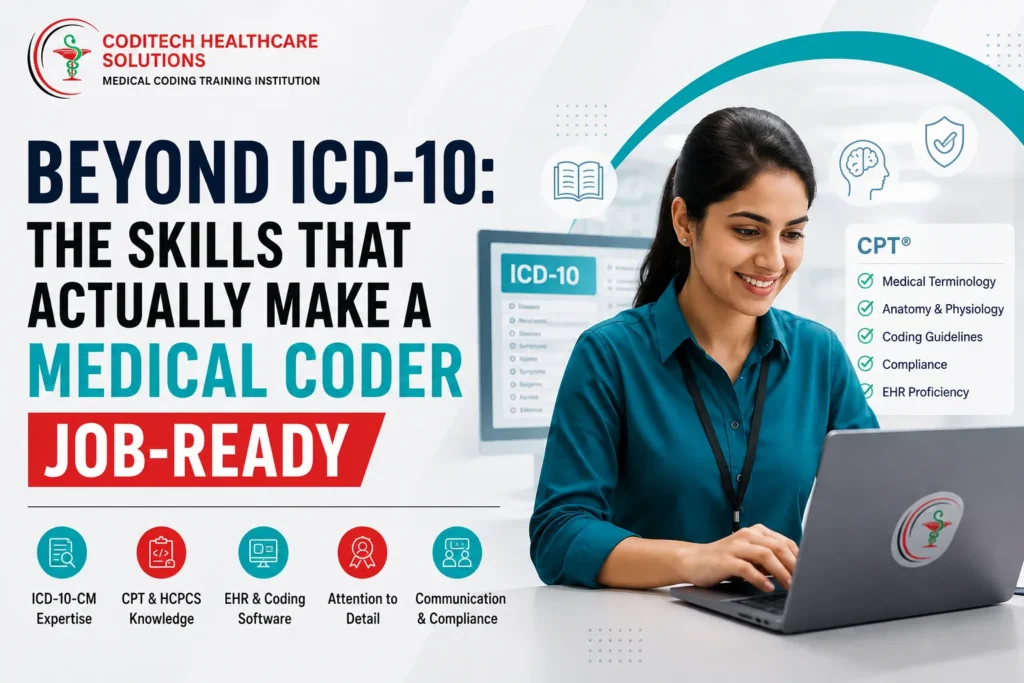
Beyond ICD-10: The Skills That Actually Make a Medical Coder Job-Ready You can memorize hundreds of medical codes and still struggle on your first day as a medical coder. That may sound surprising, but medical coding is not simply about opening an ICD-10-CM book, finding a code, and entering it into a system. Real-world coding requires much more. A job-ready medical coder needs to understand medical documentation, anatomy, procedures, coding guidelines, payer requirements, and the logic behind every coding decision. This is where the difference between learning medical coding and becoming a job-ready medical coder becomes clear. Whether you are a graduate looking for your first healthcare job, a professional planning a career change, or someone preparing for a certification such as CPC, CCS, CIC, COC, or CRC, developing practical skills is just as important as understanding coding systems. What Does It Really Mean to Be a Job-Ready Medical Coder? Being job-ready means you can look at a medical record and understand what is happening clinically before you start searching for codes. A good medical coder should be able to answer questions such as: What condition is the patient being treated for? What procedure or service was performed? What information in the documentation supports the code? Is the diagnosis confirmed or only suspected? Which coding guideline applies? Are there any applicable modifiers? Does the documentation support the level of service? Are there sequencing or bundling considerations? These questions require reasoning, not just memorization. ICD-10-CM is an important part of medical coding, but it is only one piece of the overall skill set. 1. Strong Medical Terminology Knowledge Imagine receiving documentation that contains terms such as cholecystectomy, hypertension, arthroscopy, myocardial infarction, or gastroesophageal reflux disease. If you don’t understand the terminology, finding the correct code becomes difficult. Medical terminology is essentially the language of healthcare. A coder doesn’t necessarily need to become a doctor, but they do need to understand commonly used medical terms and abbreviations. A strong foundation should include: Common medical terminology Prefixes, suffixes, and root words Disease terminology Surgical terminology Diagnostic terminology Common medical abbreviations Names of procedures and treatments This knowledge makes the coding process faster and reduces the possibility of choosing a code based only on a familiar word. 2. Anatomy and Physiology Matter More Than You Think Coding becomes much easier when you understand where a condition or procedure occurs in the body. For example, a coder working on surgical documentation may need to distinguish between different anatomical structures, organs, tissues, or body regions. A basic understanding of anatomy and physiology helps coders connect the documentation with the correct diagnosis and procedure. You should understand: Major body systems Organs and their functions Anatomical terminology Body regions Common diseases affecting each system Basic physiological processes This is especially useful when working with specialties such as surgery, emergency medicine, cardiology, orthopedics, radiology, and obstetrics. 3. Learn to Read Medical Documentation One of the most important skills for a professional medical coder is documentation reading. Coding isn’t about picking a code because a diagnosis appears somewhere in a report. You need to understand the context surrounding that diagnosis. A medical record may contain: Chief complaint History of present illness Past medical history Physical examination Assessment Plan Operative notes Discharge summaries Laboratory findings Imaging reports Procedure documentation The coder needs to identify what information is actually relevant for coding. This is one reason practical case studies are so valuable during Medical Coding Training in Pune. Working with realistic documentation helps students understand how coding decisions are made in actual situations. 4. Understand CPT and HCPCS, Not Just ICD-10 Many beginners associate medical coding primarily with ICD-10-CM. But professional coding often involves multiple code sets. Depending on the role, a coder may work with: ICD-10-CM – Diagnosis coding CPT – Procedures and professional services HCPCS Level II – Supplies, services, medications, and other healthcare items Understanding how these code sets work together is an important part of becoming job-ready. For example, a patient’s medical record may describe a condition using an ICD-10-CM code while a procedure performed for that condition is reported using a CPT code. A coder must understand the relationship between the diagnosis, service, documentation, and applicable coding rules. 5. Coding Guidelines and Conventions A medical coder cannot rely only on memory. Coding guidelines exist for a reason. ICD-10-CM includes conventions, instructional notes, sequencing rules, exclusions, combination codes, “code first” instructions, “use additional code” instructions, and other important guidance. Professional coders need to know how to locate and apply these instructions. Instead of asking: “What code do I remember for this condition?” A better question is: “What does the documentation support, and what do the official coding guidelines tell me to report?” That mindset is essential for accurate coding. 6. Learn Modifiers and Their Practical Use Modifiers can look confusing when you first encounter them. But understanding when and why modifiers are used is an important part of professional coding, particularly in CPT-based environments. Some modifiers communicate that: A service was performed under special circumstances. Multiple procedures were performed. A service was distinct or separately identifiable. A professional or technical component applies. A procedure was reduced or discontinued. However, modifiers should never be added simply because they seem appropriate. The documentation must support their use. Practical examples are one of the best ways to understand modifiers and avoid common mistakes. 7. Develop Medical Coding Logic This is the skill that often separates a memorization-based learner from a confident coder. Coding requires logical thinking. Suppose a medical record contains several diagnoses. Which one should be reported first? Which conditions are relevant to the encounter? Is a symptom separately reportable? Is there a combination code? Does the documentation support a more specific code? These are reasoning questions. A good training program should therefore include coding scenarios, case studies, chart reviews, and practice exercises instead of focusing entirely on theoretical definitions. 8. Know How to Use Coding Tools and Resources A professional coder should know how to research. You may
Medical Billing Course Pune
Blog

Medical Coding vs Medical Billing: What’s the Real Difference?

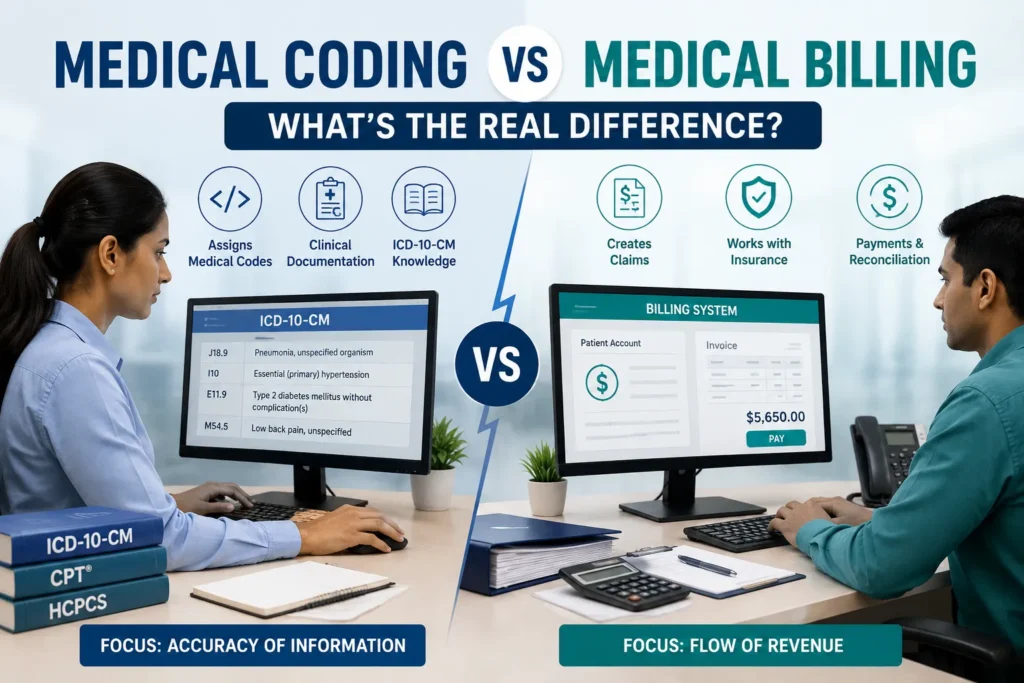
Medical Coding vs Medical Billing: What’s the Real Difference? Medical coding and medical billing are often treated as the same career. They’re not. Both roles are connected to the healthcare revenue cycle, and both are important for making sure healthcare providers receive proper payment for the services they provide. However, the work involved, skills required, responsibilities, and career paths are different. If you are considering a Medical Coding Course in Pune or exploring Medical Billing Training in Pune, understanding this difference before enrolling can help you choose a career path that actually matches your interests and strengths. Let’s break it down in simple terms. What Is Medical Coding? Medical coding is the process of converting information from a patient’s medical records into standardized medical codes. When a patient visits a hospital, clinic, or healthcare provider, the medical documentation may contain information about: The patient’s diagnosis Symptoms and conditions Medical procedures Treatments provided Laboratory services Surgical procedures Supplies and healthcare services A medical coder reviews this documentation and assigns the appropriate codes according to established coding guidelines. Some of the major coding systems used in healthcare include ICD-10-CM, CPT, and HCPCS. For example, if a physician documents a particular diagnosis and treatment, the coder needs to understand the documentation and determine which codes accurately represent the services provided. The job requires attention to detail because even a small coding error can affect a claim or healthcare reimbursement. What Is Medical Billing? Medical billing focuses more on the financial and claims side of healthcare. Once the services have been coded, the billing process involves preparing and submitting claims to insurance companies or other payers. Medical billers may also follow up on claims, check payment status, handle denials, and communicate with insurance companies regarding outstanding payments. A medical biller’s responsibilities can include: Preparing insurance claims Submitting claims to payers Checking claim status Following up on unpaid claims Working on rejected or denied claims Posting payments Reviewing patient balances Communicating with insurance companies Maintaining billing records In simple words, medical coding identifies and translates healthcare services into codes, while medical billing deals with the financial side of those coded services. Medical Coding vs Medical Billing: The Main Difference The easiest way to understand the difference is to look at where each professional fits into the healthcare revenue cycle. Medical Coding Medical Billing Reviews medical documentation Works with claims and payments Assigns medical codes Submits and tracks claims Uses ICD-10-CM, CPT and HCPCS Works with insurance and payer processes Requires strong coding knowledge Requires strong billing and claims knowledge Focuses on accurate code assignment Focuses on reimbursement and payment Documentation-oriented Financial and administrative-oriented Although the two professions work closely together, they require different skill sets. How Does Medical Coding Work? Imagine that a patient visits a hospital because of a medical problem. The physician examines the patient, documents the diagnosis, performs the required services, and records the treatment provided. The medical coder then reviews the documentation. The coder asks questions such as: What condition was diagnosed? What procedure was performed? What services were provided? Does the documentation support the selected code? Based on the documentation and coding guidelines, the appropriate codes are assigned. These codes are then used as part of the claim and reimbursement process. This is why medical coders need a strong understanding of medical terminology, anatomy, physiology, and coding guidelines. How Does Medical Billing Work? After coding is completed, the billing process comes into play. The medical biller works with the coded information and prepares the claim for submission to the appropriate payer. Once the claim is submitted, the biller may need to monitor its progress. If the claim is accepted and paid, the payment is recorded. If the claim is rejected or denied, the biller may investigate the reason, correct the issue when appropriate, and resubmit or appeal the claim according to the relevant process. This means billing professionals need to understand not only healthcare claims but also payer requirements and the financial side of healthcare administration. Medical Coding Requires Strong Attention to Detail One of the biggest characteristics of a good medical coder is attention to detail. Medical records can contain a large amount of information. A coder needs to identify the relevant documentation and select codes that accurately represent the patient’s condition and the services provided. For someone who enjoys: Working with medical information Reading documentation Learning medical terminology Following guidelines Finding details Working with codes and classification systems medical coding can be an interesting career option. This is one reason many graduates choose a Medical Coding Training in Pune program before entering the field. Medical Billing Requires Strong Communication and Follow-Up Skills Medical billing has a different working style. Billers may spend considerable time working with claims, insurance companies, payment information, and claim denials. Communication and follow-up skills can therefore be extremely useful. A billing professional may need to understand why a claim wasn’t processed correctly and determine what action needs to be taken. If you enjoy: Administrative work Claim processing Communication Insurance-related processes Problem-solving Financial documentation then medical billing may be worth exploring. Medical Coding Course Pune: What Should You Learn? If you are planning to join a Medical Coding Course in Pune, don’t choose a program simply because it has a low fee. Look at what the course actually teaches. A good training program should cover important fundamentals such as: 1. Anatomy and Physiology Understanding the human body is important because medical coding involves diagnoses, body systems, procedures, and treatments. 2. Medical Terminology You should become comfortable with common medical terms, abbreviations, conditions, procedures, and healthcare language. 3. ICD-10-CM ICD-10-CM is used to report diagnoses and health conditions in many healthcare settings. 4. CPT CPT codes are used to describe many medical procedures and professional services. 5. HCPCS HCPCS coding is important for reporting various healthcare services, supplies, and products. 6. Coding Guidelines Knowing the code itself isn’t enough. A coder must understand how and when codes should be assigned according to applicable guidelines. 7.

🎯 Admissions Open for 2026 Batch   |   💼 100% Placement Assistance   |   📞 Call Now: +91-8956660060—  For  Medical Coding Training  

Contact Us

Scroll to Top