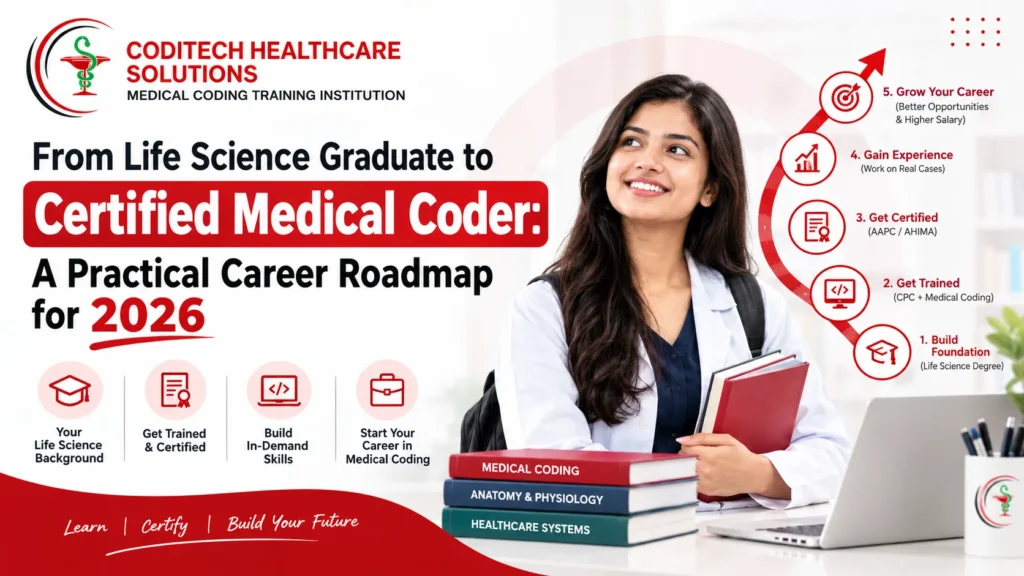
From Life Science Graduate to Certified Medical Coder: A Practical Career Roadmap for 2026
From Life Science Graduate to Certified Medical Coder: A Practical Career Roadmap for 2026 Graduation day feels like the end of one journey, but for many life science students, it is actually where the difficult questions begin. What should I do next? Should I continue studying? Should I look for a healthcare job? Is there a career where my life science knowledge can actually be useful? If you have asked yourself any of these questions, medical coding may be worth exploring. Medical coding has become an interesting career option for graduates who want to work in the healthcare industry without choosing a traditional clinical career. It combines healthcare knowledge, medical documentation, coding guidelines, technology, and attention to detail. The good news for life science graduates is that you are not starting completely from zero. You already have exposure to many concepts that can make the learning process easier. With structured training, practical experience, and certification preparation, you can gradually build the skills needed to pursue a career in medical coding. So, what does that journey actually look like? Let’s break it down. What Does a Medical Coder Actually Do? Before choosing any career, it is important to understand the actual work involved. A medical coder reviews healthcare documentation and converts relevant clinical information into standardized medical codes. A patient’s record can contain information about: Diagnoses Symptoms Medical history Procedures Treatments Laboratory tests Imaging Medications Follow-up care The coder studies this information and assigns appropriate codes according to established coding systems and official guidelines. Common code sets include: ICD-10-CM CPT HCPCS Level II ICD-10-PCS in applicable inpatient/facility coding environments It sounds straightforward until you see an actual medical record. The documentation may contain multiple conditions, procedures, abbreviations, clinical details, and instructions that need to be interpreted correctly. That is why professional medical coding requires knowledge and judgment, not just memorization. Why Life Science Graduates Have an Advantage One of the biggest benefits of coming from a life science background is that healthcare terminology may not feel completely unfamiliar. Depending on your degree, you may already have studied subjects such as: Anatomy Physiology Pathology Pharmacology Biochemistry Microbiology Human biology Disease processes This foundation can make it easier to understand medical records. For example, when you encounter terminology related to the cardiovascular, respiratory, digestive, or musculoskeletal system, you may already have some understanding of what it means. However, there is an important difference between understanding medicine and coding medicine. A life science degree gives you the foundation. Professional coding training teaches you how to apply that knowledge according to coding rules. Step 1: Understand the Medical Coding Career Don’t start by immediately buying every coding book or trying to memorize thousands of codes. Start by understanding the profession. Learn: What medical coders do Where coders work Difference between coding and billing Different types of medical coding Common coding certifications What employers look for What skills are required for entry-level roles This gives you a realistic picture of the career before you commit to it. Step 2: Strengthen Your Medical Foundation Even if you have studied life sciences, revisiting important healthcare concepts can be useful. Focus on: Anatomy and Physiology Understand the body’s major systems, organs, structures, and functions. Medical Terminology Learn commonly used medical terms, abbreviations, disease names, and procedure terminology. Pathophysiology Understand how diseases affect the body. You don’t need to become a physician to become a coder. But you do need enough clinical understanding to read and interpret healthcare documentation accurately. Step 3: Learn ICD-10-CM Once your foundation is strong, move into diagnosis coding. ICD-10-CM is used to classify diagnoses and other health conditions. This is where you start learning how clinical information is converted into standardized codes. Don’t approach ICD-10-CM as a list of numbers to memorize. Instead, learn how to: Search for diagnoses Navigate the Alphabetic Index Verify codes in the Tabular List Understand inclusion and exclusion notes Apply instructional notes Identify required specificity Follow sequencing principles Use official coding guidelines The goal is to understand the process behind code selection. Step 4: Learn CPT and HCPCS Diagnosis coding is only part of the picture. Depending on your career path, you may also need to understand procedure and service coding. CPT is used for reporting many medical procedures and professional services. HCPCS Level II covers various healthcare services, supplies, products, and other items. Understanding how diagnosis and procedure codes relate to the services documented in a patient’s record can make your coding knowledge much more complete. This is one reason a well-rounded medical coding training in Pune program should cover more than ICD-10-CM alone. Step 5: Understand Coding Guidelines This is where many beginners realize that medical coding isn’t simply about finding the closest code. Two cases may appear similar at first glance but require different coding decisions because of differences in documentation. You need to understand concepts such as: Coding conventions Sequencing Excludes notes Code-first instructions Use additional code instructions Combination codes Specificity Documentation requirements Learning the guidelines helps you explain why a code is appropriate instead of simply saying, “This looks like the right code.” Step 6: Start Practicing With Medical Records This is probably the most important stage of your journey. Reading a textbook is useful. But reading a medical record is different. A practical case may contain several diagnoses, procedures, clinical findings, and pieces of information that appear important but aren’t necessarily reportable. You need to learn how to separate the relevant information from the noise. A useful approach is: Read → Understand → Identify → Research → Verify → Code → Review With regular practice, this process becomes more natural. This is why students comparing medical coding classes in Pune should look beyond the syllabus and ask how much practical case-based learning is included. Step 7: Decide Which Certification Matches Your Goal Certification can strengthen your professional profile, but the right certification depends on the type of coding career you want. One commonly considered credential is the CPC (Certified Professional Coder). CPC preparation