
Medical Coding Courses Pune

Medical Coding Institute in Pune
Blog

From Certification to Career Growth: Your Medical Coding Roadmap in India

From Certification to Career Growth: Your Medical Coding Roadmap in India Are you looking to build a career in medical coding but don’t know where to start—or what comes after certification? You may have already searched for medical coding courses, CPC certification, job opportunities and salary information. But one question often remains unanswered: “What is the actual roadmap from learning medical coding to building a long-term career?” Medical coding is not simply about completing a course and getting a certificate. A successful career requires a combination of medical knowledge, coding skills, practical exposure, certification, interview preparation and continuous learning. If you’re a graduate or someone planning a career change, this guide will help you understand the journey from your first coding lesson to long-term career growth in India’s healthcare industry. What Is Medical Coding? Medical coding is the process of converting information from healthcare documentation into standardized medical codes. When a patient visits a hospital or healthcare provider, the medical record may contain information about: Diagnoses Symptoms Medical procedures Treatments Tests Patient conditions Physician services A medical coder reviews this documentation and assigns the appropriate codes according to established coding systems and guidelines. Common code sets include ICD-10-CM, CPT and HCPCS. The work requires attention to detail because even a small difference in documentation can affect the appropriate coding decision. Step 1: Understand Whether Medical Coding Is Right for You Before enrolling in a course, understand what the profession actually involves. Medical coding can be suitable for people who enjoy: Working with detailed information Learning medical terminology Reading and analysing documentation Following rules and guidelines Working with computers Performing structured, detail-oriented work You don’t need to know everything before starting. However, you should be willing to learn medical terminology, anatomy, coding guidelines and healthcare documentation. Step 2: Build Your Medical Foundation One of the first things a beginner should focus on is developing basic medical knowledge. Medical Terminology You need to understand the terminology used by doctors and healthcare professionals. Anatomy and Physiology Understanding body systems makes medical documentation easier to interpret. Disease Processes Learning common diseases and conditions helps you understand why certain diagnoses and procedures appear in medical records. These subjects may seem difficult at first, but they become easier when you connect them with real clinical examples. Step 3: Learn ICD-10-CM, CPT and HCPCS After building the foundation, the next stage is learning the major coding systems. ICD-10-CM ICD-10-CM is primarily used for diagnosis coding. You need to learn how to identify the appropriate diagnosis code based on documentation and applicable guidelines. CPT CPT codes are used to report many medical procedures and professional services. HCPCS HCPCS includes codes used for various healthcare services, supplies and products. Don’t approach coding as simple memorization. A professional coder needs to understand how to locate, verify and apply codes correctly. Step 4: Get Practical Coding Experience This is one of the most important stages of your journey. There is a major difference between reading about coding and actually working through a medical record. During training, practice identifying: Diagnoses Procedures Medical terminology Relevant documentation Applicable codes Coding guidelines Modifiers E/M concepts Supporting information Start with simple cases and gradually move toward more complex scenarios. Practical exposure helps you become more comfortable with the type of thinking required in a real coding environment. Step 5: Choose the Right Training Institute The training institute you choose can influence how well you understand the fundamentals. If you’re searching for a Medical Coding Training institute in Pune, don’t compare institutes only by their advertisements or course fees. Instead, look at the actual learning experience. Consider whether the institute provides: Experienced trainers Medical terminology training Anatomy and physiology ICD-10-CM training CPT and HCPCS training Practical coding exercises Certification preparation Mock tests Interview preparation Career guidance For students comparing Medical Coding Courses in Pune, practical training should be one of the most important factors to consider. Step 6: Prepare for CPC Certification Once you have developed your coding foundation, you can consider professional certification. The CPC certification is one of the credentials pursued by people building careers in professional medical coding. Preparing for certification can help you strengthen your understanding of: Coding guidelines Medical terminology Anatomy ICD-10-CM CPT HCPCS Modifiers Coding scenarios However, certification should not be considered the final destination. The certificate can demonstrate your knowledge, but employers may also look at your practical understanding, communication and ability to handle coding scenarios. Step 7: Consider CPC Certification Training in Pune If you are planning to pursue CPC certification, structured preparation can make the learning process easier. When looking for CPC Certification Training in Pune, check whether the program includes both examination preparation and practical coding knowledge. A good preparation program should help you understand: How to approach coding questions How to use coding resources How to interpret documentation How to apply guidelines How to manage your time during the examination How to avoid common mistakes The goal should be to understand why an answer is correct rather than simply memorizing answers. Step 8: Prepare for Your First Medical Coding Job Once your training and certification preparation are complete, it’s time to focus on employment. Your preparation should include both technical and HR interviews. Technical Preparation Revise: ICD-10-CM CPT HCPCS Anatomy Medical terminology Modifiers E/M Coding guidelines Practical coding cases HR Preparation Be ready to explain: Your educational background Why you chose medical coding What you learned during training Your certification Your career goals Your strengths Why you want to work in healthcare Don’t memorize complicated answers. Speak clearly and explain your knowledge naturally. Step 9: Your First Job Is the Beginning, Not the End Getting your first job is an important milestone, but career growth doesn’t stop there. Your first few months can teach you things that cannot always be learned from a classroom. You may become familiar with: Real medical documentation Production requirements Quality audits Client-specific guidelines Team workflows Common coding errors Specialty-specific documentation Pay attention to feedback from senior coders and quality teams.
Medical Coding Training Pune
Blog

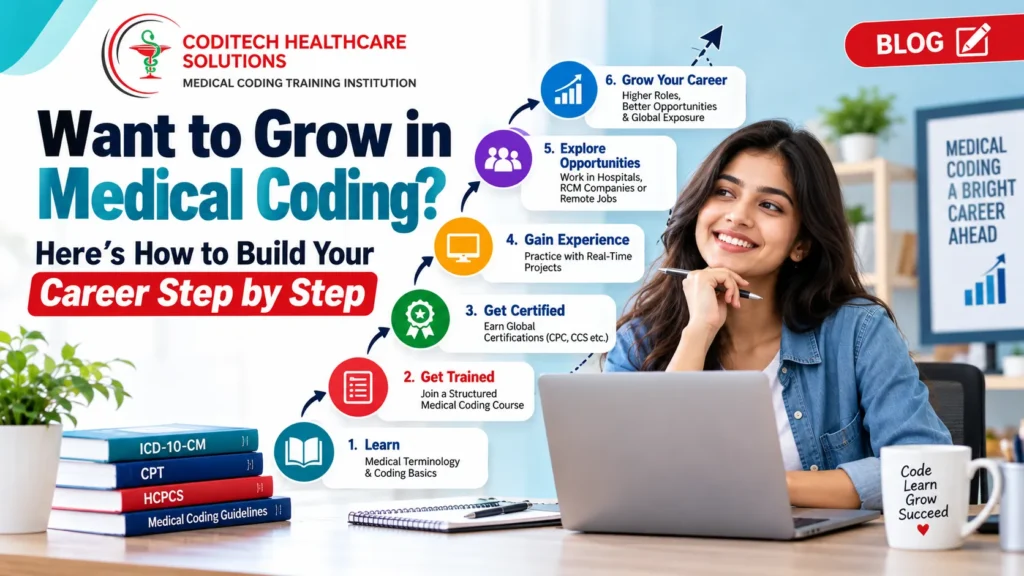
Want to Grow in Medical Coding? Here’s How to Build Your Career Step by Step

Want to Grow in Medical Coding? Here’s How to Build Your Career Step by Step Starting a career in medical coding is one thing. Knowing how to grow after you enter the field is another. Many freshers focus only on getting their first medical coding job. But once you understand the basics, a bigger question starts to come up: What should I learn next? How can I become better at coding? Should I pursue certification? Which skills can help me move into a specialized role? Medical coding is not a career where learning stops after completing a course. Coding guidelines change, healthcare documentation evolves, and different specialties require different levels of knowledge. If you want to build a long-term career, you need a step-by-step approach. This guide explains how you can start, improve your skills and gradually build a stronger career in medical coding. Step 1: Understand What Medical Coders Actually Do Before choosing medical coding as a career, understand what the job involves. Medical coders review healthcare documentation and translate diagnoses, procedures, services and other clinical information into standardized codes. Depending on the role, coders may work with: ICD-10-CM CPT HCPCS E/M coding Medical terminology Anatomy and physiology Coding guidelines Physician documentation Insurance-related information Specialty-specific coding The job requires attention to detail. A coder cannot simply choose a code because it “looks right.” The documentation needs to support the coding decision. That is why understanding the fundamentals is the first step toward career growth. Step 2: Build a Strong Foundation in Medical Terminology If medical terms are confusing, coding can quickly become difficult. A strong foundation in medical terminology helps you understand what physicians and other healthcare professionals are documenting. Start by learning: Common medical terms Prefixes and suffixes Body systems Common diseases and conditions Medical abbreviations Diagnostic terminology Surgical terminology Don’t try to memorize hundreds of terms in one day. Learn them gradually and connect them with anatomy and real clinical examples. The better you understand the language of healthcare, the easier it becomes to understand medical records. Step 3: Learn Anatomy and Physiology Medical coding isn’t just about codes. You also need to understand where a condition occurs, which body system is involved and how different medical procedures relate to the human body. For example, understanding the cardiovascular system can make cardiovascular documentation easier to interpret. Similarly, knowledge of the musculoskeletal system can help when working with orthopedic records. You don’t necessarily need to become a medical professional, but you should develop enough anatomical knowledge to understand clinical documentation accurately. Step 4: Master ICD-10-CM, CPT and HCPCS These code sets form an important part of medical coding education. ICD-10-CM ICD-10-CM is primarily used for diagnosis coding. You need to understand how to identify the appropriate diagnosis code based on the documentation and applicable guidelines. CPT CPT codes are used to report many medical procedures and professional services. HCPCS HCPCS coding includes codes used for various healthcare services, supplies and products that may not be represented by CPT alone. Don’t try to learn these code sets through memorization alone. Instead, learn how to find, verify and apply codes correctly. That difference becomes very important when you start working with actual coding scenarios. Step 5: Learn the Official Coding Guidelines Knowing where to find a code isn’t enough. You also need to understand the rules behind selecting and reporting that code. Coding guidelines help you determine how documentation should be interpreted and how codes should be assigned in different situations. As you progress, become comfortable referring to coding guidelines rather than relying only on memory. A good coder knows that sometimes the correct answer comes from carefully checking the guideline, not from remembering a code instantly. Step 6: Start Practicing With Medical Records This is where your theoretical knowledge starts becoming practical. Reading a textbook is different from reviewing an actual medical record. Practice identifying: Patient diagnoses Symptoms Procedures Relevant documentation Primary and secondary conditions Applicable codes Coding guidelines Supporting documentation Begin with simple cases and gradually move toward more complicated scenarios. The more cases you practice, the more comfortable you become with the process of analyzing documentation. Step 7: Consider Professional Certification Once you have built your fundamentals, certification can be an important part of your career development. The CPC certification, for example, is a commonly pursued credential among medical coding professionals. Certification preparation can help you develop: Coding knowledge Guideline awareness Exam-solving skills Codebook navigation skills Time management Confidence with coding scenarios However, certification should not be treated as the finish line. A certificate may strengthen your profile, but practical knowledge is still important when you enter a professional coding environment. Step 8: Choose the Right Training Program If you’re a fresher, structured training can help you avoid learning everything randomly. When looking for a medical coding training institute in Pune, don’t compare institutes only based on advertisements or course duration. Look at what the training actually covers. A useful program should ideally include: Medical terminology Anatomy and physiology ICD-10-CM CPT HCPCS Coding guidelines Practical coding exercises Mock assessments Certification preparation Interview preparation Career guidance For students searching for medical coding courses Pune, practical exposure should be one of the factors considered while comparing different programs. Step 9: Develop Skills Beyond Coding Technical coding knowledge is important, but professional growth also depends on other skills. Attention to Detail Small documentation differences can affect coding decisions. Developing a habit of carefully reviewing records is essential. Communication Coders may need to communicate with team members, auditors, physicians or other departments depending on their role. Computer Skills Medical coding is technology-driven. Being comfortable with software, electronic records and basic computer applications can make your work easier. Research Skills Sometimes the answer isn’t immediately obvious. Knowing how to research coding guidelines and documentation can be extremely valuable. Time Management Production-based coding environments often involve productivity expectations. Learning to maintain both accuracy and efficiency takes practice. Step 10: Prepare for Your First Interview Getting trained is only one part of becoming

Remote Medical Coding Jobs in 2026 | Pune Guide
Blog

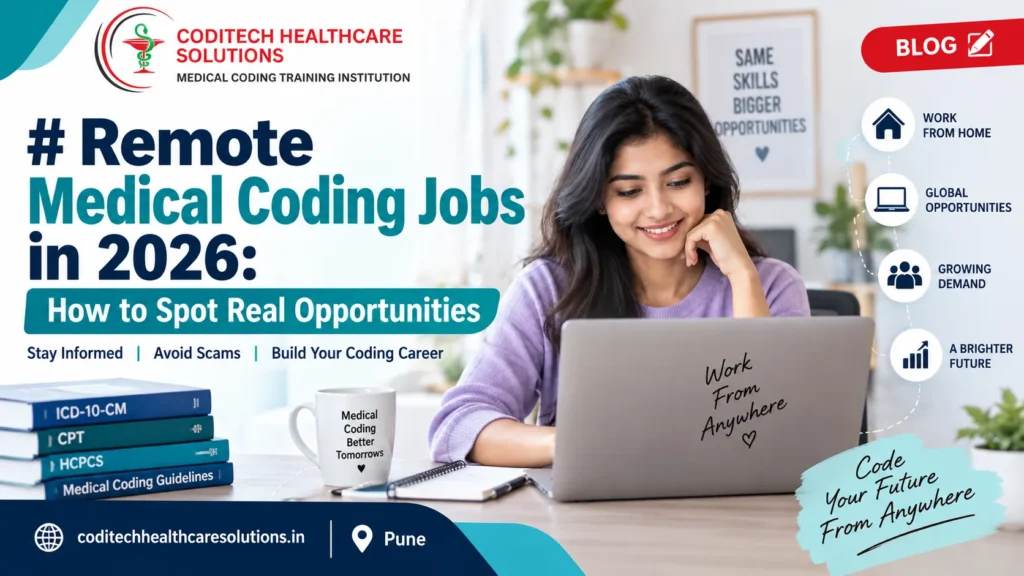
Remote Medical Coding Jobs in 2026: How to Spot Real Opportunities

Remote Medical Coding Jobs in 2026: How to Spot Real Opportunities “Work from home” sounds attractive—but when it comes to remote medical coding jobs, not every opportunity you see online is genuine. Some job posts are legitimate openings from healthcare organizations and outsourcing companies, while others may be misleading, ask for money upfront, or provide very little information about the actual role. For students and freshers planning a career in medical coding, learning how to identify a genuine remote opportunity is just as important as learning coding skills. In this guide, we’ll look at how remote medical coding jobs work in 2026, what employers usually look for, common red flags, and how proper training can help you become job-ready. What Is a Remote Medical Coding Job? A remote medical coding job allows a medical coder to perform coding-related work without being physically present at the employer’s office. Depending on the company and role, a remote coder may work with: Patient medical records Diagnosis documentation Procedure details ICD-10-CM codes CPT codes HCPCS codes E/M documentation Insurance-related information Coding audits and quality checks The actual responsibilities can vary depending on the specialty, employer, experience level, and type of coding work involved. For freshers, remote positions may be more limited than entry-level office-based opportunities because some employers prefer candidates who already have practical coding or production experience. Are Remote Medical Coding Jobs Available in 2026? Yes, remote and hybrid opportunities exist in the medical coding field. However, candidates should not assume that every job advertised as “100% work from home” is suitable for a fresher. Many legitimate employers have specific requirements such as: Medical coding certification Knowledge of ICD-10-CM, CPT and HCPCS Medical terminology Anatomy and physiology knowledge Coding guidelines Practical coding experience Good communication skills Ability to maintain productivity and accuracy Reliable internet and a suitable work environment Some organizations may also have location, shift, data-security, or experience requirements. That is why it is important to read the complete job description rather than focusing only on the “remote” label. How to Spot a Genuine Remote Medical Coding Job Finding a genuine job becomes easier when you know what to check. 1. Check the Company’s Identity Before applying, research the company. Look for: Official company website Company LinkedIn presence Professional contact information Company address Employee profiles Job listings on established platforms Information about its healthcare or medical coding services If a recruiter refuses to identify the company or only communicates through a personal messaging account, take extra care. A genuine employer should generally be able to explain who they are and what position they are hiring for. 2. Never Pay Money to Get a Job This is one of the biggest warning signs. Be careful if someone asks you to pay for: Registration Interview scheduling Job confirmation Offer letter Background verification “Security deposit” Mandatory equipment Training as a condition for employment Training fees and employment-related payments are different things. A training institute may charge for an educational course, but a job recruiter asking for money simply to provide employment should be treated with caution. 3. Look Carefully at the Salary Claims Some advertisements use extremely high salary numbers to attract candidates. For example: “Fresher medical coder – ₹50,000 per month – No experience required – Immediate joining.” A salary figure alone doesn’t prove that an opportunity is fake, but unrealistic claims combined with vague job responsibilities and requests for money are strong reasons to investigate further. Instead of focusing only on the salary, check: Job responsibilities Required qualification Experience requirements Certification requirements Working hours Company details Selection process Employment terms 4. Verify the Recruiter’s Email Address Pay attention to the email address used by the recruiter. A professional recruitment communication will generally provide identifiable company information. Be cautious when an alleged corporate recruiter uses an unrelated personal email address and cannot provide an official company contact. Don’t share sensitive documents until you have verified the employer and the purpose for which the information is being requested. 5. Understand the Interview Process A legitimate employer will usually have some form of recruitment or assessment process. For medical coding positions, this could involve: HR discussion Medical terminology assessment Coding assessment Technical interview Documentation-based questions Communication assessment Final HR discussion The exact process differs between organizations. If someone says “No interview, no assessment, guaranteed job after payment,” that should immediately make you cautious. Why Medical Coding Knowledge Matters for Remote Jobs Remote work does not mean the job is easier. In fact, working independently requires you to be comfortable making coding decisions based on documentation and following coding guidelines accurately. A remote medical coder should understand areas such as: Medical Terminology You need to understand the language used in medical records. Anatomy and Physiology Knowing how the human body and its systems work helps you understand clinical documentation. ICD-10-CM You should know how diagnoses are represented using ICD-10-CM codes and how to apply the relevant coding guidelines. CPT and HCPCS Procedure and service coding knowledge is important for many coding roles. E/M Coding Understanding evaluation and management documentation can be valuable depending on the job role. Documentation A coder must know how to read clinical documentation carefully instead of simply searching for keywords. This is where proper practical training can make a significant difference. Can Freshers Get Remote Medical Coding Jobs? Yes, freshers can build toward remote medical coding opportunities, but expectations should be realistic. Many beginners assume that completing a course automatically means they will receive a remote job. In reality, employers may consider several factors before hiring a candidate. For a fresher, having the following can strengthen your profile: Relevant educational background Medical coding training Strong medical terminology knowledge ICD-10-CM knowledge CPT/HCPCS knowledge Coding practice Certification such as CPC, where appropriate Good communication Interview preparation Familiarity with real-world coding scenarios For many freshers, starting with an onsite or hybrid position can also be a practical way to gain industry experience before moving toward fully remote roles. Is CPC Certification Useful for Remote Medical

Blog

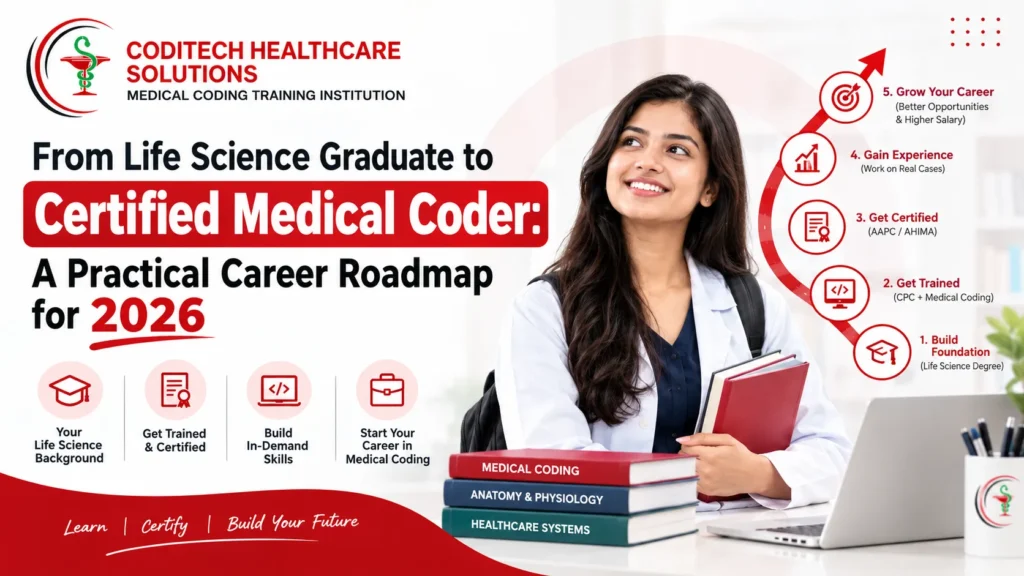
From Life Science Graduate to Certified Medical Coder: A Practical Career Roadmap for 2026

From Life Science Graduate to Certified Medical Coder: A Practical Career Roadmap for 2026 Graduation day feels like the end of one journey, but for many life science students, it is actually where the difficult questions begin. What should I do next? Should I continue studying? Should I look for a healthcare job? Is there a career where my life science knowledge can actually be useful? If you have asked yourself any of these questions, medical coding may be worth exploring. Medical coding has become an interesting career option for graduates who want to work in the healthcare industry without choosing a traditional clinical career. It combines healthcare knowledge, medical documentation, coding guidelines, technology, and attention to detail. The good news for life science graduates is that you are not starting completely from zero. You already have exposure to many concepts that can make the learning process easier. With structured training, practical experience, and certification preparation, you can gradually build the skills needed to pursue a career in medical coding. So, what does that journey actually look like? Let’s break it down. What Does a Medical Coder Actually Do? Before choosing any career, it is important to understand the actual work involved. A medical coder reviews healthcare documentation and converts relevant clinical information into standardized medical codes. A patient’s record can contain information about: Diagnoses Symptoms Medical history Procedures Treatments Laboratory tests Imaging Medications Follow-up care The coder studies this information and assigns appropriate codes according to established coding systems and official guidelines. Common code sets include: ICD-10-CM CPT HCPCS Level II ICD-10-PCS in applicable inpatient/facility coding environments It sounds straightforward until you see an actual medical record. The documentation may contain multiple conditions, procedures, abbreviations, clinical details, and instructions that need to be interpreted correctly. That is why professional medical coding requires knowledge and judgment, not just memorization. Why Life Science Graduates Have an Advantage One of the biggest benefits of coming from a life science background is that healthcare terminology may not feel completely unfamiliar. Depending on your degree, you may already have studied subjects such as: Anatomy Physiology Pathology Pharmacology Biochemistry Microbiology Human biology Disease processes This foundation can make it easier to understand medical records. For example, when you encounter terminology related to the cardiovascular, respiratory, digestive, or musculoskeletal system, you may already have some understanding of what it means. However, there is an important difference between understanding medicine and coding medicine. A life science degree gives you the foundation. Professional coding training teaches you how to apply that knowledge according to coding rules. Step 1: Understand the Medical Coding Career Don’t start by immediately buying every coding book or trying to memorize thousands of codes. Start by understanding the profession. Learn: What medical coders do Where coders work Difference between coding and billing Different types of medical coding Common coding certifications What employers look for What skills are required for entry-level roles This gives you a realistic picture of the career before you commit to it. Step 2: Strengthen Your Medical Foundation Even if you have studied life sciences, revisiting important healthcare concepts can be useful. Focus on: Anatomy and Physiology Understand the body’s major systems, organs, structures, and functions. Medical Terminology Learn commonly used medical terms, abbreviations, disease names, and procedure terminology. Pathophysiology Understand how diseases affect the body. You don’t need to become a physician to become a coder. But you do need enough clinical understanding to read and interpret healthcare documentation accurately. Step 3: Learn ICD-10-CM Once your foundation is strong, move into diagnosis coding. ICD-10-CM is used to classify diagnoses and other health conditions. This is where you start learning how clinical information is converted into standardized codes. Don’t approach ICD-10-CM as a list of numbers to memorize. Instead, learn how to: Search for diagnoses Navigate the Alphabetic Index Verify codes in the Tabular List Understand inclusion and exclusion notes Apply instructional notes Identify required specificity Follow sequencing principles Use official coding guidelines The goal is to understand the process behind code selection. Step 4: Learn CPT and HCPCS Diagnosis coding is only part of the picture. Depending on your career path, you may also need to understand procedure and service coding. CPT is used for reporting many medical procedures and professional services. HCPCS Level II covers various healthcare services, supplies, products, and other items. Understanding how diagnosis and procedure codes relate to the services documented in a patient’s record can make your coding knowledge much more complete. This is one reason a well-rounded medical coding training in Pune program should cover more than ICD-10-CM alone. Step 5: Understand Coding Guidelines This is where many beginners realize that medical coding isn’t simply about finding the closest code. Two cases may appear similar at first glance but require different coding decisions because of differences in documentation. You need to understand concepts such as: Coding conventions Sequencing Excludes notes Code-first instructions Use additional code instructions Combination codes Specificity Documentation requirements Learning the guidelines helps you explain why a code is appropriate instead of simply saying, “This looks like the right code.” Step 6: Start Practicing With Medical Records This is probably the most important stage of your journey. Reading a textbook is useful. But reading a medical record is different. A practical case may contain several diagnoses, procedures, clinical findings, and pieces of information that appear important but aren’t necessarily reportable. You need to learn how to separate the relevant information from the noise. A useful approach is: Read → Understand → Identify → Research → Verify → Code → Review With regular practice, this process becomes more natural. This is why students comparing medical coding classes in Pune should look beyond the syllabus and ask how much practical case-based learning is included. Step 7: Decide Which Certification Matches Your Goal Certification can strengthen your professional profile, but the right certification depends on the type of coding career you want. One commonly considered credential is the CPC (Certified Professional Coder). CPC preparation

🎯 Admissions Open for 2026 Batch   |   💼 100% Placement Assistance   |   📞 Call Now: +91-8956660060—  For  Medical Coding Training  

Contact Us

Scroll to Top