Medical Coding Course Pune

Medical Coding Certification
Blog

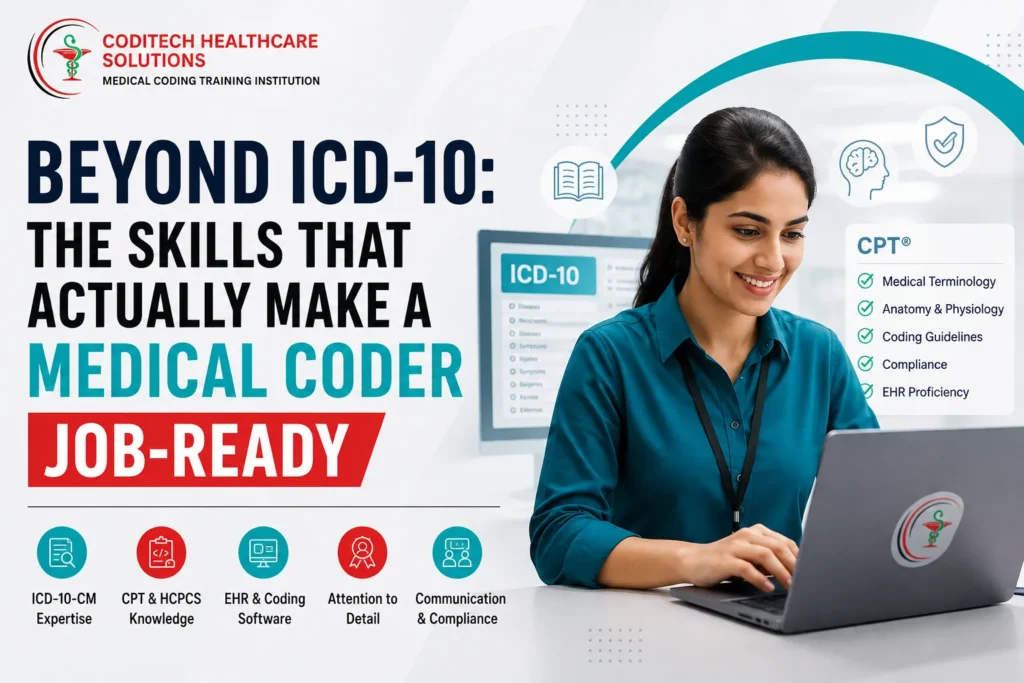
Beyond ICD-10: The Skills That Actually Make a Medical Coder Job-Ready

Beyond ICD-10: The Skills That Actually Make a Medical Coder Job-Ready You can memorize hundreds of medical codes and still struggle on your first day as a medical coder. That may sound surprising, but medical coding is not simply about opening an ICD-10-CM book, finding a code, and entering it into a system. Real-world coding requires much more. A job-ready medical coder needs to understand medical documentation, anatomy, procedures, coding guidelines, payer requirements, and the logic behind every coding decision. This is where the difference between learning medical coding and becoming a job-ready medical coder becomes clear. Whether you are a graduate looking for your first healthcare job, a professional planning a career change, or someone preparing for a certification such as CPC, CCS, CIC, COC, or CRC, developing practical skills is just as important as understanding coding systems. What Does It Really Mean to Be a Job-Ready Medical Coder? Being job-ready means you can look at a medical record and understand what is happening clinically before you start searching for codes. A good medical coder should be able to answer questions such as: What condition is the patient being treated for? What procedure or service was performed? What information in the documentation supports the code? Is the diagnosis confirmed or only suspected? Which coding guideline applies? Are there any applicable modifiers? Does the documentation support the level of service? Are there sequencing or bundling considerations? These questions require reasoning, not just memorization. ICD-10-CM is an important part of medical coding, but it is only one piece of the overall skill set. 1. Strong Medical Terminology Knowledge Imagine receiving documentation that contains terms such as cholecystectomy, hypertension, arthroscopy, myocardial infarction, or gastroesophageal reflux disease. If you don’t understand the terminology, finding the correct code becomes difficult. Medical terminology is essentially the language of healthcare. A coder doesn’t necessarily need to become a doctor, but they do need to understand commonly used medical terms and abbreviations. A strong foundation should include: Common medical terminology Prefixes, suffixes, and root words Disease terminology Surgical terminology Diagnostic terminology Common medical abbreviations Names of procedures and treatments This knowledge makes the coding process faster and reduces the possibility of choosing a code based only on a familiar word. 2. Anatomy and Physiology Matter More Than You Think Coding becomes much easier when you understand where a condition or procedure occurs in the body. For example, a coder working on surgical documentation may need to distinguish between different anatomical structures, organs, tissues, or body regions. A basic understanding of anatomy and physiology helps coders connect the documentation with the correct diagnosis and procedure. You should understand: Major body systems Organs and their functions Anatomical terminology Body regions Common diseases affecting each system Basic physiological processes This is especially useful when working with specialties such as surgery, emergency medicine, cardiology, orthopedics, radiology, and obstetrics. 3. Learn to Read Medical Documentation One of the most important skills for a professional medical coder is documentation reading. Coding isn’t about picking a code because a diagnosis appears somewhere in a report. You need to understand the context surrounding that diagnosis. A medical record may contain: Chief complaint History of present illness Past medical history Physical examination Assessment Plan Operative notes Discharge summaries Laboratory findings Imaging reports Procedure documentation The coder needs to identify what information is actually relevant for coding. This is one reason practical case studies are so valuable during Medical Coding Training in Pune. Working with realistic documentation helps students understand how coding decisions are made in actual situations. 4. Understand CPT and HCPCS, Not Just ICD-10 Many beginners associate medical coding primarily with ICD-10-CM. But professional coding often involves multiple code sets. Depending on the role, a coder may work with: ICD-10-CM – Diagnosis coding CPT – Procedures and professional services HCPCS Level II – Supplies, services, medications, and other healthcare items Understanding how these code sets work together is an important part of becoming job-ready. For example, a patient’s medical record may describe a condition using an ICD-10-CM code while a procedure performed for that condition is reported using a CPT code. A coder must understand the relationship between the diagnosis, service, documentation, and applicable coding rules. 5. Coding Guidelines and Conventions A medical coder cannot rely only on memory. Coding guidelines exist for a reason. ICD-10-CM includes conventions, instructional notes, sequencing rules, exclusions, combination codes, “code first” instructions, “use additional code” instructions, and other important guidance. Professional coders need to know how to locate and apply these instructions. Instead of asking: “What code do I remember for this condition?” A better question is: “What does the documentation support, and what do the official coding guidelines tell me to report?” That mindset is essential for accurate coding. 6. Learn Modifiers and Their Practical Use Modifiers can look confusing when you first encounter them. But understanding when and why modifiers are used is an important part of professional coding, particularly in CPT-based environments. Some modifiers communicate that: A service was performed under special circumstances. Multiple procedures were performed. A service was distinct or separately identifiable. A professional or technical component applies. A procedure was reduced or discontinued. However, modifiers should never be added simply because they seem appropriate. The documentation must support their use. Practical examples are one of the best ways to understand modifiers and avoid common mistakes. 7. Develop Medical Coding Logic This is the skill that often separates a memorization-based learner from a confident coder. Coding requires logical thinking. Suppose a medical record contains several diagnoses. Which one should be reported first? Which conditions are relevant to the encounter? Is a symptom separately reportable? Is there a combination code? Does the documentation support a more specific code? These are reasoning questions. A good training program should therefore include coding scenarios, case studies, chart reviews, and practice exercises instead of focusing entirely on theoretical definitions. 8. Know How to Use Coding Tools and Resources A professional coder should know how to research. You may
AI transforming medical coding in 2026
Blog

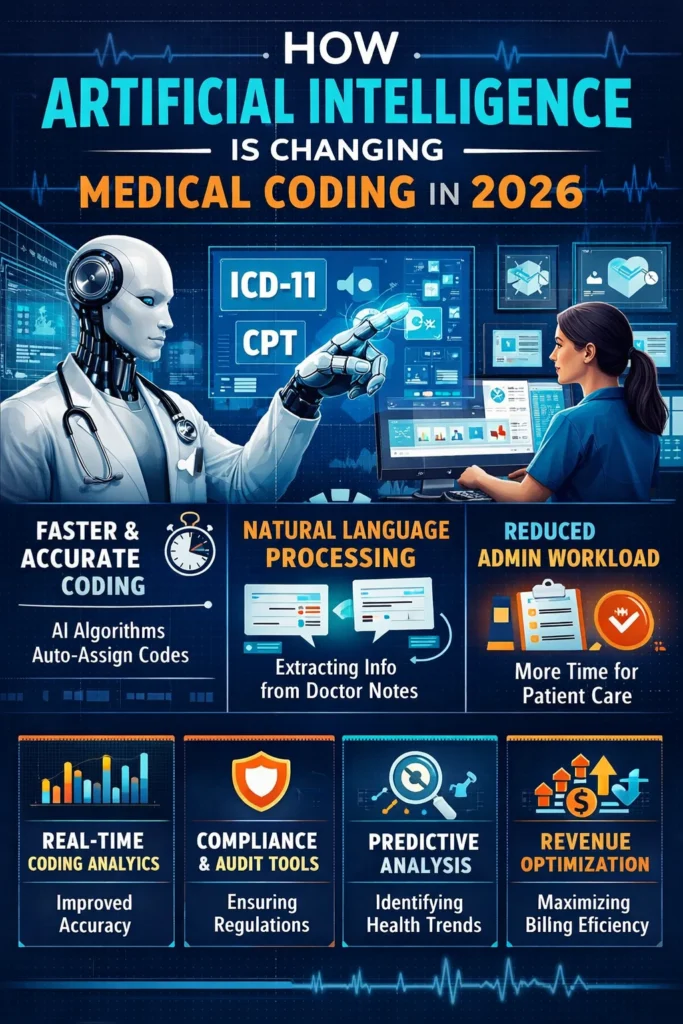
How Artificial Intelligence Is Changing Medical Coding in 2026

How Artificial Intelligence Is Changing Medical Coding in 2026 By Coditech Healthcare Solutions | Leading Medical Coding Institute in Pune Introduction: The AI Revolution Has Arrived in Medical Coding Artificial Intelligence is no longer a futuristic concept confined to science fiction or technology conferences. In 2026, AI is actively reshaping industries across the globe — and medical coding is no exception. From automating routine code assignments to flagging compliance errors in real time, AI is fundamentally changing the way medical coders work, learn, and grow in their careers. For students enrolled in medical coding classes in Pune and for working professionals in the healthcare industry, understanding how AI is transforming medical coding is no longer optional — it is essential. The coders who thrive in the coming years will not be the ones who fear AI, but the ones who learn to work alongside it. At Coditech Healthcare Solutions, one of the most trusted medical coding institutes in Pune, we believe that the future of medical coding belongs to skilled, certified, and AI-literate coders. In this blog, we take a deep dive into how Artificial Intelligence is changing medical coding in 2026, what it means for your career, and how you can stay ahead of the curve. What Is AI-Powered Medical Coding? AI-powered medical coding refers to the use of machine learning algorithms, natural language processing (NLP), and deep learning models to automatically read clinical documentation — such as physician notes, discharge summaries, operative reports, and lab results — and suggest or assign the appropriate medical codes. Traditional medical coding is a manual process where trained coders read clinical documents and assign ICD-10-CM, CPT, and HCPCS codes based on their knowledge of coding guidelines and medical terminology. AI tools aim to assist or partially automate this process by analyzing large volumes of clinical text at speeds no human coder can match. In 2026, AI medical coding tools are being used by hospitals, healthcare BPO companies, and insurance organizations across the world — including in India’s rapidly growing RCM sector where many medical coding classes in Pune are now incorporating AI literacy into their training curriculum. How AI Is Being Used in Medical Coding in 2026 1. Automated Code Suggestion The most visible application of AI in medical coding today is automated code suggestion. AI tools scan clinical documentation and recommend ICD-10-CM diagnosis codes, CPT procedure codes, and HCPCS codes based on patterns learned from millions of previously coded records. Rather than replacing the coder, these tools function as intelligent assistants — surfacing the most likely codes for the coder to review, validate, and finalize. This dramatically reduces the time a coder spends searching through codebooks and cross-referencing guidelines, allowing them to focus on accuracy, compliance, and clinical judgment. At Coditech Healthcare Solutions, our medical coding classes in Pune now include dedicated sessions on understanding how AI code suggestion tools work so that our students are prepared for the modern workplace from day one. 2. Natural Language Processing (NLP) in Clinical Documentation Natural Language Processing is the branch of AI that enables computers to understand, interpret, and extract meaning from human language. In medical coding, NLP engines read unstructured clinical text — which is full of abbreviations, medical jargon, and inconsistent formatting — and convert it into structured, codeable data. In 2026, NLP-powered coding tools can read a physician’s handwritten or dictated note and identify the principal diagnosis, secondary diagnoses, co-morbidities, procedures performed, and complications — all in seconds. This capability is particularly transformative for high-volume coding environments like emergency departments, large inpatient facilities, and healthcare BPOs. 3. Computer-Assisted Coding (CAC) Computer-Assisted Coding (CAC) is one of the most mature and widely adopted AI applications in medical coding. CAC systems use NLP and machine learning to analyze clinical documentation and present suggested codes to human coders for review and approval. Unlike fully automated coding — which carries significant compliance risks — CAC maintains the human coder in the loop as the final decision-maker. This hybrid approach is widely considered the most effective and responsible model for AI integration in medical coding. Major CAC platforms in use in 2026 include 3M’s 360 Encompass System, Optum’s CAC solution, Nuance’s AI-powered coding tools, and several newer AI-native platforms. Many companies that hire graduates from medical coding institutes in Pune now expect candidates to be familiar with at least one CAC platform. 4. Real-Time Coding Audits and Compliance Checks AI is also being used extensively for real-time coding audits. Traditional coding quality audits were retrospective — someone reviewed codes after they had already been submitted. In 2026, AI audit tools review codes at the point of entry, flagging potential errors, upcoding risks, undercoding patterns, and compliance violations before claims are submitted. This shift from retrospective to real-time auditing is dramatically reducing claim denials, improving clean claim rates, and protecting healthcare organizations from fraud and abuse risks. For coders, it means working in an environment where AI is constantly checking their work — which makes deep knowledge of coding guidelines more important than ever, not less. 5. Predictive Analytics and Revenue Cycle Optimization Beyond coding itself, AI is being used to predict claim denial patterns, identify revenue leakage points, optimize DRG assignment, and forecast reimbursement outcomes. These predictive analytics capabilities are giving healthcare organizations unprecedented visibility into their revenue cycles. For medical coders, this means that coding accuracy is now directly linked to measurable financial outcomes in ways that are tracked, reported, and acted upon in near real-time. Coders who understand both coding guidelines and basic revenue cycle concepts are becoming increasingly valuable in this AI-enhanced environment. 6. AI-Powered Medical Coding Education One of the most exciting developments for students at medical coding institutes in Pune is the emergence of AI-powered learning platforms for medical coding education. These platforms use adaptive learning algorithms to identify each student’s weak areas, customize practice question sets, and provide personalized study recommendations. At Coditech Healthcare Solutions, we are actively integrating AI-powered practice tools and coding simulators into our medical

🎯 Admissions Open for 2026 Batch   |   💼 100% Placement Assistance   |   📞 Call Now: +91-8956660060—  For  Medical Coding Training  

Contact Us

Scroll to Top