Medical Coding Course in Pune

Remote Medical Coding Jobs in 2026 | Pune Guide
Blog

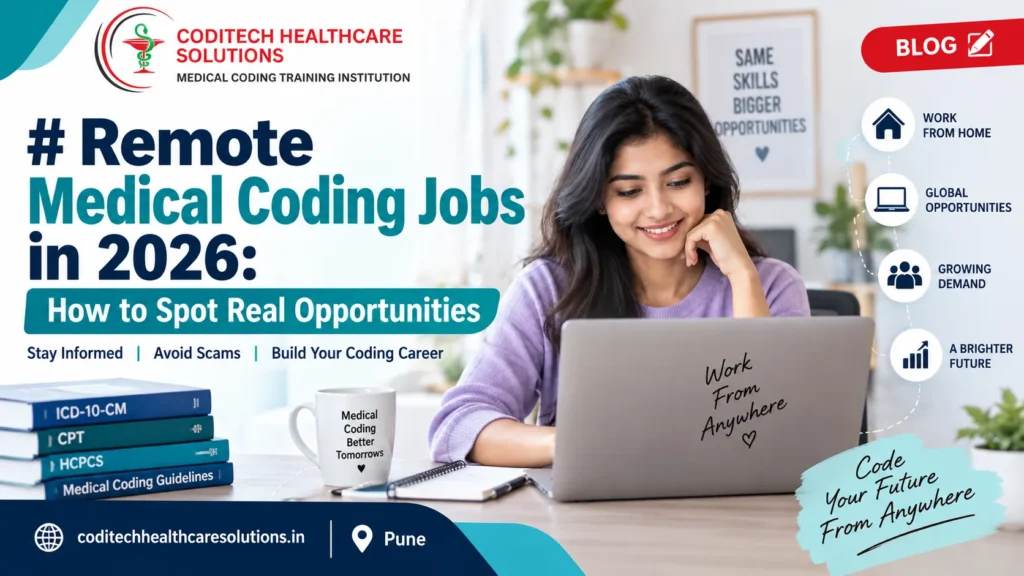
Remote Medical Coding Jobs in 2026: How to Spot Real Opportunities

Remote Medical Coding Jobs in 2026: How to Spot Real Opportunities “Work from home” sounds attractive—but when it comes to remote medical coding jobs, not every opportunity you see online is genuine. Some job posts are legitimate openings from healthcare organizations and outsourcing companies, while others may be misleading, ask for money upfront, or provide very little information about the actual role. For students and freshers planning a career in medical coding, learning how to identify a genuine remote opportunity is just as important as learning coding skills. In this guide, we’ll look at how remote medical coding jobs work in 2026, what employers usually look for, common red flags, and how proper training can help you become job-ready. What Is a Remote Medical Coding Job? A remote medical coding job allows a medical coder to perform coding-related work without being physically present at the employer’s office. Depending on the company and role, a remote coder may work with: Patient medical records Diagnosis documentation Procedure details ICD-10-CM codes CPT codes HCPCS codes E/M documentation Insurance-related information Coding audits and quality checks The actual responsibilities can vary depending on the specialty, employer, experience level, and type of coding work involved. For freshers, remote positions may be more limited than entry-level office-based opportunities because some employers prefer candidates who already have practical coding or production experience. Are Remote Medical Coding Jobs Available in 2026? Yes, remote and hybrid opportunities exist in the medical coding field. However, candidates should not assume that every job advertised as “100% work from home” is suitable for a fresher. Many legitimate employers have specific requirements such as: Medical coding certification Knowledge of ICD-10-CM, CPT and HCPCS Medical terminology Anatomy and physiology knowledge Coding guidelines Practical coding experience Good communication skills Ability to maintain productivity and accuracy Reliable internet and a suitable work environment Some organizations may also have location, shift, data-security, or experience requirements. That is why it is important to read the complete job description rather than focusing only on the “remote” label. How to Spot a Genuine Remote Medical Coding Job Finding a genuine job becomes easier when you know what to check. 1. Check the Company’s Identity Before applying, research the company. Look for: Official company website Company LinkedIn presence Professional contact information Company address Employee profiles Job listings on established platforms Information about its healthcare or medical coding services If a recruiter refuses to identify the company or only communicates through a personal messaging account, take extra care. A genuine employer should generally be able to explain who they are and what position they are hiring for. 2. Never Pay Money to Get a Job This is one of the biggest warning signs. Be careful if someone asks you to pay for: Registration Interview scheduling Job confirmation Offer letter Background verification “Security deposit” Mandatory equipment Training as a condition for employment Training fees and employment-related payments are different things. A training institute may charge for an educational course, but a job recruiter asking for money simply to provide employment should be treated with caution. 3. Look Carefully at the Salary Claims Some advertisements use extremely high salary numbers to attract candidates. For example: “Fresher medical coder – ₹50,000 per month – No experience required – Immediate joining.” A salary figure alone doesn’t prove that an opportunity is fake, but unrealistic claims combined with vague job responsibilities and requests for money are strong reasons to investigate further. Instead of focusing only on the salary, check: Job responsibilities Required qualification Experience requirements Certification requirements Working hours Company details Selection process Employment terms 4. Verify the Recruiter’s Email Address Pay attention to the email address used by the recruiter. A professional recruitment communication will generally provide identifiable company information. Be cautious when an alleged corporate recruiter uses an unrelated personal email address and cannot provide an official company contact. Don’t share sensitive documents until you have verified the employer and the purpose for which the information is being requested. 5. Understand the Interview Process A legitimate employer will usually have some form of recruitment or assessment process. For medical coding positions, this could involve: HR discussion Medical terminology assessment Coding assessment Technical interview Documentation-based questions Communication assessment Final HR discussion The exact process differs between organizations. If someone says “No interview, no assessment, guaranteed job after payment,” that should immediately make you cautious. Why Medical Coding Knowledge Matters for Remote Jobs Remote work does not mean the job is easier. In fact, working independently requires you to be comfortable making coding decisions based on documentation and following coding guidelines accurately. A remote medical coder should understand areas such as: Medical Terminology You need to understand the language used in medical records. Anatomy and Physiology Knowing how the human body and its systems work helps you understand clinical documentation. ICD-10-CM You should know how diagnoses are represented using ICD-10-CM codes and how to apply the relevant coding guidelines. CPT and HCPCS Procedure and service coding knowledge is important for many coding roles. E/M Coding Understanding evaluation and management documentation can be valuable depending on the job role. Documentation A coder must know how to read clinical documentation carefully instead of simply searching for keywords. This is where proper practical training can make a significant difference. Can Freshers Get Remote Medical Coding Jobs? Yes, freshers can build toward remote medical coding opportunities, but expectations should be realistic. Many beginners assume that completing a course automatically means they will receive a remote job. In reality, employers may consider several factors before hiring a candidate. For a fresher, having the following can strengthen your profile: Relevant educational background Medical coding training Strong medical terminology knowledge ICD-10-CM knowledge CPT/HCPCS knowledge Coding practice Certification such as CPC, where appropriate Good communication Interview preparation Familiarity with real-world coding scenarios For many freshers, starting with an onsite or hybrid position can also be a practical way to gain industry experience before moving toward fully remote roles. Is CPC Certification Useful for Remote Medical
Blog

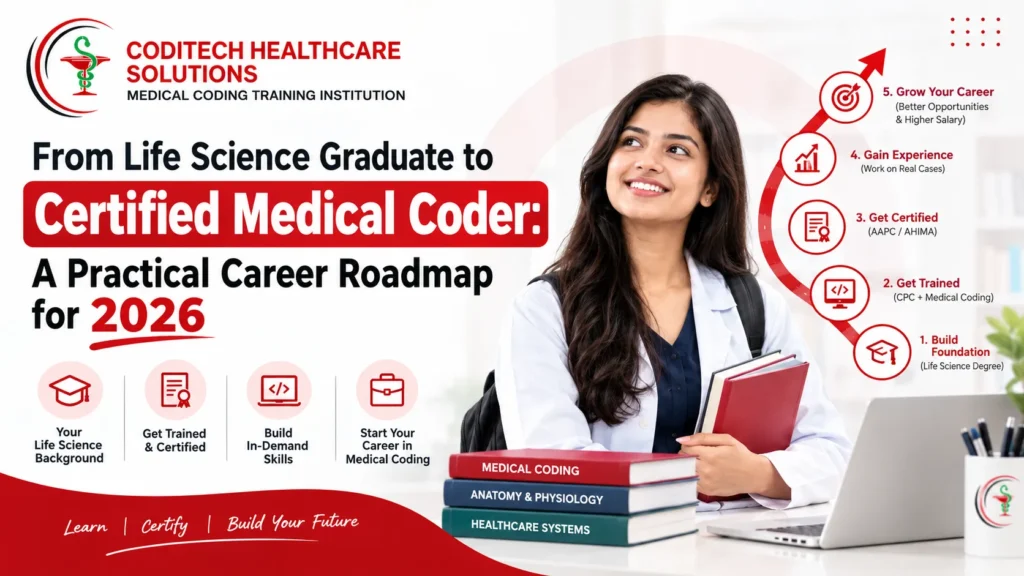
From Life Science Graduate to Certified Medical Coder: A Practical Career Roadmap for 2026

From Life Science Graduate to Certified Medical Coder: A Practical Career Roadmap for 2026 Graduation day feels like the end of one journey, but for many life science students, it is actually where the difficult questions begin. What should I do next? Should I continue studying? Should I look for a healthcare job? Is there a career where my life science knowledge can actually be useful? If you have asked yourself any of these questions, medical coding may be worth exploring. Medical coding has become an interesting career option for graduates who want to work in the healthcare industry without choosing a traditional clinical career. It combines healthcare knowledge, medical documentation, coding guidelines, technology, and attention to detail. The good news for life science graduates is that you are not starting completely from zero. You already have exposure to many concepts that can make the learning process easier. With structured training, practical experience, and certification preparation, you can gradually build the skills needed to pursue a career in medical coding. So, what does that journey actually look like? Let’s break it down. What Does a Medical Coder Actually Do? Before choosing any career, it is important to understand the actual work involved. A medical coder reviews healthcare documentation and converts relevant clinical information into standardized medical codes. A patient’s record can contain information about: Diagnoses Symptoms Medical history Procedures Treatments Laboratory tests Imaging Medications Follow-up care The coder studies this information and assigns appropriate codes according to established coding systems and official guidelines. Common code sets include: ICD-10-CM CPT HCPCS Level II ICD-10-PCS in applicable inpatient/facility coding environments It sounds straightforward until you see an actual medical record. The documentation may contain multiple conditions, procedures, abbreviations, clinical details, and instructions that need to be interpreted correctly. That is why professional medical coding requires knowledge and judgment, not just memorization. Why Life Science Graduates Have an Advantage One of the biggest benefits of coming from a life science background is that healthcare terminology may not feel completely unfamiliar. Depending on your degree, you may already have studied subjects such as: Anatomy Physiology Pathology Pharmacology Biochemistry Microbiology Human biology Disease processes This foundation can make it easier to understand medical records. For example, when you encounter terminology related to the cardiovascular, respiratory, digestive, or musculoskeletal system, you may already have some understanding of what it means. However, there is an important difference between understanding medicine and coding medicine. A life science degree gives you the foundation. Professional coding training teaches you how to apply that knowledge according to coding rules. Step 1: Understand the Medical Coding Career Don’t start by immediately buying every coding book or trying to memorize thousands of codes. Start by understanding the profession. Learn: What medical coders do Where coders work Difference between coding and billing Different types of medical coding Common coding certifications What employers look for What skills are required for entry-level roles This gives you a realistic picture of the career before you commit to it. Step 2: Strengthen Your Medical Foundation Even if you have studied life sciences, revisiting important healthcare concepts can be useful. Focus on: Anatomy and Physiology Understand the body’s major systems, organs, structures, and functions. Medical Terminology Learn commonly used medical terms, abbreviations, disease names, and procedure terminology. Pathophysiology Understand how diseases affect the body. You don’t need to become a physician to become a coder. But you do need enough clinical understanding to read and interpret healthcare documentation accurately. Step 3: Learn ICD-10-CM Once your foundation is strong, move into diagnosis coding. ICD-10-CM is used to classify diagnoses and other health conditions. This is where you start learning how clinical information is converted into standardized codes. Don’t approach ICD-10-CM as a list of numbers to memorize. Instead, learn how to: Search for diagnoses Navigate the Alphabetic Index Verify codes in the Tabular List Understand inclusion and exclusion notes Apply instructional notes Identify required specificity Follow sequencing principles Use official coding guidelines The goal is to understand the process behind code selection. Step 4: Learn CPT and HCPCS Diagnosis coding is only part of the picture. Depending on your career path, you may also need to understand procedure and service coding. CPT is used for reporting many medical procedures and professional services. HCPCS Level II covers various healthcare services, supplies, products, and other items. Understanding how diagnosis and procedure codes relate to the services documented in a patient’s record can make your coding knowledge much more complete. This is one reason a well-rounded medical coding training in Pune program should cover more than ICD-10-CM alone. Step 5: Understand Coding Guidelines This is where many beginners realize that medical coding isn’t simply about finding the closest code. Two cases may appear similar at first glance but require different coding decisions because of differences in documentation. You need to understand concepts such as: Coding conventions Sequencing Excludes notes Code-first instructions Use additional code instructions Combination codes Specificity Documentation requirements Learning the guidelines helps you explain why a code is appropriate instead of simply saying, “This looks like the right code.” Step 6: Start Practicing With Medical Records This is probably the most important stage of your journey. Reading a textbook is useful. But reading a medical record is different. A practical case may contain several diagnoses, procedures, clinical findings, and pieces of information that appear important but aren’t necessarily reportable. You need to learn how to separate the relevant information from the noise. A useful approach is: Read → Understand → Identify → Research → Verify → Code → Review With regular practice, this process becomes more natural. This is why students comparing medical coding classes in Pune should look beyond the syllabus and ask how much practical case-based learning is included. Step 7: Decide Which Certification Matches Your Goal Certification can strengthen your professional profile, but the right certification depends on the type of coding career you want. One commonly considered credential is the CPC (Certified Professional Coder). CPC preparation

Medical Coding Training Pune
Blog

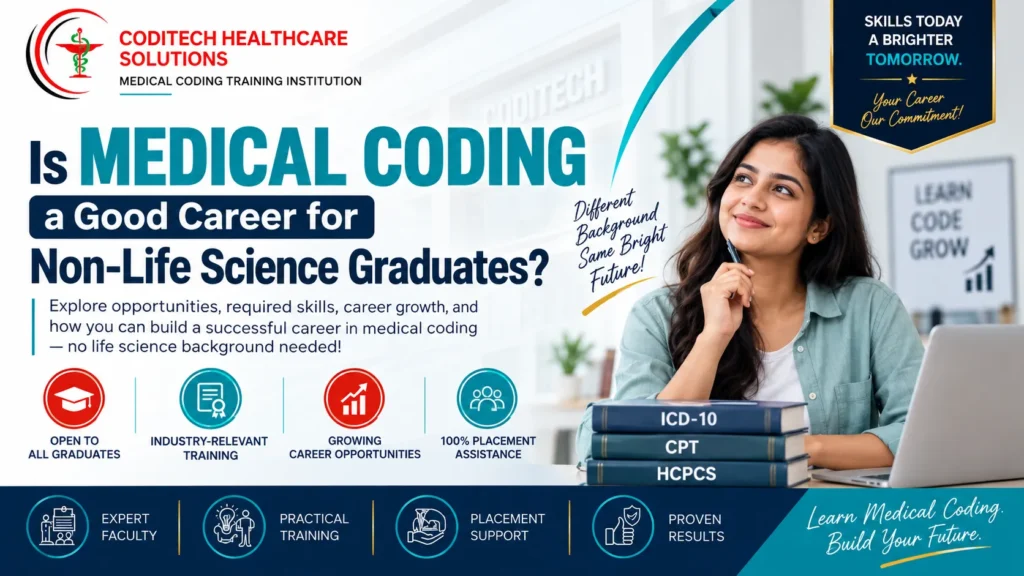
Is Medical Coding a Good Career for Non-Life Science Graduates?

Is Medical Coding a Good Career for Non-Life Science Graduates? What if your degree is in engineering, computer science, commerce, or another non-life science field—but you still want to enter the healthcare industry? You may have already searched for different healthcare career options and come across medical coding. At first, medical coding can seem like a career meant only for students with a medical or life science background. After all, coders work with diagnoses, medical procedures, anatomy, and clinical documentation. But is a life science degree really necessary to build a career in medical coding? Not necessarily. With the right training, consistent practice, and an interest in learning healthcare concepts, students from non-life science backgrounds can develop the skills required for medical coding. The important question isn’t only what you studied in college—it is whether you are willing to learn the fundamentals and apply them correctly. Let’s understand what it takes. What Is Medical Coding? Before deciding whether medical coding is suitable for you, it helps to understand what the job actually involves. Medical coding is the process of converting information from healthcare documentation into standardized medical codes. When a patient visits a hospital or healthcare provider, the medical record may contain information about: Symptoms Diagnoses Medical history Treatments Procedures Investigations Medications Follow-up care A medical coder reviews this documentation and assigns appropriate codes according to established coding systems and guidelines. Some commonly used code sets include: ICD-10-CM CPT HCPCS Level II ICD-10-PCS for applicable facility/inpatient coding environments So, medical coding is not simply about typing codes into a computer. It requires documentation reading, medical knowledge, attention to detail, and logical thinking. Do You Need a Life Science Degree to Become a Medical Coder? This is one of the biggest questions asked by students from non-medical backgrounds. A life science or healthcare education can certainly provide an advantage because you may already know anatomy, physiology, medical terminology, and basic disease concepts. However, coming from a non-life science background does not automatically mean that medical coding is closed to you. You can learn the required healthcare concepts through structured training. For example, a student with a background in: Computer Science Engineering Commerce Business Administration Mathematics Arts Other graduate disciplines may begin learning medical coding by first developing the necessary medical foundation. The learning curve may be different from someone who studied biology or healthcare, but that does not mean the career is impossible. What Challenges Can Non-Life Science Graduates Face? Let’s be realistic. A non-life science graduate may initially find certain medical concepts unfamiliar. Terms such as myocardial infarction, cholecystitis, nephrolithiasis, or arthroscopy may look complicated when you encounter them for the first time. Similarly, understanding body systems and medical documentation can take time. The good news is that these are learnable skills. The key is not to rush directly into advanced coding. Start with the basics. Build Your Foundation First A beginner should gradually learn: Medical Terminology → Anatomy & Physiology → Disease Processes → ICD-10-CM → CPT → HCPCS → Coding Guidelines → Practical Cases Once the foundation becomes stronger, coding concepts become much easier to understand. Medical Terminology: Your First Step Into Healthcare If you’re from a non-life science background, medical terminology should be one of your first priorities. Think of medical terminology as learning a new language. Many medical words can be broken into smaller parts, such as prefixes, roots, and suffixes. Understanding these components can help you recognize the meaning of unfamiliar terms. For example, learning common terminology related to: Cardiovascular system Respiratory system Digestive system Musculoskeletal system Nervous system Urinary system can gradually make medical records easier to understand. You don’t need to learn every medical term in existence. You need to build a strong working vocabulary that helps you understand the documentation you encounter as a coder. Anatomy and Physiology Can Be Learned Another area that may initially feel difficult is anatomy. A non-life science graduate might not have studied the human body in detail during college. That’s okay. A good Medical Coding Training in Pune program should introduce anatomy and physiology in a way that connects directly to coding. Instead of simply memorizing the names of organs, try to understand: Where an organ is located What it does Which body system it belongs to Common conditions affecting it Common procedures performed on it When you understand the relationship between anatomy, disease, and treatment, medical documentation becomes much easier to interpret. Medical Coding Is More Than Memorizing Codes One of the biggest misconceptions about medical coding is that successful coders simply memorize thousands of codes. That’s not how professional coding works. A coder needs to understand the documentation and then use coding resources and guidelines to determine the appropriate code. For example, a medical record may mention a condition but provide additional details that affect code selection. You may need to determine: The exact diagnosis The anatomical location Acuity or clinical status where relevant Whether the condition is documented as confirmed Whether additional codes are required Which guideline applies What should be sequenced first This is why analytical thinking can be just as important as medical knowledge. And this is one area where students from technical or analytical backgrounds can often develop useful strengths. What Skills Do You Need to Become a Medical Coder? Your degree is only one part of the picture. To become a competent medical coder, focus on developing the following skills. 1. Medical Terminology You need to understand commonly used healthcare language. 2. Anatomy and Physiology Learn the body’s major systems and their functions. 3. Coding Knowledge Understand ICD-10-CM, CPT, HCPCS, and other relevant coding systems. 4. Documentation Reading Learn how to identify the information that matters for coding. 5. Coding Guidelines Understand how official guidelines and coding conventions affect code selection. 6. Attention to Detail A small documentation difference can sometimes change the coding decision. 7. Analytical Thinking You need to interpret information rather than simply copy it. 8. Computer Skills Most coding work involves digital systems, electronic

Medical Coding Certification
Blog

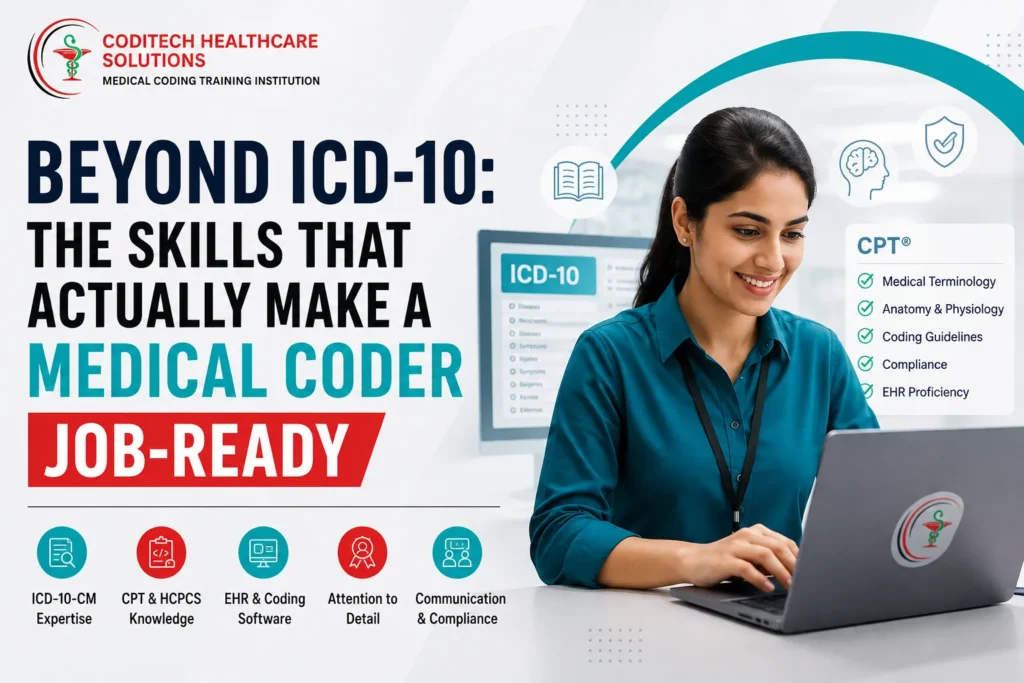
Beyond ICD-10: The Skills That Actually Make a Medical Coder Job-Ready

Beyond ICD-10: The Skills That Actually Make a Medical Coder Job-Ready You can memorize hundreds of medical codes and still struggle on your first day as a medical coder. That may sound surprising, but medical coding is not simply about opening an ICD-10-CM book, finding a code, and entering it into a system. Real-world coding requires much more. A job-ready medical coder needs to understand medical documentation, anatomy, procedures, coding guidelines, payer requirements, and the logic behind every coding decision. This is where the difference between learning medical coding and becoming a job-ready medical coder becomes clear. Whether you are a graduate looking for your first healthcare job, a professional planning a career change, or someone preparing for a certification such as CPC, CCS, CIC, COC, or CRC, developing practical skills is just as important as understanding coding systems. What Does It Really Mean to Be a Job-Ready Medical Coder? Being job-ready means you can look at a medical record and understand what is happening clinically before you start searching for codes. A good medical coder should be able to answer questions such as: What condition is the patient being treated for? What procedure or service was performed? What information in the documentation supports the code? Is the diagnosis confirmed or only suspected? Which coding guideline applies? Are there any applicable modifiers? Does the documentation support the level of service? Are there sequencing or bundling considerations? These questions require reasoning, not just memorization. ICD-10-CM is an important part of medical coding, but it is only one piece of the overall skill set. 1. Strong Medical Terminology Knowledge Imagine receiving documentation that contains terms such as cholecystectomy, hypertension, arthroscopy, myocardial infarction, or gastroesophageal reflux disease. If you don’t understand the terminology, finding the correct code becomes difficult. Medical terminology is essentially the language of healthcare. A coder doesn’t necessarily need to become a doctor, but they do need to understand commonly used medical terms and abbreviations. A strong foundation should include: Common medical terminology Prefixes, suffixes, and root words Disease terminology Surgical terminology Diagnostic terminology Common medical abbreviations Names of procedures and treatments This knowledge makes the coding process faster and reduces the possibility of choosing a code based only on a familiar word. 2. Anatomy and Physiology Matter More Than You Think Coding becomes much easier when you understand where a condition or procedure occurs in the body. For example, a coder working on surgical documentation may need to distinguish between different anatomical structures, organs, tissues, or body regions. A basic understanding of anatomy and physiology helps coders connect the documentation with the correct diagnosis and procedure. You should understand: Major body systems Organs and their functions Anatomical terminology Body regions Common diseases affecting each system Basic physiological processes This is especially useful when working with specialties such as surgery, emergency medicine, cardiology, orthopedics, radiology, and obstetrics. 3. Learn to Read Medical Documentation One of the most important skills for a professional medical coder is documentation reading. Coding isn’t about picking a code because a diagnosis appears somewhere in a report. You need to understand the context surrounding that diagnosis. A medical record may contain: Chief complaint History of present illness Past medical history Physical examination Assessment Plan Operative notes Discharge summaries Laboratory findings Imaging reports Procedure documentation The coder needs to identify what information is actually relevant for coding. This is one reason practical case studies are so valuable during Medical Coding Training in Pune. Working with realistic documentation helps students understand how coding decisions are made in actual situations. 4. Understand CPT and HCPCS, Not Just ICD-10 Many beginners associate medical coding primarily with ICD-10-CM. But professional coding often involves multiple code sets. Depending on the role, a coder may work with: ICD-10-CM – Diagnosis coding CPT – Procedures and professional services HCPCS Level II – Supplies, services, medications, and other healthcare items Understanding how these code sets work together is an important part of becoming job-ready. For example, a patient’s medical record may describe a condition using an ICD-10-CM code while a procedure performed for that condition is reported using a CPT code. A coder must understand the relationship between the diagnosis, service, documentation, and applicable coding rules. 5. Coding Guidelines and Conventions A medical coder cannot rely only on memory. Coding guidelines exist for a reason. ICD-10-CM includes conventions, instructional notes, sequencing rules, exclusions, combination codes, “code first” instructions, “use additional code” instructions, and other important guidance. Professional coders need to know how to locate and apply these instructions. Instead of asking: “What code do I remember for this condition?” A better question is: “What does the documentation support, and what do the official coding guidelines tell me to report?” That mindset is essential for accurate coding. 6. Learn Modifiers and Their Practical Use Modifiers can look confusing when you first encounter them. But understanding when and why modifiers are used is an important part of professional coding, particularly in CPT-based environments. Some modifiers communicate that: A service was performed under special circumstances. Multiple procedures were performed. A service was distinct or separately identifiable. A professional or technical component applies. A procedure was reduced or discontinued. However, modifiers should never be added simply because they seem appropriate. The documentation must support their use. Practical examples are one of the best ways to understand modifiers and avoid common mistakes. 7. Develop Medical Coding Logic This is the skill that often separates a memorization-based learner from a confident coder. Coding requires logical thinking. Suppose a medical record contains several diagnoses. Which one should be reported first? Which conditions are relevant to the encounter? Is a symptom separately reportable? Is there a combination code? Does the documentation support a more specific code? These are reasoning questions. A good training program should therefore include coding scenarios, case studies, chart reviews, and practice exercises instead of focusing entirely on theoretical definitions. 8. Know How to Use Coding Tools and Resources A professional coder should know how to research. You may

CPC Certification Course in Pune
Blog

Affordable Medical Coding Courses with 100% Placement Support

Affordable Medical Coding Courses with 100% Placement Support Affordable Medical Coding Courses with 100% Placement Support in Pune Looking for a healthcare career that offers strong growth without spending years in college? Medical coding could be the opportunity you’ve been searching for. With the healthcare industry expanding rapidly, skilled medical coders are increasingly needed to maintain accurate medical records, billing, insurance claims, and healthcare documentation. For students and graduates in Pune, choosing the right medical coding course can be the first step toward building a stable career in the healthcare industry. But with so many training institutes available, one question matters most: Which institute provides practical training, certification preparation, and genuine placement assistance at an affordable fee? Why Choose Medical Coding as a Career? Medical coding is an important part of the healthcare revenue cycle. Medical coders convert diagnoses, medical procedures, and healthcare services into standardized codes used for billing, insurance claims, and documentation. The best part is that you don’t necessarily need a medical degree to start learning medical coding. With proper training in anatomy, physiology, ICD-10-CM, CPT, HCPCS and medical coding guidelines, candidates can develop the skills required for entry-level coding jobs. This makes medical coding an attractive career option for: B.Sc. and life-science graduates Pharmacy graduates Nursing graduates Allied healthcare professionals Fresh graduates looking for healthcare careers Professionals planning to switch careers Candidates interested in CPC certification Affordable Medical Coding Courses in Pune Cost is an important factor when selecting a training program. However, choosing a course only because it is cheap may not always be the right decision. A good medical coding training institute in Pune should provide a combination of experienced trainers, practical learning, certification preparation, doubt-solving support, mock examinations, and placement assistance. At Coditech Healthcare Solutions, the focus is on providing career-oriented medical coding training that helps students understand both the fundamentals and practical aspects of coding. The training can cover important areas such as: Anatomy & Physiology ICD-10-CM Coding CPT Coding HCPCS Coding Medical Terminology Coding Guidelines Medical Billing Basics Healthcare Documentation Case-based coding practice Certification exam preparation CPC Certification Training in Pune The CPC (Certified Professional Coder) certification is one of the most recognized credentials for professionals interested in medical coding. A CPC-focused training program helps candidates prepare for the concepts and coding guidelines they are likely to encounter during certification preparation and professional coding work. If your goal is to become a certified medical coder, choosing a CPC certification training institute in Pune that provides structured preparation can make the learning process much easier. At Coditech Healthcare Solutions, students can prepare for CPC certification while developing their understanding of medical coding concepts through guided training and practice. Medical Coding & CPC Certification Courses A strong medical coding program should not focus only on theory. Students need to understand how coding concepts are applied to real-world healthcare documentation. A comprehensive medical coding and CPC certification course in Pune can help students build knowledge in: Medical Coding → Anatomy & Physiology → ICD-10-CM → CPT → HCPCS → Coding Guidelines → Case Studies → CPC Exam Preparation This step-by-step approach helps beginners understand coding concepts rather than simply memorizing codes. 100% Placement Assistance for Students Completing a course is only one part of starting a career. The next challenge is finding the right job opportunity. That’s why 100% placement assistance can be an important factor when selecting a medical coding institute. At Coditech Healthcare Solutions, students receive placement assistance after completing their training. The objective is to help candidates become job-ready and guide them through the recruitment process. Placement assistance may include: Resume preparation Interview preparation Job opportunity updates Interview guidance Communication and professional skills Assistance during the recruitment process Important: Placement assistance means dedicated support throughout the job-search process; actual hiring depends on the candidate’s performance, eligibility, and employer selection process. 100% Pass Guarantee for Certification Preparation Certification examinations can be challenging, especially for beginners who are unfamiliar with medical coding guidelines. Proper preparation, regular practice, mock tests, and trainer support can make a significant difference. Coditech Healthcare Solutions provides a 100% pass guarantee as part of its training commitment, helping students prepare systematically for their certification journey. The goal is not simply to complete the syllabus but to make students confident with coding concepts and exam-oriented practice. Why Choose Coditech Healthcare Solutions in Pune? Choosing the right institute can save you time, money, and unnecessary confusion. Coditech Healthcare Solutions focuses on practical and career-oriented medical coding education. Key Benefits Include: ✔ Experienced TrainersLearn important coding concepts with guidance from experienced trainers. ✔ Online & Offline ClassesChoose a learning format that fits your schedule. ✔ Flexible Learning SupportUseful for students and working professionals who need flexibility. ✔ CPC Certification TrainingStructured preparation for candidates targeting CPC certification. ✔ Practical Coding TrainingUnderstand coding through examples and case-based learning. ✔ 100% Placement AssistanceGet support while preparing to enter the medical coding job market. ✔ 100% Pass GuaranteeDedicated preparation to help candidates work toward certification success. ✔ Affordable Course OptionsCareer-focused training designed to provide value without unnecessary expenses. Other Medical Coding Certifications You Can Explore CPC is not the only certification available in medical coding. Depending on your career goals, you can explore different certification paths. Some popular options include: CPC – Certified Professional Coder CCS – Certified Coding Specialist CIC – Certified Inpatient Coder COC – Certified Outpatient Coder CRC – Certified Risk Adjustment Coder BCHH-C – Board Certified Home Health Coder Each certification focuses on different areas of healthcare coding. Before choosing one, it is important to understand your educational background and career objective. Who Can Join a Medical Coding Course? Medical coding training can be suitable for candidates from different educational backgrounds. You can consider medical coding training if you are: A graduate looking for a healthcare career From a life-science background A pharmacy or nursing graduate An allied healthcare professional A fresher searching for a career opportunity Interested in CPC certification Looking for a career change Interested in working in medical

Career Progression in Medical Coding
Blog

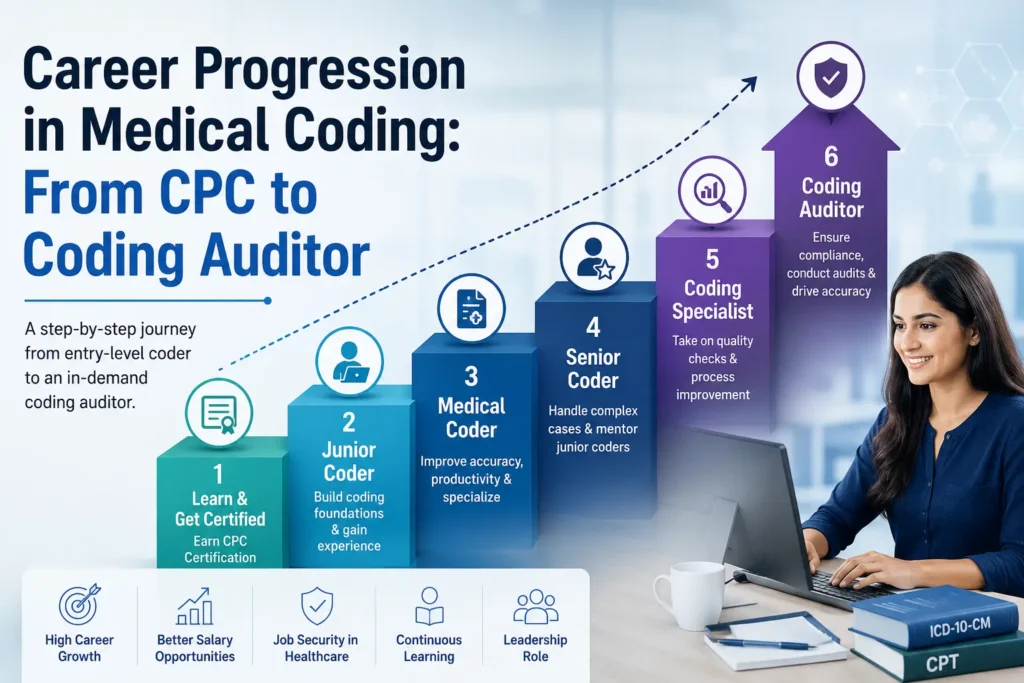
Career Progression in Medical Coding: From CPC to Coding Auditor

Career Progression in Medical Coding: From CPC to Coding Auditor Career Progression in Medical Coding: From CPC to Coding Auditor The healthcare industry is growing rapidly, and so is the demand for skilled medical coders. Today, medical coding is no longer just an entry-level profession—it offers excellent career growth, attractive salaries, and opportunities to specialize in different areas. Many students begin their journey with a Certified Professional Coder (CPC) certification and gradually move into advanced positions such as Senior Medical Coder, Coding Quality Analyst, Team Lead, Coding Educator, and Coding Auditor. If you’re planning a long-term career in healthcare without becoming a doctor or nurse, medical coding can be an excellent choice. At Coditech Healthcare Solutions, Pune, we help students build a strong foundation through practical training, industry-oriented curriculum, and certification guidance that supports long-term career success. What is Medical Coding? Medical coding is the process of converting medical diagnoses, procedures, treatments, and healthcare services into standardized codes using coding systems such as: ICD-10-CM CPT HCPCS Level II These codes help hospitals and insurance companies process medical claims accurately and ensure healthcare providers receive proper reimbursement. Step 1: Become a Certified Professional Coder (CPC) The first milestone in a medical coding career is earning the CPC (Certified Professional Coder) certification offered by AAPC. A CPC certification demonstrates that you understand: Medical terminology Human anatomy ICD-10-CM coding CPT coding HCPCS coding Insurance guidelines Medical documentation This certification is highly recognized by hospitals, healthcare organizations, and medical coding companies worldwide. Students looking for CPC Certification Training Institute in Pune often choose Coditech Healthcare Solutions because of its practical training approach, experienced trainers, and placement support. Step 2: Gain Practical Experience After obtaining CPC certification, most professionals start working as: Junior Medical Coder Outpatient Medical Coder Physician Coder Medical Billing Executive Healthcare Documentation Specialist During this stage, coders learn: Real-time medical records Coding accuracy Productivity targets Claim submission Insurance requirements Compliance standards This practical experience builds confidence and prepares coders for advanced roles. Step 3: Specialize in Medical Coding Once you gain 1–3 years of experience, specialization can significantly improve your career prospects. Popular specialty coding domains include: Evaluation & Management (E/M) Focuses on physician consultation coding and outpatient visits. Surgery Coding Involves coding complex surgical procedures across multiple specialties. Emergency Department (ED) Coding Requires quick understanding of emergency documentation and coding rules. IP-DRG Coding Specializes in inpatient hospital coding and Diagnosis Related Groups (DRGs). HCC Coding Risk adjustment coding for chronic conditions and Medicare Advantage plans. Home Health Coding (BCHH-C) Focuses on coding for home healthcare services and patient care documentation. At Coditech Healthcare Solutions, students can pursue advanced specialty training in E/M, ED, Surgery, IP-DRG, HCC, and BCHH-C to expand their career opportunities. Step 4: Earn Advanced Certifications After gaining experience, professionals often pursue advanced certifications to increase their earning potential. Popular certifications include: CCS (Certified Coding Specialist) CIC (Certified Inpatient Coder) COC (Certified Outpatient Coder) CRC (Certified Risk Adjustment Coder) BCHH-C Certification CPMA (Certified Professional Medical Auditor) These certifications demonstrate advanced coding knowledge and make candidates more competitive in the healthcare job market. Step 5: Become a Senior Medical Coder With strong coding skills and several years of experience, professionals can advance to the role of Senior Medical Coder. Responsibilities include: Reviewing complex medical records Assisting junior coders Resolving coding queries Improving coding quality Ensuring compliance with coding guidelines Coordinating with physicians and healthcare providers Senior coders are valued for both their technical expertise and leadership abilities. Step 6: Move into Coding Quality and Compliance Many experienced coders transition into quality-focused roles such as: Coding Quality Analyst Coding Compliance Specialist Documentation Improvement Specialist (CDI) Coding Trainer These professionals ensure that coding is accurate, compliant with industry standards, and aligned with payer requirements. This stage also offers opportunities to mentor new coders and contribute to organizational quality improvement. Step 7: Become a Coding Auditor One of the most respected positions in the medical coding profession is Coding Auditor. A coding auditor reviews medical records to verify: Coding accuracy Compliance with coding guidelines Documentation completeness Revenue integrity Audit readiness Risk identification Coding auditors play a critical role in helping healthcare organizations reduce claim denials, prevent compliance issues, and improve reimbursement accuracy. Professionals in this role often work with hospitals, insurance companies, healthcare consulting firms, and revenue cycle management organizations. Skills Needed for Career Growth Career progression in medical coding depends on continuous learning and skill development. Key skills include: Strong knowledge of ICD-10-CM, CPT, and HCPCS Medical terminology Human anatomy and physiology Analytical thinking Attention to detail Time management Communication skills Problem-solving Knowledge of payer guidelines Compliance awareness Professionals who regularly update their coding knowledge are more likely to secure promotions and advanced roles. Typical Medical Coding Career Path Experience Position Fresher CPC Certified Medical Coder 1–2 Years Medical Coder 2–4 Years Senior Medical Coder 4–6 Years Specialty Coder / Team Lead 5–8 Years Coding Quality Analyst 6–10 Years Coding Auditor 8+ Years Coding Manager / Coding Consultant / Trainer Why Choose Coditech Healthcare Solutions? If you’re looking for a Medical Coding Training Institute in Pune, choosing the right institute is the first step toward a successful career. At Coditech Healthcare Solutions, we focus on building practical skills that prepare students for real-world healthcare environments. We Offer: CPC Certification Training CCS Certification Training CIC Certification Training COC Certification Training CRC Certification Training BCHH-C Certification Training Australian Medical Coding Training E/M Specialty Training Surgery Coding Training ED Coding Training IP-DRG Training HCC Coding Training Live Practical Coding Sessions Interview Preparation Resume Building Support Certification Guidance 100% Placement Assistance Our experienced trainers provide industry-focused learning that helps students confidently begin their careers and prepare for future advancement. Final Thoughts A career in medical coding offers much more than an entry-level job. With the right certifications, practical experience, and continuous learning, professionals can progress from a Certified Professional Coder (CPC) to respected roles such as Senior Medical Coder, Coding Quality Analyst, and ultimately Coding Auditor. If you’re ready to build a rewarding career in

medical coding jobs in Pune
Blog

The Credential Crossroads: Why Experienced Coders Are Dropping CPC for CCS in 2026

The Credential Crossroads: Why Experienced Coders Are Dropping CPC for CCS in 2026 A growing number of seasoned medical coders are making a bold career move — trading in their CPC for the CCS. Here’s what’s driving the shift and whether it makes sense for you. Introduction: The Credential Landscape Is Shifting For years, the Certified Professional Coder (CPC) credential — offered by the American Academy of Professional Coders (AAPC) — was the gold standard for anyone entering the medical coding profession. It was the first step, the most recognizable badge, and the credential that opened doors in physician offices and outpatient clinics across the country. But in 2026, something interesting is happening. Experienced coders — professionals with five, eight, even fifteen years under their belt — are sitting for the Certified Coding Specialist (CCS) exam offered by AHIMA. Some are replacing their CPC entirely. Others are stacking credentials. And a surprising number are walking away from outpatient-focused roles into the higher-complexity world of inpatient hospital coding. So what exactly is driving this shift? And is the CCS right for you? Understanding the Two Credentials Before we dive into the “why,” let’s quickly outline what sets these two certifications apart: Feature CPC (AAPC) CCS (AHIMA) Issuing Body AAPC AHIMA Primary Setting Outpatient / Physician Office Inpatient Hospital / Facility Code Sets CPT, ICD-10-CM, HCPCS ICD-10-CM, ICD-10-PCS, DRG Exam Difficulty Moderate High (especially PCS) Salary Potential Moderate–Good Good–Excellent 1. The Salary Gap Is Real — and Growing Let’s be honest: one of the biggest motivators for any professional credential switch is money. And the salary data in 2026 is hard to ignore. Inpatient coders holding the CCS credential — particularly those working in acute care hospitals or large health systems — consistently command higher salaries than their outpatient CPC counterparts. The complexity of inpatient coding, which involves ICD-10-PCS procedures, Diagnosis-Related Groups (DRGs), Medicare Severity DRGs (MS-DRGs), and Case Mix Index (CMI) calculations, means that qualified coders are harder to find and easier to pay well. With healthcare systems under increasing pressure to optimize reimbursement, specialists who understand DRG optimization and Clinical Documentation Improvement (CDI) are more valuable than ever. The CCS is your ticket into that world. 2. ICD-10-PCS: The Great Differentiator If you’ve only ever worked with CPT codes, ICD-10-PCS will feel like learning a new language — because it essentially is one. With over 87,000 codes built on a 7-character alphanumeric structure, PCS demands a level of anatomical precision and logical reasoning that CPT coding simply doesn’t require. This steep learning curve is exactly why CCS-credentialed coders are scarce. And scarcity, in any market, translates to leverage. Experienced CPC holders who invest the time to master PCS are effectively moving from a crowded pool into a much smaller, more specialized one. Many experienced coders report that mastering PCS — while challenging — is intellectually rewarding in a way that outpatient coding simply isn’t after years of repetition. 3. Hospital and Health System Demand Is Surging Post-pandemic restructuring, the rapid expansion of hospital-at-home programs, and the increasing complexity of inpatient case mixes have all contributed to a persistent shortage of qualified inpatient coders. Large health systems are actively recruiting — and increasingly, they’re specifying CCS in their job postings. In 2026, remote inpatient coding positions — once rare — have become standard. Health systems across the country are hiring remote CCS-credentialed coders, giving professionals the flexibility of working from home alongside the compensation of a hospital-level role. For experienced CPCs who already work remotely, the path is clear: upgrade the credential, unlock a new tier of opportunity. 4. CDI Integration: Where Coding Meets Strategy Clinical Documentation Improvement (CDI) has become one of the fastest-growing specialties in health information management. And CCS-credentialed professionals are perfectly positioned to transition into CDI roles. CDI specialists work directly with physicians and clinical staff to ensure that documentation accurately reflects the complexity and severity of patient conditions — directly impacting DRG assignment and hospital reimbursement. These roles are highly strategic, command excellent salaries, and often come with titles like CDI Specialist, CDI Auditor, or Revenue Integrity Analyst. CPCs, by contrast, rarely have the inpatient DRG knowledge base to step into CDI positions. The CCS essentially unlocks an entirely new career track. 5. Credibility in the HIM World AHIMA (the American Health Information Management Association) has long been the more academically oriented of the two major coding bodies, with stronger ties to HIM directors, compliance officers, and health information technology. The CCS is recognized not just as a coding credential but as a marker of clinical knowledge and analytical ability. For experienced coders looking to move into leadership, auditing, compliance, or consulting roles, the CCS carries significant credibility in hospital and health system environments — sometimes more so than the CPC, which is strongly associated with physician office billing. 6. The CCS Exam: What Makes It Hard — and Beatable Make no mistake: the CCS exam is genuinely difficult. AHIMA’s exam includes medical record analysis cases for both inpatient and outpatient settings, requiring coders to assign complete code sets — including principal diagnosis, secondary diagnoses, ICD-10-PCS procedure codes, and DRG assignment — under timed conditions. But here’s what experienced CPCs have going for them: Strong ICD-10-CM foundation: Years of outpatient coding build excellent diagnosis coding skills. Medical terminology mastery: Clinical knowledge developed over years of coding across specialties. Coding logic and guidelines: The structured thinking that makes a good coder translates directly. The primary gaps to fill are ICD-10-PCS, inpatient sequencing guidelines (UHDDS), DRG/MS-DRG logic, and facility coding guidelines. With a structured study plan, experienced coders typically need 3–6 months of focused preparation to be exam-ready. 7. Should You Replace Your CPC or Stack Both? This is the question every coder at the crossroads faces. The honest answer: it depends on your goals. If you want to stay in outpatient/physician office coding — keep your CPC. It’s the right credential for that world, and it’s well-respected. If you want to transition to inpatient hospital coding — pursue the CCS. It’s

medical coding course fee in pune
Blog

Is Medical Coding Difficult to Learn for Beginners? (Complete Guide)

Is Medical Coding Difficult to Learn for Beginners? (Complete Guide) If you are planning to start a career in healthcare, one common question is: “Is medical coding difficult to learn for beginners?” The answer is No, medical coding is not difficult—especially when you learn it through the right medical coding training in Pune with expert guidance. At Coditech Healthcare Solutions, we help beginners learn medical coding step-by-step through practical medical coding classes in Pune designed for freshers. What is Medical Coding? Medical coding is the process of converting medical diagnoses, procedures, and treatments into standardized codes used in: • Insurance claims• Hospital billing• Medical documentation• Healthcare compliance The main coding systems include: • ICD-10-CM• CPT• HCPCS Learning these systems is the foundation of any medical coding course in Pune. Is Medical Coding Difficult for Beginners? Medical coding can feel challenging in the beginning because everything is new. However, with structured learning and proper training, it becomes easy to understand. Common Challenges Beginners Face: • Learning medical terminology• Understanding coding guidelines• Applying codes correctly• Lack of practical exposure But when you join professional medical coding training in Pune, these challenges become much easier to overcome. Why Medical Coding is Easy to Learn 1. Structured Learning Approach A well-designed medical coding course in Pune teaches concepts step-by-step. 2. Practical Training Hands-on practice through real case studies makes learning easier. 3. Rule-Based System Coding follows clear guidelines, so once you understand the rules, it becomes simple. 4. High Demand for Freshers Many companies hire beginners, which motivates students to learn faster. At Coditech Healthcare Solutions, we focus on simplifying concepts through practical medical coding classes in Pune. Skills Required to Learn Medical Coding To make learning easier, beginners should develop: Basic Medical Knowledge Understanding anatomy, diseases, and treatments. Attention to Detail Accuracy is important to avoid coding errors. Analytical Thinking You need to analyze patient records and apply correct codes. Regular Practice Daily practice improves speed and confidence. Our medical coding training in Pune ensures students build these skills through continuous practice. How to Learn Medical Coding Easily (Step-by-Step) Step 1: Join a Professional Course Enroll in a trusted institute offering medical coding course in Pune. Step 2: Focus on Basics Start with medical terminology and anatomy. Step 3: Learn Coding Guidelines Understanding ICD-10, CPT, and HCPCS rules is key. Step 4: Practice Daily Solve coding cases and mock tests. Step 5: Prepare for Certification Certification like CPC increases job opportunities. At Coditech Healthcare Solutions, our medical coding classes in Pune are designed to follow this exact roadmap. Medical Coding Course Fee in Pune Many students also ask about the medical coding course fee in Pune. Average Fee Range: ₹25,000 to ₹80,000 (depending on institute and training level) What Affects the Fee? • Course duration• Certification preparation• Practical training• Placement support At Coditech Healthcare Solutions, we provide affordable and value-based medical coding training in Pune with complete career support. Who Can Learn Medical Coding? Medical coding is suitable for: • BSc Nursing students• BPharm / DPharm graduates• Life science students• Medical graduates• Any graduate interested in healthcare Even non-medical students can join a medical coding course in Pune and start their career. Career Opportunities After Medical Coding After completing training, beginners can apply for: • Medical Coder• Coding Associate• Medical Billing Executive• Coding Analyst Many companies hire freshers who complete medical coding training in Pune. Salary for Freshers in Pune Starting Salary: ₹15,000 to ₹25,000 per month With certification and experience, salary increases significantly. Why Choose Coditech Healthcare Solutions? If you are looking for beginner-friendly medical coding classes in Pune, Coditech Healthcare Solutions offers: • Complete medical coding course in Pune• Expert trainers• Practical coding sessions• CPC certification preparation• Interview and placement support We make medical coding easy to learn—even for beginners. Final Thoughts So, is medical coding difficult to learn for beginners? No, it is not difficult if you learn it the right way. With proper guidance, structured medical coding training in Pune, and regular practice, anyone can master medical coding and build a successful career. If you want to start your journey, Coditech Healthcare Solutions is here to help you with the best training and career support.

medical coding training in Pune
Blog

Best Medical Coding Course in Pune (Complete Guide for 2026)

Best Medical Coding Course in Pune (Complete Guide for 2026) If you are planning to build a career in the healthcare industry without becoming a doctor, medical coding is one of the best options. With the increasing demand for skilled professionals, choosing the best medical coding course in Pune can help you start a stable and high-growth career. In this blog, we will guide you through everything you need to know about medical coding training in Pune, classes in Pune, and fee in Pune, along with career opportunities and how to choose the right institute. At Coditech Healthcare Solutions, we provide industry-focused training designed to help students become job-ready medical coding professionals. What is Medical Coding? Medical coding is the process of converting medical diagnoses, treatments, and procedures into standardized codes used for billing and insurance purposes. The main coding systems include: • ICD-10-CM – Diagnosis coding• CPT – Procedure coding• HCPCS – Supplies and services coding Medical coding plays a key role in hospital billing, insurance claims, and healthcare documentation. Why Choose Medical Coding as a Career? Medical coding is one of the fastest-growing career options in the healthcare industry. Key Benefits: • No clinical or patient interaction required• High demand in India and abroad• Opportunities for freshers• Work-from-home options available• Stable and long-term career Students enrolling in medical coding training in Pune can quickly enter the healthcare IT sector with the right skills. Best Medical Coding Course in Pune – What to Look For? Choosing the right institute is the most important step in your career journey. 1. Updated Curriculum The course should cover: • ICD-10-CM• CPT coding• HCPCS• Real-time case studies 2. Expert Trainers Learning from industry professionals helps you understand real-world coding scenarios. 3. Practical Training Hands-on coding practice improves accuracy and confidence. 4. Certification Preparation The course should prepare you for certifications like CPC (Certified Professional Coder). 5. Placement Support A good institute provides interview preparation and job assistance. At Coditech Healthcare Solutions, our medical coding classes in Pune are designed to cover all these aspects with practical learning and career guidance. Medical Coding Training in Pune With the rise of healthcare outsourcing and insurance processes, the demand for trained coders is increasing rapidly. Professional medical coding training in Pune helps students: • Learn industry-standard coding systems• Gain practical coding experience• Prepare for certification exams• Build job-ready skills Our training at Coditech Healthcare Solutions focuses on both theoretical knowledge and practical exposure to real-world cases. Medical Coding Classes in Pune Choosing the right medical coding classes in Pune ensures better learning and career outcomes. Features of Quality Training: • Classroom + practical sessions• Daily coding practice• Mock tests and assessments• Doubt-clearing sessions• Interview preparation At Coditech Healthcare Solutions, we provide structured learning programs that help beginners become confident coders. Medical Coding Course Fee in Pune One of the most common questions students ask is about the medical coding course fee in Pune. Average Fee Range: ₹25,000 to ₹80,000 (depending on institute and course level) Factors Affecting Fees: • Course duration• Certification preparation (CPC, etc.)• Practical training and internship• Placement support While choosing a course, focus on quality training rather than just low fees. At Coditech Healthcare Solutions, we offer value-based training with complete career support. Who Can Join a Medical Coding Course? Medical coding is suitable for: • BSc Nursing• BPharm / DPharm• Life Science graduates• Medical graduates• Any graduate interested in healthcare Even non-medical students can join after proper training. Career Opportunities After Medical Coding Course After completing a medical coding course in Pune, you can apply for roles such as: • Medical Coder• Coding Analyst• Medical Billing Executive• Coding Auditor (with experience) Many companies hire freshers, making it a great entry-level career. Salary After Medical Coding Course Fresher Salary in Pune: ₹15,000 to ₹25,000 per month With certification and experience, salary can increase significantly. Why Choose Coditech Healthcare Solutions? If you are looking for the best medical coding course in Pune, Coditech Healthcare Solutions offers: • Complete medical coding training in Pune• Expert trainers with industry experience• Practical coding sessions• CPC certification preparation• Job assistance and interview support Our goal is to help students build a successful career in the healthcare industry. Final Thoughts Choosing the best medical coding course in Pune is the first step toward a successful career in healthcare. With the right training, certification, and practice, you can secure a job as a medical coder—even as a fresher. If you want to start your journey with expert guidance, Coditech Healthcare Solutions is here to support you with professional medical coding training in Pune, classes in Pune, and career-focused programs.

medical coding training in Pune
Blog

How AI Is Transforming Medical Coding Careers

How AI Is Transforming Medical Coding Careers How AI Is Transforming Medical Coding Careers (Complete Guide for 2026) The healthcare industry is undergoing a major transformation, and Artificial Intelligence (AI) is playing a crucial role in reshaping medical coding careers. As healthcare systems shift toward automation and data-driven processes, medical coding is no longer limited to manual work. Today, AI is enhancing how medical codes are assigned, reviewed, and optimized—creating new opportunities for skilled professionals. At Coditech Healthcare Solutions, we prepare students not just for current job roles but also for the future of healthcare careers through advanced medical coding training in Pune. The Role of AI in Modern Medical Coding AI in medical coding uses advanced technologies like: • Machine Learning (ML)• Natural Language Processing (NLP)• Automation tools These technologies help analyze clinical documents and assign accurate codes such as: • ICD-10-CM• CPT• HCPCS AI-powered tools can: • Read and understand doctor’s notes• Suggest accurate diagnosis and procedure codes• Identify missing or incomplete documentation• Reduce manual errors• Speed up insurance claim processing AI is not replacing medical coders—it is helping them become more efficient and accurate. From Manual Coding to AI-Assisted Coding Earlier, medical coding was completely manual and required reviewing patient charts line by line. While effective, this process was time-consuming and prone to errors. With AI-assisted coding: • Simple cases are automatically coded• Complex cases are reviewed by experts• Coders focus on auditing and validation• Productivity and accuracy improve significantly This shift means coders must now develop analytical thinking and decision-making skills rather than just basic coding knowledge. Students enrolling in a medical coding course in Pune should ensure their training includes exposure to modern AI tools and workflows. New Career Opportunities Created by AI AI has expanded career options in the medical coding field. Some emerging roles include: • AI Medical Coding Specialist• Coding Quality Analyst• Clinical Documentation Improvement (CDI) Specialist• Medical Coding Auditor• Revenue Cycle Analyst These roles require both coding expertise and an understanding of AI-based systems. At Coditech Healthcare Solutions, our medical coding training in Pune is designed to prepare students for these advanced job roles. Why Human Coders Are Still Important Even with advanced AI tools, human coders remain essential in the healthcare system. AI cannot fully understand: • Complex medical cases• Doctor’s intent• Changing healthcare regulations• Compliance and legal standards Medical coders ensure that all codes are accurate, compliant, and aligned with insurance requirements. This makes trained professionals highly valuable, even in an AI-driven environment. Skills Required for Medical Coders in the AI Era To succeed in this evolving field, coders must upgrade their skills. Key skills include: • Strong knowledge of ICD-10, CPT, and HCPCS• Understanding of AI-assisted coding tools• Clinical documentation analysis• Auditing and compliance knowledge• Adaptability to new technologies Our medical coding course in Pune at Coditech Healthcare Solutions focuses on both fundamental coding skills and future-ready technologies. How Coditech Healthcare Solutions Prepares You As a growing institute for medical coding training in Pune, Coditech Healthcare Solutions focuses on industry-relevant learning. Our training includes: • Complete medical coding course in Pune• Practical case-based learning• CPC certification preparation• Exposure to AI-based coding concepts• Interview preparation and placement support We ensure students are ready for both traditional and AI-assisted coding roles. Global Opportunities with AI in Medical Coding Countries like: • USA• Canada• Australia• Middle East are rapidly adopting AI-based healthcare systems. Medical coders trained with AI knowledge can access: • High-paying job opportunities• Remote and work-from-home roles• International healthcare projects This makes AI skills a major advantage for students pursuing medical coding training in Pune. Future of Medical Coding Careers The future of medical coding is a combination of: Human expertise + AI technology Coders who adapt to this change will benefit from: • Better job security• Faster career growth• Higher salaries• Advanced roles in healthcare IT AI is not a threat—it is an opportunity to grow beyond traditional coding roles. Conclusion AI is transforming medical coding careers by improving accuracy, speed, and job opportunities. However, success in this field depends on proper training, certification, and continuous skill development. At Coditech Healthcare Solutions, we help students build future-ready careers through expert-led medical coding training in Pune, practical learning, and certification support. If you want to start a stable and high-growth career in medical coding, now is the right time to begin—with the right skills and the right guidance.

🎯 Admissions Open for 2026 Batch   |   💼 100% Placement Assistance   |   📞 Call Now: +91-8956660060—  For  Medical Coding Training  

Contact Us

Scroll to Top