Medical Coding Course Classes in Pune

Medical Coding Training Pune
Blog

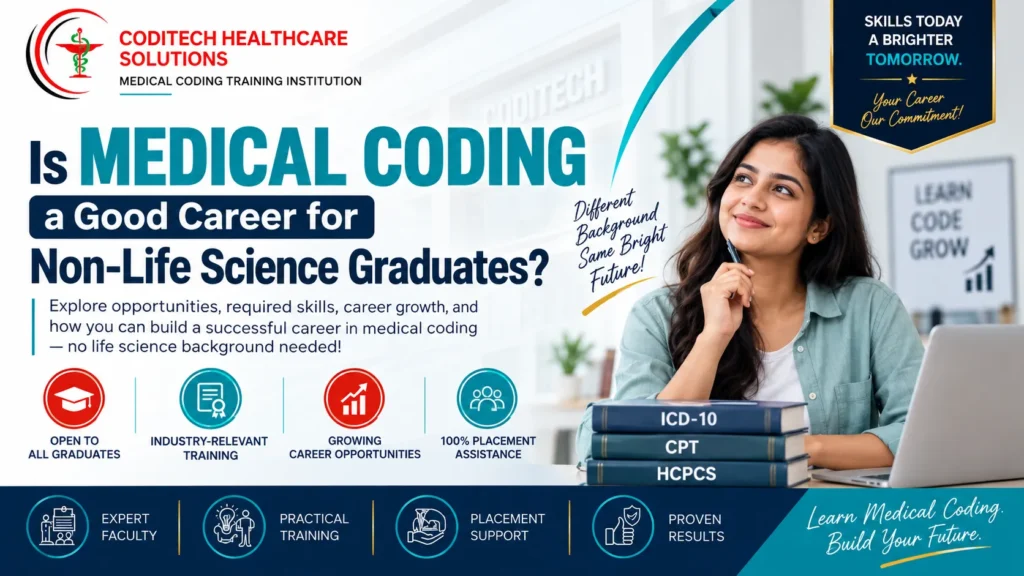
Is Medical Coding a Good Career for Non-Life Science Graduates?

Is Medical Coding a Good Career for Non-Life Science Graduates? What if your degree is in engineering, computer science, commerce, or another non-life science field—but you still want to enter the healthcare industry? You may have already searched for different healthcare career options and come across medical coding. At first, medical coding can seem like a career meant only for students with a medical or life science background. After all, coders work with diagnoses, medical procedures, anatomy, and clinical documentation. But is a life science degree really necessary to build a career in medical coding? Not necessarily. With the right training, consistent practice, and an interest in learning healthcare concepts, students from non-life science backgrounds can develop the skills required for medical coding. The important question isn’t only what you studied in college—it is whether you are willing to learn the fundamentals and apply them correctly. Let’s understand what it takes. What Is Medical Coding? Before deciding whether medical coding is suitable for you, it helps to understand what the job actually involves. Medical coding is the process of converting information from healthcare documentation into standardized medical codes. When a patient visits a hospital or healthcare provider, the medical record may contain information about: Symptoms Diagnoses Medical history Treatments Procedures Investigations Medications Follow-up care A medical coder reviews this documentation and assigns appropriate codes according to established coding systems and guidelines. Some commonly used code sets include: ICD-10-CM CPT HCPCS Level II ICD-10-PCS for applicable facility/inpatient coding environments So, medical coding is not simply about typing codes into a computer. It requires documentation reading, medical knowledge, attention to detail, and logical thinking. Do You Need a Life Science Degree to Become a Medical Coder? This is one of the biggest questions asked by students from non-medical backgrounds. A life science or healthcare education can certainly provide an advantage because you may already know anatomy, physiology, medical terminology, and basic disease concepts. However, coming from a non-life science background does not automatically mean that medical coding is closed to you. You can learn the required healthcare concepts through structured training. For example, a student with a background in: Computer Science Engineering Commerce Business Administration Mathematics Arts Other graduate disciplines may begin learning medical coding by first developing the necessary medical foundation. The learning curve may be different from someone who studied biology or healthcare, but that does not mean the career is impossible. What Challenges Can Non-Life Science Graduates Face? Let’s be realistic. A non-life science graduate may initially find certain medical concepts unfamiliar. Terms such as myocardial infarction, cholecystitis, nephrolithiasis, or arthroscopy may look complicated when you encounter them for the first time. Similarly, understanding body systems and medical documentation can take time. The good news is that these are learnable skills. The key is not to rush directly into advanced coding. Start with the basics. Build Your Foundation First A beginner should gradually learn: Medical Terminology → Anatomy & Physiology → Disease Processes → ICD-10-CM → CPT → HCPCS → Coding Guidelines → Practical Cases Once the foundation becomes stronger, coding concepts become much easier to understand. Medical Terminology: Your First Step Into Healthcare If you’re from a non-life science background, medical terminology should be one of your first priorities. Think of medical terminology as learning a new language. Many medical words can be broken into smaller parts, such as prefixes, roots, and suffixes. Understanding these components can help you recognize the meaning of unfamiliar terms. For example, learning common terminology related to: Cardiovascular system Respiratory system Digestive system Musculoskeletal system Nervous system Urinary system can gradually make medical records easier to understand. You don’t need to learn every medical term in existence. You need to build a strong working vocabulary that helps you understand the documentation you encounter as a coder. Anatomy and Physiology Can Be Learned Another area that may initially feel difficult is anatomy. A non-life science graduate might not have studied the human body in detail during college. That’s okay. A good Medical Coding Training in Pune program should introduce anatomy and physiology in a way that connects directly to coding. Instead of simply memorizing the names of organs, try to understand: Where an organ is located What it does Which body system it belongs to Common conditions affecting it Common procedures performed on it When you understand the relationship between anatomy, disease, and treatment, medical documentation becomes much easier to interpret. Medical Coding Is More Than Memorizing Codes One of the biggest misconceptions about medical coding is that successful coders simply memorize thousands of codes. That’s not how professional coding works. A coder needs to understand the documentation and then use coding resources and guidelines to determine the appropriate code. For example, a medical record may mention a condition but provide additional details that affect code selection. You may need to determine: The exact diagnosis The anatomical location Acuity or clinical status where relevant Whether the condition is documented as confirmed Whether additional codes are required Which guideline applies What should be sequenced first This is why analytical thinking can be just as important as medical knowledge. And this is one area where students from technical or analytical backgrounds can often develop useful strengths. What Skills Do You Need to Become a Medical Coder? Your degree is only one part of the picture. To become a competent medical coder, focus on developing the following skills. 1. Medical Terminology You need to understand commonly used healthcare language. 2. Anatomy and Physiology Learn the body’s major systems and their functions. 3. Coding Knowledge Understand ICD-10-CM, CPT, HCPCS, and other relevant coding systems. 4. Documentation Reading Learn how to identify the information that matters for coding. 5. Coding Guidelines Understand how official guidelines and coding conventions affect code selection. 6. Attention to Detail A small documentation difference can sometimes change the coding decision. 7. Analytical Thinking You need to interpret information rather than simply copy it. 8. Computer Skills Most coding work involves digital systems, electronic
CCS Certification Pune
Blog

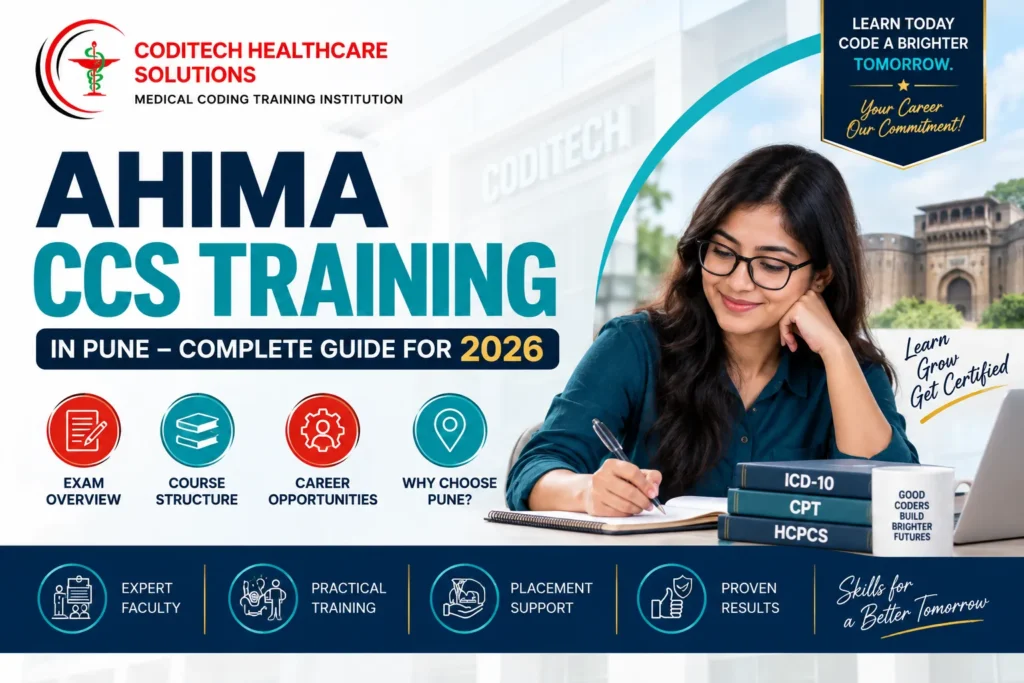
AHIMA CCS Training in Pune – Complete Guide for 2026

AHIMA CCS Training in Pune – Complete Guide for 2026 Knowing medical codes is one thing. Understanding a complete medical record and choosing the right codes with confidence is something else entirely. If you are planning to build a serious career in medical coding, you have probably come across the AHIMA CCS certification. The Certified Coding Specialist (CCS) credential is particularly relevant for professionals who want to demonstrate strong coding knowledge and move beyond basic entry-level coding. But before enrolling in a course, many students have the same questions: What exactly is CCS? Is it suitable for freshers? What does the training cover? How difficult is the certification? What skills do I need? And where should I start my preparation in Pune? This guide answers those questions and explains what you should know about AHIMA CCS Training in Pune in 2026. What Is AHIMA CCS Certification? The Certified Coding Specialist (CCS) credential is offered by the American Health Information Management Association (AHIMA). CCS is designed for professionals who work with medical data and coding and want to demonstrate their ability to accurately assign diagnosis and procedure codes from healthcare documentation. Unlike learning individual codes in isolation, CCS preparation requires you to understand the complete coding process. That includes reading documentation, interpreting clinical information, applying coding guidelines, selecting appropriate codes, and understanding how different coding systems work together. This is why proper preparation matters. Why Consider CCS Certification in 2026? Healthcare organizations continue to depend on accurate clinical documentation and coding. As healthcare systems become more digital and complex, coding professionals need stronger analytical and documentation-review skills. For someone already familiar with medical coding, CCS can be a valuable next step. It can help you demonstrate knowledge in areas such as: Diagnosis coding Procedure coding Medical terminology Anatomy and physiology Coding guidelines Clinical documentation Inpatient and outpatient coding concepts ICD-10-CM ICD-10-PCS CPT Healthcare compliance concepts Coding accuracy and quality The certification should not be viewed simply as another certificate to add to a resume. The real value comes from the knowledge and coding judgment developed during preparation. Who Should Consider CCS Training? CCS preparation may be suitable for different types of learners. Medical Coding Freshers If you are beginning your career and want to develop a strong foundation in coding, structured training can help you understand the concepts systematically. However, CCS-level preparation can be more demanding than basic introductory coding, so building your fundamentals first is important. Existing Medical Coders Professionals already working in coding may consider CCS to strengthen their knowledge and demonstrate their coding capabilities. CPC-Certified Professionals If you already have a CPC or another coding credential, CCS preparation can help you expand your understanding, particularly if you want exposure to hospital and facility coding concepts. Healthcare Graduates Graduates from healthcare-related educational backgrounds may also explore CCS as part of their professional development. The right starting point depends on your existing knowledge, coding experience, and career goals. CCS vs Basic Medical Coding Training One common mistake students make is assuming that a certification course and basic coding training are exactly the same. They aren’t. A beginner-focused Medical Coding Training in Pune may introduce students to: Medical terminology Anatomy ICD-10-CM CPT HCPCS Basic coding guidelines Documentation concepts CCS preparation generally requires a deeper level of understanding and stronger coding judgment. You may need to work through complex documentation and determine the appropriate codes based on the complete clinical picture. Therefore, if you are completely new to medical coding, don’t worry if CCS concepts initially seem difficult. Building your foundation step by step can make advanced preparation much easier. What Does CCS Training Usually Cover? A good CCS Certification Training in Pune should go beyond simply explaining the exam. Your training should help you develop practical coding skills. 1. Medical Terminology You need to understand the language used in medical records. This includes diseases, symptoms, procedures, treatments, abbreviations, and clinical terminology. 2. Anatomy and Physiology Understanding the human body makes medical documentation easier to interpret. You should be familiar with the major body systems, organs, anatomical locations, and basic physiological functions. 3. ICD-10-CM ICD-10-CM is an essential part of diagnosis coding. Training should teach you how to navigate the code structure, understand instructional notes, apply conventions, and select the most appropriate code supported by documentation. 4. ICD-10-PCS For learners preparing for CCS, ICD-10-PCS is an important area to understand. It uses a different structure from ICD-10-CM and requires you to understand the components used to build procedure codes. This is one area where practical exercises can make a significant difference. 5. CPT CPT coding is another important component of medical coding knowledge. Students should understand procedure categories, code selection principles, documentation requirements, and relevant guidelines. 6. Coding Guidelines You cannot become a strong coder simply by memorizing codes. You need to understand why a particular code is selected. That means learning how to use official coding guidelines, instructional notes, sequencing rules, exclusions, and other conventions. Why Medical Record Reading Is So Important Imagine receiving a lengthy patient chart containing a history, examination findings, diagnoses, procedures, laboratory results, and discharge information. The correct code isn’t always sitting in one obvious sentence. You have to understand the documentation as a whole. A professional coder needs to identify: The reason for the encounter Confirmed diagnoses Relevant clinical conditions Procedures performed Supporting documentation Complications and associated conditions Information affecting code selection This is why CCS Certification Classes in Pune should ideally include plenty of case-based practice. The more records you analyze, the more comfortable you become with real-world coding situations. Is CCS Difficult? Let’s be honest: CCS preparation can be challenging. But difficult doesn’t mean impossible. The challenge usually comes from the combination of clinical knowledge, coding guidelines, multiple code sets, and the need to analyze documentation carefully. Students who try to memorize everything often find the preparation stressful. A better approach is to understand the logic behind coding. Instead of asking: “Which code should I memorize for this case?” learn to ask: “What

🎯 Admissions Open for 2026 Batch   |   💼 100% Placement Assistance   |   📞 Call Now: +91-8956660060—  For  Medical Coding Training  

Contact Us

Scroll to Top