

CPC Certification

Medical Coding Career Guide in Sambhajinagar
Blog

Medical Coding Courses in Sambhajinagar: Complete Career Guide for 2026

Medical Coding Courses in Sambhajinagar: Complete Career Guide for 2026 Imagine starting a healthcare career where you do not have to work directly with patients to make a meaningful contribution to their treatment. You could be working with medical records, understanding diagnoses, reviewing procedures, and helping healthcare providers maintain accurate documentation. That is the role of a medical coder. For students and graduates in Sambhajinagar (formerly Aurangabad), medical coding is a career option worth exploring, particularly for those with a background in pharmacy, life sciences, nursing, or other healthcare-related subjects. However, choosing a course is only the first step. Before enrolling, you should understand what medical coding involves, which skills employers expect, how certification works, and what kind of career opportunities may be available after training. Coditech Healthcare Solutions helps aspiring medical coding professionals understand the skills and knowledge required to prepare for this career. In this guide, we will explore medical coding courses in Sambhajinagar, the importance of CPC certification, course selection, career opportunities, and practical steps for beginners in 2026. What Is Medical Coding and Why Does It Matter? Every healthcare visit creates information. A doctor may record a patient’s symptoms, diagnose an illness, recommend investigations, prescribe treatment, or perform a procedure. This information needs to be documented and translated into standardized codes for purposes such as insurance claims, billing, reporting, and healthcare administration. Medical coding is the process of assigning the appropriate codes to diagnoses, procedures, and medical services based on healthcare documentation and applicable coding guidelines. For example, when a patient visits a physician for a medical condition, the coder reviews the provider’s documentation and determines which diagnosis and procedure codes are supported by the record. The coder must follow the relevant rules rather than simply selecting a code that sounds appropriate. Accuracy is essential. An incorrect code can lead to claim delays, denials, compliance concerns, or inaccurate healthcare records. Medical coding therefore requires more than memorizing code numbers. It involves understanding medical terminology, anatomy, clinical documentation, coding conventions, and the reasoning behind code selection. Why Consider a Medical Coding Career in 2026? Healthcare organizations depend on accurate documentation and coding to manage administrative and financial processes. Medical coding professionals may work with hospitals, physician practices, medical billing companies, healthcare service providers, and organizations supporting international healthcare operations. For graduates who want to work in the healthcare industry without necessarily entering a direct patient-care role, this field may offer an alternative career path. Here are some reasons to explore this profession: Healthcare knowledge: You can use your understanding of medical subjects in a professional setting. Specialized skills: Coding requires knowledge of established classification systems and guidelines. Different career pathways: Depending on your qualifications and experience, you may progress towards specialized coding, auditing, quality review, or related healthcare operations. Scope for professional development: Continued learning helps coders keep up with coding updates and changing documentation requirements. Opportunities across locations: Some employers offer office-based, hybrid, or remote roles, although work arrangements depend on the employer and position. One important point: completing a training course does not automatically guarantee employment. Your subject knowledge, practical coding ability, communication skills, certification, and interview performance all matter. Who Can Enrol in Medical Coding Courses in Sambhajinagar? Medical coding may be suitable for graduates who have an interest in healthcare, medical records, and detail-oriented work. Students commonly explore this field after completing qualifications such as: B.Pharm or M.Pharm B.Sc. or M.Sc. in relevant life science subjects Nursing qualifications BDS and other relevant healthcare qualifications Other degrees that meet the training provider’s and employer’s eligibility requirements The precise eligibility criteria can differ between courses and employers. Candidates should confirm the requirements before paying a course fee or registering for a certification examination. Students from pharmacy and life science backgrounds may already have some familiarity with anatomy, physiology, diseases, or medical terminology. However, they still need to learn how to apply formal coding guidelines to actual documentation. Candidates without a healthcare background should first check whether they need additional foundational training in anatomy, medical terminology, and related subjects. How to Choose a Medical Coding Training Institute in Sambhajinagar Selecting the right institute can make a significant difference to your learning experience. A course should help you understand coding concepts and apply them to practical situations, rather than simply prepare you to repeat definitions in an examination. When comparing a medical coding training institute in Sambhajinagar, look beyond promotional offers and promises of quick employment. 1. Check the Course Curriculum A structured course should introduce the fundamentals of medical coding and explain the major code sets used in the relevant coding environment. Depending on the programme, the curriculum may cover: Medical terminology Human anatomy and physiology Disease processes and clinical documentation ICD-10-CM diagnosis coding CPT procedure coding HCPCS Level II coding Coding guidelines and conventions Modifiers and evaluation and management coding Practical coding exercises and case-based learning The exact curriculum should match the certification or coding specialisation you intend to pursue. 2. Look for Practical Training Suppose you understand the definition of a diagnosis code but cannot determine which code is supported by a patient’s medical record. In a real coding role, that gap in understanding can become a problem. Practical sessions allow students to review sample documentation, identify relevant clinical details, consult coding references, and explain why a particular code is appropriate. Before joining a programme, ask how much time is devoted to practice questions, case studies, mock tests, and doubt-clearing sessions. 3. Understand the Trainers’ Experience An experienced trainer should be able to explain not only what a coding rule says but also how it applies to a real coding scenario. Ask about the trainer’s coding background, teaching experience, familiarity with current guidelines, and approach to helping beginners who find technical topics difficult. 4. Ask About CPC Exam Preparation If your goal is professional certification, verify whether the programme includes CPC examination preparation, practice assessments, and guidance on using coding manuals. Also ask whether the certification examination fee, books, membership, and other charges

Medical Coding Institute in Pune
Blog

From Certification to Career Growth: Your Medical Coding Roadmap in India

From Certification to Career Growth: Your Medical Coding Roadmap in India Are you looking to build a career in medical coding but don’t know where to start—or what comes after certification? You may have already searched for medical coding courses, CPC certification, job opportunities and salary information. But one question often remains unanswered: “What is the actual roadmap from learning medical coding to building a long-term career?” Medical coding is not simply about completing a course and getting a certificate. A successful career requires a combination of medical knowledge, coding skills, practical exposure, certification, interview preparation and continuous learning. If you’re a graduate or someone planning a career change, this guide will help you understand the journey from your first coding lesson to long-term career growth in India’s healthcare industry. What Is Medical Coding? Medical coding is the process of converting information from healthcare documentation into standardized medical codes. When a patient visits a hospital or healthcare provider, the medical record may contain information about: Diagnoses Symptoms Medical procedures Treatments Tests Patient conditions Physician services A medical coder reviews this documentation and assigns the appropriate codes according to established coding systems and guidelines. Common code sets include ICD-10-CM, CPT and HCPCS. The work requires attention to detail because even a small difference in documentation can affect the appropriate coding decision. Step 1: Understand Whether Medical Coding Is Right for You Before enrolling in a course, understand what the profession actually involves. Medical coding can be suitable for people who enjoy: Working with detailed information Learning medical terminology Reading and analysing documentation Following rules and guidelines Working with computers Performing structured, detail-oriented work You don’t need to know everything before starting. However, you should be willing to learn medical terminology, anatomy, coding guidelines and healthcare documentation. Step 2: Build Your Medical Foundation One of the first things a beginner should focus on is developing basic medical knowledge. Medical Terminology You need to understand the terminology used by doctors and healthcare professionals. Anatomy and Physiology Understanding body systems makes medical documentation easier to interpret. Disease Processes Learning common diseases and conditions helps you understand why certain diagnoses and procedures appear in medical records. These subjects may seem difficult at first, but they become easier when you connect them with real clinical examples. Step 3: Learn ICD-10-CM, CPT and HCPCS After building the foundation, the next stage is learning the major coding systems. ICD-10-CM ICD-10-CM is primarily used for diagnosis coding. You need to learn how to identify the appropriate diagnosis code based on documentation and applicable guidelines. CPT CPT codes are used to report many medical procedures and professional services. HCPCS HCPCS includes codes used for various healthcare services, supplies and products. Don’t approach coding as simple memorization. A professional coder needs to understand how to locate, verify and apply codes correctly. Step 4: Get Practical Coding Experience This is one of the most important stages of your journey. There is a major difference between reading about coding and actually working through a medical record. During training, practice identifying: Diagnoses Procedures Medical terminology Relevant documentation Applicable codes Coding guidelines Modifiers E/M concepts Supporting information Start with simple cases and gradually move toward more complex scenarios. Practical exposure helps you become more comfortable with the type of thinking required in a real coding environment. Step 5: Choose the Right Training Institute The training institute you choose can influence how well you understand the fundamentals. If you’re searching for a Medical Coding Training institute in Pune, don’t compare institutes only by their advertisements or course fees. Instead, look at the actual learning experience. Consider whether the institute provides: Experienced trainers Medical terminology training Anatomy and physiology ICD-10-CM training CPT and HCPCS training Practical coding exercises Certification preparation Mock tests Interview preparation Career guidance For students comparing Medical Coding Courses in Pune, practical training should be one of the most important factors to consider. Step 6: Prepare for CPC Certification Once you have developed your coding foundation, you can consider professional certification. The CPC certification is one of the credentials pursued by people building careers in professional medical coding. Preparing for certification can help you strengthen your understanding of: Coding guidelines Medical terminology Anatomy ICD-10-CM CPT HCPCS Modifiers Coding scenarios However, certification should not be considered the final destination. The certificate can demonstrate your knowledge, but employers may also look at your practical understanding, communication and ability to handle coding scenarios. Step 7: Consider CPC Certification Training in Pune If you are planning to pursue CPC certification, structured preparation can make the learning process easier. When looking for CPC Certification Training in Pune, check whether the program includes both examination preparation and practical coding knowledge. A good preparation program should help you understand: How to approach coding questions How to use coding resources How to interpret documentation How to apply guidelines How to manage your time during the examination How to avoid common mistakes The goal should be to understand why an answer is correct rather than simply memorizing answers. Step 8: Prepare for Your First Medical Coding Job Once your training and certification preparation are complete, it’s time to focus on employment. Your preparation should include both technical and HR interviews. Technical Preparation Revise: ICD-10-CM CPT HCPCS Anatomy Medical terminology Modifiers E/M Coding guidelines Practical coding cases HR Preparation Be ready to explain: Your educational background Why you chose medical coding What you learned during training Your certification Your career goals Your strengths Why you want to work in healthcare Don’t memorize complicated answers. Speak clearly and explain your knowledge naturally. Step 9: Your First Job Is the Beginning, Not the End Getting your first job is an important milestone, but career growth doesn’t stop there. Your first few months can teach you things that cannot always be learned from a classroom. You may become familiar with: Real medical documentation Production requirements Quality audits Client-specific guidelines Team workflows Common coding errors Specialty-specific documentation Pay attention to feedback from senior coders and quality teams.

Medical Coding Training Pune
Blog

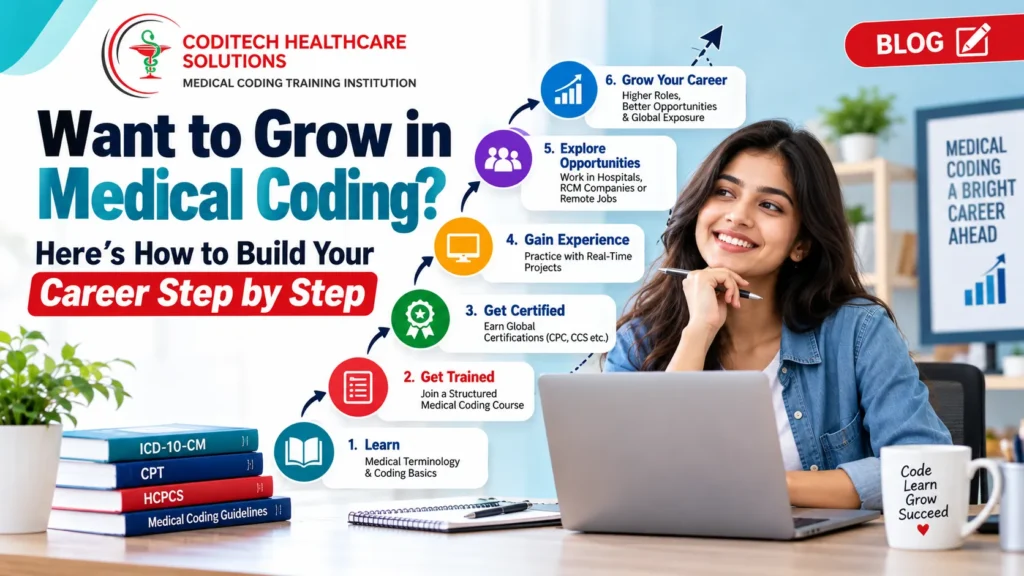
Want to Grow in Medical Coding? Here’s How to Build Your Career Step by Step

Want to Grow in Medical Coding? Here’s How to Build Your Career Step by Step Starting a career in medical coding is one thing. Knowing how to grow after you enter the field is another. Many freshers focus only on getting their first medical coding job. But once you understand the basics, a bigger question starts to come up: What should I learn next? How can I become better at coding? Should I pursue certification? Which skills can help me move into a specialized role? Medical coding is not a career where learning stops after completing a course. Coding guidelines change, healthcare documentation evolves, and different specialties require different levels of knowledge. If you want to build a long-term career, you need a step-by-step approach. This guide explains how you can start, improve your skills and gradually build a stronger career in medical coding. Step 1: Understand What Medical Coders Actually Do Before choosing medical coding as a career, understand what the job involves. Medical coders review healthcare documentation and translate diagnoses, procedures, services and other clinical information into standardized codes. Depending on the role, coders may work with: ICD-10-CM CPT HCPCS E/M coding Medical terminology Anatomy and physiology Coding guidelines Physician documentation Insurance-related information Specialty-specific coding The job requires attention to detail. A coder cannot simply choose a code because it “looks right.” The documentation needs to support the coding decision. That is why understanding the fundamentals is the first step toward career growth. Step 2: Build a Strong Foundation in Medical Terminology If medical terms are confusing, coding can quickly become difficult. A strong foundation in medical terminology helps you understand what physicians and other healthcare professionals are documenting. Start by learning: Common medical terms Prefixes and suffixes Body systems Common diseases and conditions Medical abbreviations Diagnostic terminology Surgical terminology Don’t try to memorize hundreds of terms in one day. Learn them gradually and connect them with anatomy and real clinical examples. The better you understand the language of healthcare, the easier it becomes to understand medical records. Step 3: Learn Anatomy and Physiology Medical coding isn’t just about codes. You also need to understand where a condition occurs, which body system is involved and how different medical procedures relate to the human body. For example, understanding the cardiovascular system can make cardiovascular documentation easier to interpret. Similarly, knowledge of the musculoskeletal system can help when working with orthopedic records. You don’t necessarily need to become a medical professional, but you should develop enough anatomical knowledge to understand clinical documentation accurately. Step 4: Master ICD-10-CM, CPT and HCPCS These code sets form an important part of medical coding education. ICD-10-CM ICD-10-CM is primarily used for diagnosis coding. You need to understand how to identify the appropriate diagnosis code based on the documentation and applicable guidelines. CPT CPT codes are used to report many medical procedures and professional services. HCPCS HCPCS coding includes codes used for various healthcare services, supplies and products that may not be represented by CPT alone. Don’t try to learn these code sets through memorization alone. Instead, learn how to find, verify and apply codes correctly. That difference becomes very important when you start working with actual coding scenarios. Step 5: Learn the Official Coding Guidelines Knowing where to find a code isn’t enough. You also need to understand the rules behind selecting and reporting that code. Coding guidelines help you determine how documentation should be interpreted and how codes should be assigned in different situations. As you progress, become comfortable referring to coding guidelines rather than relying only on memory. A good coder knows that sometimes the correct answer comes from carefully checking the guideline, not from remembering a code instantly. Step 6: Start Practicing With Medical Records This is where your theoretical knowledge starts becoming practical. Reading a textbook is different from reviewing an actual medical record. Practice identifying: Patient diagnoses Symptoms Procedures Relevant documentation Primary and secondary conditions Applicable codes Coding guidelines Supporting documentation Begin with simple cases and gradually move toward more complicated scenarios. The more cases you practice, the more comfortable you become with the process of analyzing documentation. Step 7: Consider Professional Certification Once you have built your fundamentals, certification can be an important part of your career development. The CPC certification, for example, is a commonly pursued credential among medical coding professionals. Certification preparation can help you develop: Coding knowledge Guideline awareness Exam-solving skills Codebook navigation skills Time management Confidence with coding scenarios However, certification should not be treated as the finish line. A certificate may strengthen your profile, but practical knowledge is still important when you enter a professional coding environment. Step 8: Choose the Right Training Program If you’re a fresher, structured training can help you avoid learning everything randomly. When looking for a medical coding training institute in Pune, don’t compare institutes only based on advertisements or course duration. Look at what the training actually covers. A useful program should ideally include: Medical terminology Anatomy and physiology ICD-10-CM CPT HCPCS Coding guidelines Practical coding exercises Mock assessments Certification preparation Interview preparation Career guidance For students searching for medical coding courses Pune, practical exposure should be one of the factors considered while comparing different programs. Step 9: Develop Skills Beyond Coding Technical coding knowledge is important, but professional growth also depends on other skills. Attention to Detail Small documentation differences can affect coding decisions. Developing a habit of carefully reviewing records is essential. Communication Coders may need to communicate with team members, auditors, physicians or other departments depending on their role. Computer Skills Medical coding is technology-driven. Being comfortable with software, electronic records and basic computer applications can make your work easier. Research Skills Sometimes the answer isn’t immediately obvious. Knowing how to research coding guidelines and documentation can be extremely valuable. Time Management Production-based coding environments often involve productivity expectations. Learning to maintain both accuracy and efficiency takes practice. Step 10: Prepare for Your First Interview Getting trained is only one part of becoming

🎯 Admissions Open for 2026 Batch   |   💼 100% Placement Assistance   |   📞 Call Now: +91-8956660060—  For  Medical Coding Training  

Contact Us

Scroll to Top