CPC Certification Training Institute in Pune

Remote Medical Coding Jobs in 2026 | Pune Guide
Blog

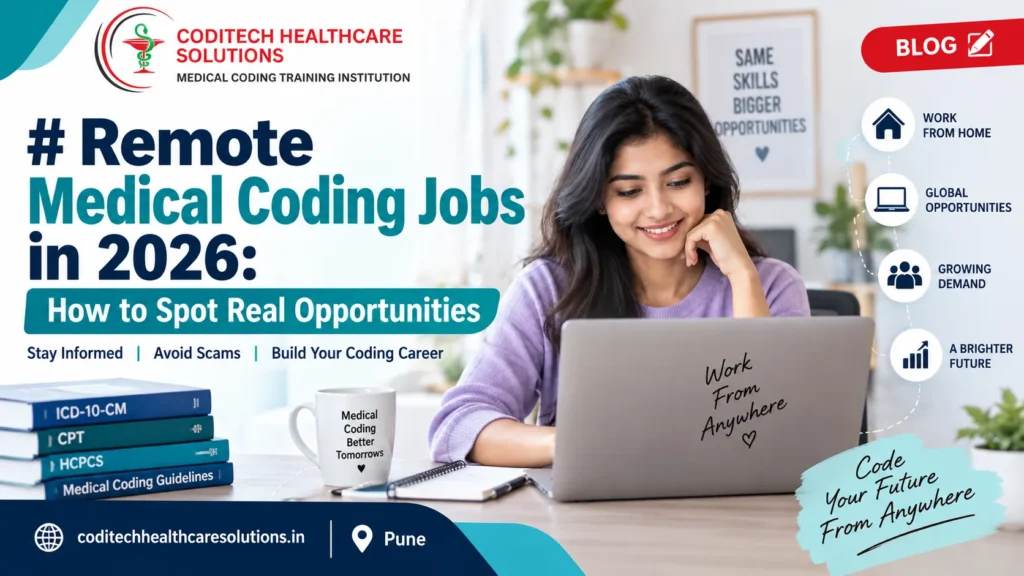
Remote Medical Coding Jobs in 2026: How to Spot Real Opportunities

Remote Medical Coding Jobs in 2026: How to Spot Real Opportunities “Work from home” sounds attractive—but when it comes to remote medical coding jobs, not every opportunity you see online is genuine. Some job posts are legitimate openings from healthcare organizations and outsourcing companies, while others may be misleading, ask for money upfront, or provide very little information about the actual role. For students and freshers planning a career in medical coding, learning how to identify a genuine remote opportunity is just as important as learning coding skills. In this guide, we’ll look at how remote medical coding jobs work in 2026, what employers usually look for, common red flags, and how proper training can help you become job-ready. What Is a Remote Medical Coding Job? A remote medical coding job allows a medical coder to perform coding-related work without being physically present at the employer’s office. Depending on the company and role, a remote coder may work with: Patient medical records Diagnosis documentation Procedure details ICD-10-CM codes CPT codes HCPCS codes E/M documentation Insurance-related information Coding audits and quality checks The actual responsibilities can vary depending on the specialty, employer, experience level, and type of coding work involved. For freshers, remote positions may be more limited than entry-level office-based opportunities because some employers prefer candidates who already have practical coding or production experience. Are Remote Medical Coding Jobs Available in 2026? Yes, remote and hybrid opportunities exist in the medical coding field. However, candidates should not assume that every job advertised as “100% work from home” is suitable for a fresher. Many legitimate employers have specific requirements such as: Medical coding certification Knowledge of ICD-10-CM, CPT and HCPCS Medical terminology Anatomy and physiology knowledge Coding guidelines Practical coding experience Good communication skills Ability to maintain productivity and accuracy Reliable internet and a suitable work environment Some organizations may also have location, shift, data-security, or experience requirements. That is why it is important to read the complete job description rather than focusing only on the “remote” label. How to Spot a Genuine Remote Medical Coding Job Finding a genuine job becomes easier when you know what to check. 1. Check the Company’s Identity Before applying, research the company. Look for: Official company website Company LinkedIn presence Professional contact information Company address Employee profiles Job listings on established platforms Information about its healthcare or medical coding services If a recruiter refuses to identify the company or only communicates through a personal messaging account, take extra care. A genuine employer should generally be able to explain who they are and what position they are hiring for. 2. Never Pay Money to Get a Job This is one of the biggest warning signs. Be careful if someone asks you to pay for: Registration Interview scheduling Job confirmation Offer letter Background verification “Security deposit” Mandatory equipment Training as a condition for employment Training fees and employment-related payments are different things. A training institute may charge for an educational course, but a job recruiter asking for money simply to provide employment should be treated with caution. 3. Look Carefully at the Salary Claims Some advertisements use extremely high salary numbers to attract candidates. For example: “Fresher medical coder – ₹50,000 per month – No experience required – Immediate joining.” A salary figure alone doesn’t prove that an opportunity is fake, but unrealistic claims combined with vague job responsibilities and requests for money are strong reasons to investigate further. Instead of focusing only on the salary, check: Job responsibilities Required qualification Experience requirements Certification requirements Working hours Company details Selection process Employment terms 4. Verify the Recruiter’s Email Address Pay attention to the email address used by the recruiter. A professional recruitment communication will generally provide identifiable company information. Be cautious when an alleged corporate recruiter uses an unrelated personal email address and cannot provide an official company contact. Don’t share sensitive documents until you have verified the employer and the purpose for which the information is being requested. 5. Understand the Interview Process A legitimate employer will usually have some form of recruitment or assessment process. For medical coding positions, this could involve: HR discussion Medical terminology assessment Coding assessment Technical interview Documentation-based questions Communication assessment Final HR discussion The exact process differs between organizations. If someone says “No interview, no assessment, guaranteed job after payment,” that should immediately make you cautious. Why Medical Coding Knowledge Matters for Remote Jobs Remote work does not mean the job is easier. In fact, working independently requires you to be comfortable making coding decisions based on documentation and following coding guidelines accurately. A remote medical coder should understand areas such as: Medical Terminology You need to understand the language used in medical records. Anatomy and Physiology Knowing how the human body and its systems work helps you understand clinical documentation. ICD-10-CM You should know how diagnoses are represented using ICD-10-CM codes and how to apply the relevant coding guidelines. CPT and HCPCS Procedure and service coding knowledge is important for many coding roles. E/M Coding Understanding evaluation and management documentation can be valuable depending on the job role. Documentation A coder must know how to read clinical documentation carefully instead of simply searching for keywords. This is where proper practical training can make a significant difference. Can Freshers Get Remote Medical Coding Jobs? Yes, freshers can build toward remote medical coding opportunities, but expectations should be realistic. Many beginners assume that completing a course automatically means they will receive a remote job. In reality, employers may consider several factors before hiring a candidate. For a fresher, having the following can strengthen your profile: Relevant educational background Medical coding training Strong medical terminology knowledge ICD-10-CM knowledge CPT/HCPCS knowledge Coding practice Certification such as CPC, where appropriate Good communication Interview preparation Familiarity with real-world coding scenarios For many freshers, starting with an onsite or hybrid position can also be a practical way to gain industry experience before moving toward fully remote roles. Is CPC Certification Useful for Remote Medical
Blog

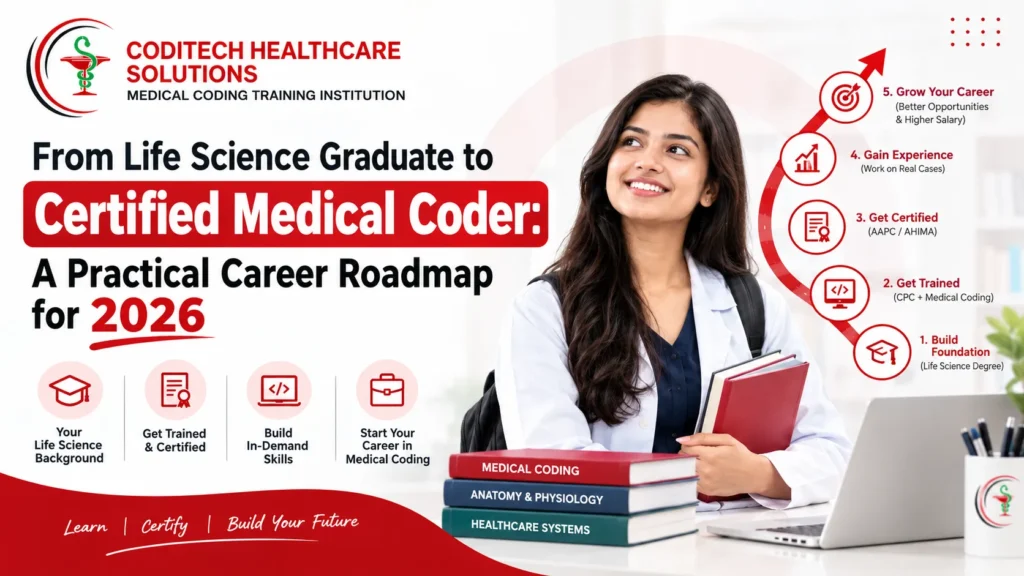
From Life Science Graduate to Certified Medical Coder: A Practical Career Roadmap for 2026

From Life Science Graduate to Certified Medical Coder: A Practical Career Roadmap for 2026 Graduation day feels like the end of one journey, but for many life science students, it is actually where the difficult questions begin. What should I do next? Should I continue studying? Should I look for a healthcare job? Is there a career where my life science knowledge can actually be useful? If you have asked yourself any of these questions, medical coding may be worth exploring. Medical coding has become an interesting career option for graduates who want to work in the healthcare industry without choosing a traditional clinical career. It combines healthcare knowledge, medical documentation, coding guidelines, technology, and attention to detail. The good news for life science graduates is that you are not starting completely from zero. You already have exposure to many concepts that can make the learning process easier. With structured training, practical experience, and certification preparation, you can gradually build the skills needed to pursue a career in medical coding. So, what does that journey actually look like? Let’s break it down. What Does a Medical Coder Actually Do? Before choosing any career, it is important to understand the actual work involved. A medical coder reviews healthcare documentation and converts relevant clinical information into standardized medical codes. A patient’s record can contain information about: Diagnoses Symptoms Medical history Procedures Treatments Laboratory tests Imaging Medications Follow-up care The coder studies this information and assigns appropriate codes according to established coding systems and official guidelines. Common code sets include: ICD-10-CM CPT HCPCS Level II ICD-10-PCS in applicable inpatient/facility coding environments It sounds straightforward until you see an actual medical record. The documentation may contain multiple conditions, procedures, abbreviations, clinical details, and instructions that need to be interpreted correctly. That is why professional medical coding requires knowledge and judgment, not just memorization. Why Life Science Graduates Have an Advantage One of the biggest benefits of coming from a life science background is that healthcare terminology may not feel completely unfamiliar. Depending on your degree, you may already have studied subjects such as: Anatomy Physiology Pathology Pharmacology Biochemistry Microbiology Human biology Disease processes This foundation can make it easier to understand medical records. For example, when you encounter terminology related to the cardiovascular, respiratory, digestive, or musculoskeletal system, you may already have some understanding of what it means. However, there is an important difference between understanding medicine and coding medicine. A life science degree gives you the foundation. Professional coding training teaches you how to apply that knowledge according to coding rules. Step 1: Understand the Medical Coding Career Don’t start by immediately buying every coding book or trying to memorize thousands of codes. Start by understanding the profession. Learn: What medical coders do Where coders work Difference between coding and billing Different types of medical coding Common coding certifications What employers look for What skills are required for entry-level roles This gives you a realistic picture of the career before you commit to it. Step 2: Strengthen Your Medical Foundation Even if you have studied life sciences, revisiting important healthcare concepts can be useful. Focus on: Anatomy and Physiology Understand the body’s major systems, organs, structures, and functions. Medical Terminology Learn commonly used medical terms, abbreviations, disease names, and procedure terminology. Pathophysiology Understand how diseases affect the body. You don’t need to become a physician to become a coder. But you do need enough clinical understanding to read and interpret healthcare documentation accurately. Step 3: Learn ICD-10-CM Once your foundation is strong, move into diagnosis coding. ICD-10-CM is used to classify diagnoses and other health conditions. This is where you start learning how clinical information is converted into standardized codes. Don’t approach ICD-10-CM as a list of numbers to memorize. Instead, learn how to: Search for diagnoses Navigate the Alphabetic Index Verify codes in the Tabular List Understand inclusion and exclusion notes Apply instructional notes Identify required specificity Follow sequencing principles Use official coding guidelines The goal is to understand the process behind code selection. Step 4: Learn CPT and HCPCS Diagnosis coding is only part of the picture. Depending on your career path, you may also need to understand procedure and service coding. CPT is used for reporting many medical procedures and professional services. HCPCS Level II covers various healthcare services, supplies, products, and other items. Understanding how diagnosis and procedure codes relate to the services documented in a patient’s record can make your coding knowledge much more complete. This is one reason a well-rounded medical coding training in Pune program should cover more than ICD-10-CM alone. Step 5: Understand Coding Guidelines This is where many beginners realize that medical coding isn’t simply about finding the closest code. Two cases may appear similar at first glance but require different coding decisions because of differences in documentation. You need to understand concepts such as: Coding conventions Sequencing Excludes notes Code-first instructions Use additional code instructions Combination codes Specificity Documentation requirements Learning the guidelines helps you explain why a code is appropriate instead of simply saying, “This looks like the right code.” Step 6: Start Practicing With Medical Records This is probably the most important stage of your journey. Reading a textbook is useful. But reading a medical record is different. A practical case may contain several diagnoses, procedures, clinical findings, and pieces of information that appear important but aren’t necessarily reportable. You need to learn how to separate the relevant information from the noise. A useful approach is: Read → Understand → Identify → Research → Verify → Code → Review With regular practice, this process becomes more natural. This is why students comparing medical coding classes in Pune should look beyond the syllabus and ask how much practical case-based learning is included. Step 7: Decide Which Certification Matches Your Goal Certification can strengthen your professional profile, but the right certification depends on the type of coding career you want. One commonly considered credential is the CPC (Certified Professional Coder). CPC preparation

Career Progression in Medical Coding
Blog

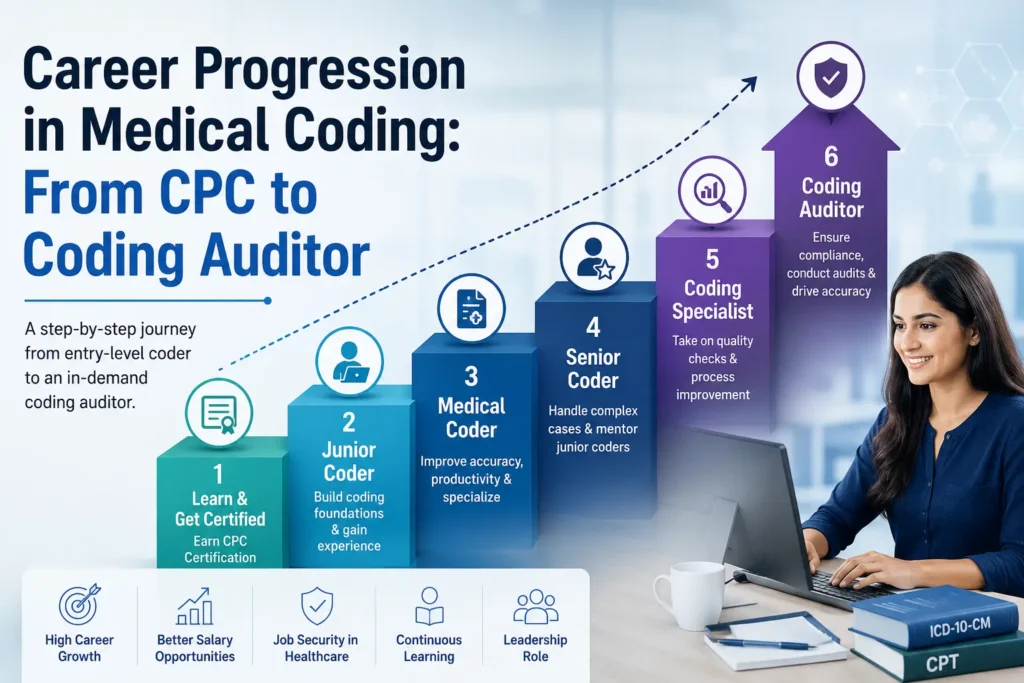
Career Progression in Medical Coding: From CPC to Coding Auditor

Career Progression in Medical Coding: From CPC to Coding Auditor Career Progression in Medical Coding: From CPC to Coding Auditor The healthcare industry is growing rapidly, and so is the demand for skilled medical coders. Today, medical coding is no longer just an entry-level profession—it offers excellent career growth, attractive salaries, and opportunities to specialize in different areas. Many students begin their journey with a Certified Professional Coder (CPC) certification and gradually move into advanced positions such as Senior Medical Coder, Coding Quality Analyst, Team Lead, Coding Educator, and Coding Auditor. If you’re planning a long-term career in healthcare without becoming a doctor or nurse, medical coding can be an excellent choice. At Coditech Healthcare Solutions, Pune, we help students build a strong foundation through practical training, industry-oriented curriculum, and certification guidance that supports long-term career success. What is Medical Coding? Medical coding is the process of converting medical diagnoses, procedures, treatments, and healthcare services into standardized codes using coding systems such as: ICD-10-CM CPT HCPCS Level II These codes help hospitals and insurance companies process medical claims accurately and ensure healthcare providers receive proper reimbursement. Step 1: Become a Certified Professional Coder (CPC) The first milestone in a medical coding career is earning the CPC (Certified Professional Coder) certification offered by AAPC. A CPC certification demonstrates that you understand: Medical terminology Human anatomy ICD-10-CM coding CPT coding HCPCS coding Insurance guidelines Medical documentation This certification is highly recognized by hospitals, healthcare organizations, and medical coding companies worldwide. Students looking for CPC Certification Training Institute in Pune often choose Coditech Healthcare Solutions because of its practical training approach, experienced trainers, and placement support. Step 2: Gain Practical Experience After obtaining CPC certification, most professionals start working as: Junior Medical Coder Outpatient Medical Coder Physician Coder Medical Billing Executive Healthcare Documentation Specialist During this stage, coders learn: Real-time medical records Coding accuracy Productivity targets Claim submission Insurance requirements Compliance standards This practical experience builds confidence and prepares coders for advanced roles. Step 3: Specialize in Medical Coding Once you gain 1–3 years of experience, specialization can significantly improve your career prospects. Popular specialty coding domains include: Evaluation & Management (E/M) Focuses on physician consultation coding and outpatient visits. Surgery Coding Involves coding complex surgical procedures across multiple specialties. Emergency Department (ED) Coding Requires quick understanding of emergency documentation and coding rules. IP-DRG Coding Specializes in inpatient hospital coding and Diagnosis Related Groups (DRGs). HCC Coding Risk adjustment coding for chronic conditions and Medicare Advantage plans. Home Health Coding (BCHH-C) Focuses on coding for home healthcare services and patient care documentation. At Coditech Healthcare Solutions, students can pursue advanced specialty training in E/M, ED, Surgery, IP-DRG, HCC, and BCHH-C to expand their career opportunities. Step 4: Earn Advanced Certifications After gaining experience, professionals often pursue advanced certifications to increase their earning potential. Popular certifications include: CCS (Certified Coding Specialist) CIC (Certified Inpatient Coder) COC (Certified Outpatient Coder) CRC (Certified Risk Adjustment Coder) BCHH-C Certification CPMA (Certified Professional Medical Auditor) These certifications demonstrate advanced coding knowledge and make candidates more competitive in the healthcare job market. Step 5: Become a Senior Medical Coder With strong coding skills and several years of experience, professionals can advance to the role of Senior Medical Coder. Responsibilities include: Reviewing complex medical records Assisting junior coders Resolving coding queries Improving coding quality Ensuring compliance with coding guidelines Coordinating with physicians and healthcare providers Senior coders are valued for both their technical expertise and leadership abilities. Step 6: Move into Coding Quality and Compliance Many experienced coders transition into quality-focused roles such as: Coding Quality Analyst Coding Compliance Specialist Documentation Improvement Specialist (CDI) Coding Trainer These professionals ensure that coding is accurate, compliant with industry standards, and aligned with payer requirements. This stage also offers opportunities to mentor new coders and contribute to organizational quality improvement. Step 7: Become a Coding Auditor One of the most respected positions in the medical coding profession is Coding Auditor. A coding auditor reviews medical records to verify: Coding accuracy Compliance with coding guidelines Documentation completeness Revenue integrity Audit readiness Risk identification Coding auditors play a critical role in helping healthcare organizations reduce claim denials, prevent compliance issues, and improve reimbursement accuracy. Professionals in this role often work with hospitals, insurance companies, healthcare consulting firms, and revenue cycle management organizations. Skills Needed for Career Growth Career progression in medical coding depends on continuous learning and skill development. Key skills include: Strong knowledge of ICD-10-CM, CPT, and HCPCS Medical terminology Human anatomy and physiology Analytical thinking Attention to detail Time management Communication skills Problem-solving Knowledge of payer guidelines Compliance awareness Professionals who regularly update their coding knowledge are more likely to secure promotions and advanced roles. Typical Medical Coding Career Path Experience Position Fresher CPC Certified Medical Coder 1–2 Years Medical Coder 2–4 Years Senior Medical Coder 4–6 Years Specialty Coder / Team Lead 5–8 Years Coding Quality Analyst 6–10 Years Coding Auditor 8+ Years Coding Manager / Coding Consultant / Trainer Why Choose Coditech Healthcare Solutions? If you’re looking for a Medical Coding Training Institute in Pune, choosing the right institute is the first step toward a successful career. At Coditech Healthcare Solutions, we focus on building practical skills that prepare students for real-world healthcare environments. We Offer: CPC Certification Training CCS Certification Training CIC Certification Training COC Certification Training CRC Certification Training BCHH-C Certification Training Australian Medical Coding Training E/M Specialty Training Surgery Coding Training ED Coding Training IP-DRG Training HCC Coding Training Live Practical Coding Sessions Interview Preparation Resume Building Support Certification Guidance 100% Placement Assistance Our experienced trainers provide industry-focused learning that helps students confidently begin their careers and prepare for future advancement. Final Thoughts A career in medical coding offers much more than an entry-level job. With the right certifications, practical experience, and continuous learning, professionals can progress from a Certified Professional Coder (CPC) to respected roles such as Senior Medical Coder, Coding Quality Analyst, and ultimately Coding Auditor. If you’re ready to build a rewarding career in

🎯 Admissions Open for 2026 Batch   |   BMCT New Batch Starting Soon | CPC Certification New Batch Starting Soon | IPDRG New Batch Starting Soon | New Batch for BCHH-C Training With 100% Placement Guarantee | 💼 100% Placement Assistance   |   📞 Call Now: +91-8956660060—  For  Medical Coding Training  

Contact Us

Scroll to Top